
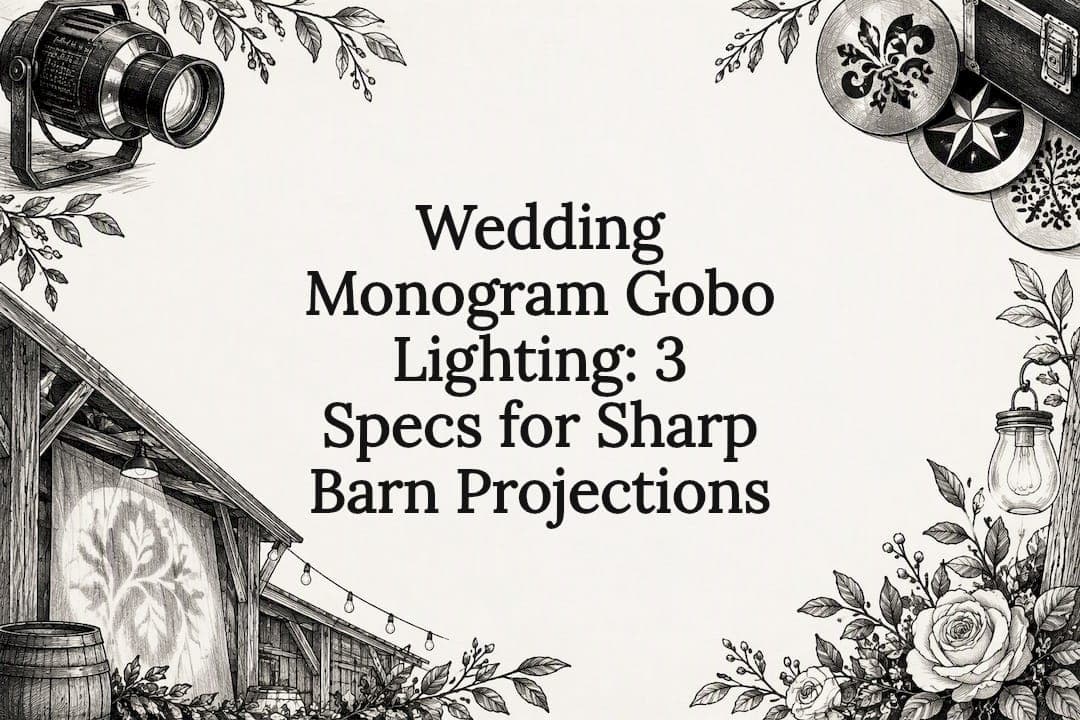
A monogram gobo is a projected stencil of a name or logo, and the fastest way to add a personalized "in lights" moment is a digital file preloaded on a rented projector. We'd only recommend ordering a metal or glass gobo when you need a permanent fixture or ultra-high-detail artwork. Before booking anything, confirm your projection surface and send vector artwork to your lighting vendor.
TL;DR:
- Digital gobos offer quick, last-minute customization and animation options, making them ideal for couples with tight wedding timelines.
- Metal gobos provide crisp, budget-friendly silhouettes but are less flexible and usually require about a week to produce.
- Glass gobos deliver richer detail and color but are more fragile and costlier, suitable for fixed, painterly projections.
- Proper projection requires matching throw distance, lens angle, and brightness to room size and ambient light conditions for optimal clarity.
- Using venue-managed lighting simplifies setup and ensures consistent results, especially in textured barn interiors where smooth mounting surfaces improve projection quality.
Table of Contents
- What Is a Gobo, and How Does Digital Projection Change the Game?
- Metal, Glass, or Digital: Which Gobo Fits Your Event?
- Picking the Right Projector and Lens for a Sharp Monogram
- Where the Monogram Lands: Surfaces, Angles, and Fixes
- Ordering Your Monogram: Artwork, Tabbing, and Timelines
- Day-Of Setup: What to Confirm Before the Lights Go On
- Should You Rent a Projector or Buy a Custom Gobo?
- Where to Put the Monogram for Maximum Impact
- Barn-Venue Lessons: Mounting Spots and Coordination That Works
- When Letting the Venue Handle Lighting Beats a Separate Rental
- Let Our Barn Handle the Lighting Details for You
- FAQ
- Sources
What Is a Gobo, and How Does Digital Projection Change the Game?
A gobo is a small stencil or disc placed in the optical gate of a lighting fixture so the beam projects a pattern, name, or image onto a wall, floor, or backdrop, according to GoboPlus. Traditionally this meant a physical metal or glass disc inserted into a fixture's gate, but modern digital projectors skip the hardware entirely and load artwork as a file.
- A physical gobo is etched once and stays fixed for the life of the event.
- A digital gobo lives as a file, so it can animate, change color, or update at the last minute.
- Digital delivery removes shipping and lead time from the equation entirely.
For couples finalizing a monogram the week of the wedding, that flexibility often matters more than material authenticity.
Metal, Glass, or Digital: Which Gobo Fits Your Event?
Each format solves a different problem. Metal gobos give crisp, high-contrast silhouettes and work well for text and geometric monograms, and they're the most budget-friendly option, according to Signovation. Glass gobos handle grayscale shading and full-color detail that metal simply can't reproduce, but they cost more and chip or crack more easily in transit.
- Metal: crisp lines, lower cost, limited by tabbing requirements on open letterforms.
- Glass: richer detail and color, higher price, more fragile to ship and handle.
- Digital: instant turnaround, supports animation, no physical disc to lose or break.
For a wedding booked on a tight timeline, digital is usually the practical default. Reserve glass for couples who want a painterly monogram projected at a fixed focal point all night.
Pro Tip: Ask your vendor for a digital proof before the event, even if you're ordering a physical gobo, so you can approve the exact typography and spacing.
Picking the Right Projector and Lens for a Sharp Monogram
Getting the monogram to fill the dance floor or backdrop correctly comes down to three numbers: throw distance, throw ratio, and lens angle.
- Calculate the image size first. Projected diameter equals throw distance divided by the fixture's throw ratio, so a projector placed several meters from the wall with a typical throw ratio can produce an image sized suitably for the space, according to Vanray Lighting.
- Match the lens angle to your room. A 26-degree lens is a versatile standard that suits most reception spaces, while a narrower 19-degree lens throws a tighter, higher-impact beam over longer distances, according to Rosco Spectrum. Compact fixtures sometimes offer lens options from roughly 6 to 45 degrees, letting you fine-tune the spread for a specific room, per GoboSource's spec sheet.
- Check brightness against ambient light. Lumen output listed by lens angle, not just the raw bulb rating, tells you whether the monogram will hold up against chandeliers or string lights, per Griven USA's datasheet.
Ask for a fixture with zoom, focus, rotation, and a solid CRI rating so the monogram stays sharp and true to color.
Where the Monogram Lands: Surfaces, Angles, and Fixes
Smooth, light-colored walls and polished dance floors give the cleanest projection. Textured surfaces like barn wood, exposed brick, or stucco scatter the beam and blur fine type.
- Smooth drywall or a plain floor reads crisp from nearly any seat.
- Barn wood, brick, and stucco break up edges and swallow small text.
- Mirrored or glossy floors can double the effect with a reflection.
Keystoning, the stretched or skewed look you get when a projector sits at an angle to its target, is one of the most common complaints at receptions. Rosco Spectrum notes that the fix usually comes from repositioning the fixture, using built-in keystone correction, or pre-distorting the artwork itself so it reads straight once projected, a trick worth requesting specifically for textured barn walls. For venues with bright ambient light, planning a darker zone or renting a higher-output fixture does more good than trying to dim an entire room, per Rosco Spectrum.
Ordering Your Monogram: Artwork, Tabbing, and Timelines
Vendors typically want vector artwork (AI, EPS, or high-resolution PDF) with clean, closed strokes, since thin or disconnected lines don't etch or project well.
- Keep strokes thick enough to survive etching, especially for metal gobos.
- Expect "tabbing," small structural bridges added inside open letters like O, A, or R, so the metal disc holds together, per Signovation.
- Approve a proof before production, since tabbing can alter a letterform slightly.
Turnaround varies by material: digital files can be ready rapidly, custom metal gobos generally require about a week, and glass gobos usually take longer and cost more, according to Gobos To Go.
Day-Of Setup: What to Confirm Before the Lights Go On
A smooth projection depends on decisions made before the truck even arrives.
- Confirm throw distance and lens choice with your vendor ahead of time, not on-site.
- Request a preloaded digital proof and schedule a focus and alignment check once the fixture is mounted.
- Verify power access, mounting hardware, and a backup plan for bright ambient light.
Pro Tip: Walk the room at the time of day your event starts; lighting that looks perfect at 2 p.m. can wash out completely once the sun sets through nearby windows.
Should You Rent a Projector or Buy a Custom Gobo?
For a single wedding or a timeline under two weeks, renting a projector with a digital file is almost always the simpler and cheaper route. It skips shipping, skips fragile glass, and lets you make last-minute edits to spelling or color.
- Rent a projector and digital file for one-time events or fast turnarounds.
- Order a metal or glass gobo when you plan to reuse it or need painterly detail a projector screen alone can't replicate.
- A couple projecting a simple monogram onto a dance floor for one night rarely needs anything beyond the rental route.
- A business that wants the same logo projected at every company event is a better candidate for a durable metal gobo.
Where to Put the Monogram for Maximum Impact
The dance floor and the head table wall remain the classic choices because every guest's camera ends up pointed there eventually.
- Project onto the dance floor for a focal point during the first dance.
- Light the head table or ceremony backdrop for a consistent photo backdrop all night.
- Use the dessert table or an entryway sign for a smaller, secondary touch guests notice on their way in.
Coordinate placement with your photographer's shot list and your DJ's timeline so the monogram is live exactly when the cameras come out, and check our creative wedding photo spot ideas for pairing projection with other backdrop moments.
Barn-Venue Lessons: Mounting Spots and Coordination That Works
Textured wood walls are part of a barn's charm, but they're exactly the surface that scatters a crisp monogram. We've found that mounting the projector to face a smoother interior wall or a hung backdrop, rather than straight at exposed beams, keeps lettering readable. Setup runs smoothest when the lighting tech, DJ, and couple agree on placement and timing during the same walkthrough, well before guests arrive, coordinating with a professional Southern California wedding & event pianist to ensure lighting and music flow seamlessly. Our team brings extensive hands-on DJ and event lighting experience to that conversation, and our gallery shows how past couples have used projection in our barn space.

When Letting the Venue Handle Lighting Beats a Separate Rental
Venue-managed lighting cuts down the number of people you have to coordinate on the big day, and a team that already knows the room's power access, mounting points, and sightlines tends to avoid the surprises that come with an outside crew seeing the space for the first time. A separate lighting designer still makes sense for elaborate multi-fixture setups or branded corporate events with strict design specs. Either way, ask any vendor the same questions: what throw distance and lens will they use, who handles focus on-site, and what's the backup plan if ambient light is stronger than expected?

Let Our Barn Handle the Lighting Details for You
We coordinate venue lighting as part of hosting weddings and special events at our venue, and our team has experience with mounting spots and projection angles that work well in a rustic barn interior. Couples planning a celebration with us can see real examples in our ceremony gallery before booking.
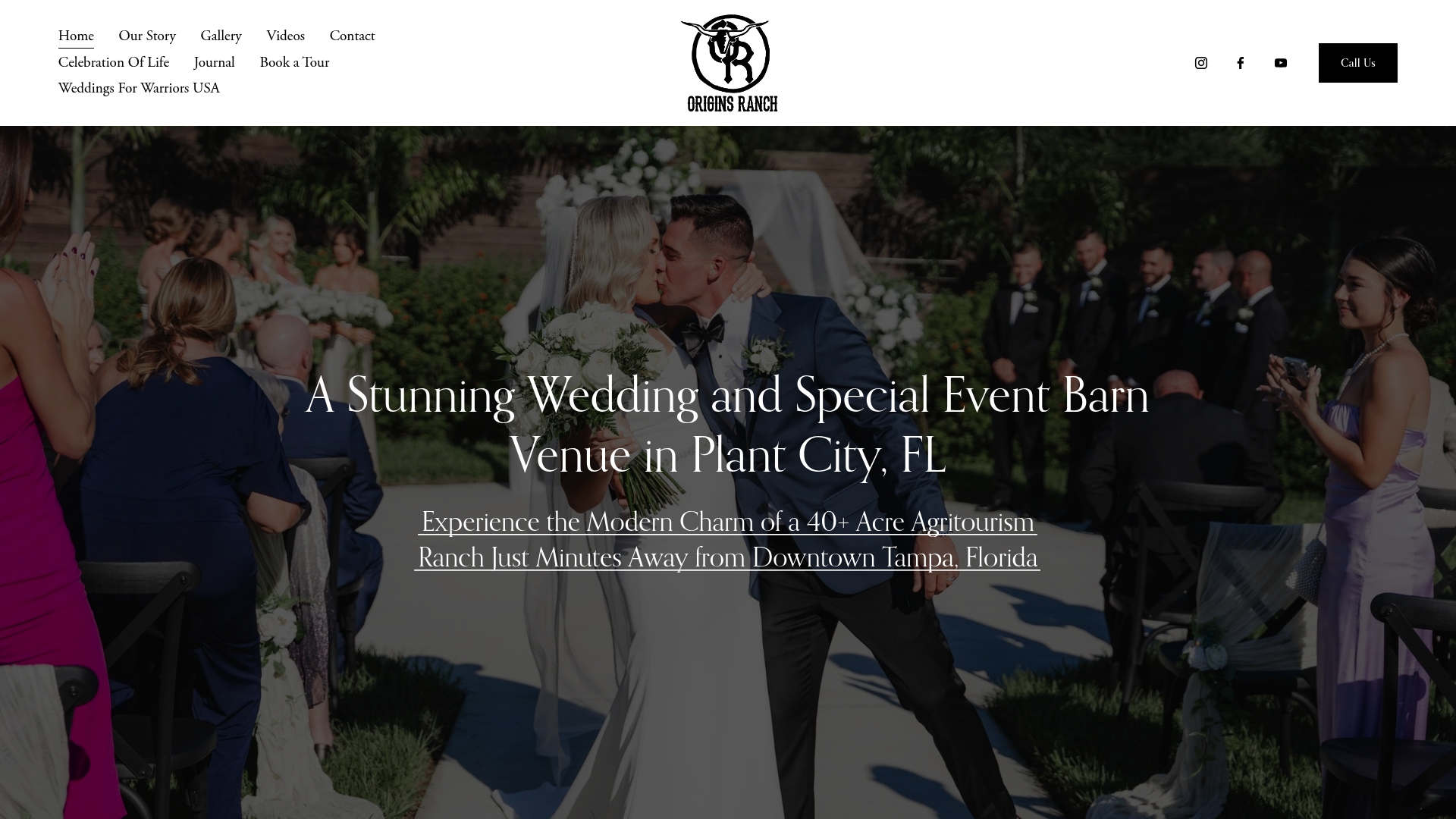
- Browse photos of past events lit up in our space before you decide on a design.
- Reach out through our venue booking page to ask about available dates and how we support personalized lighting touches.
We'd love to show you around and talk through what a monogram moment could look like under our roof.
FAQ
What Is a Monogram Gobo?
A monogram gobo is a projected stencil of a couple's initials or a logo, created either as a physical metal or glass disc placed in a fixture's optical gate or as a digital file loaded directly onto a projector, according to GoboPlus. Most weddings today use the digital version because it's faster to produce and easier to adjust.
How Much Does a Custom Gobo Cost?
Pricing depends on material and vendor, with digital files generally the least expensive option since there's no physical disc to etch or ship. Costs rise for metal gobos and rise further for glass, which requires more detailed etching and careful handling, per Signovation.
What Does Gobo Lighting Mean?
Gobo lighting refers to projecting a pattern, image, or text through a stencil placed inside a lighting fixture's gate, a technique borrowed from theatrical and stage lighting, according to GoboPlus. The same principle now applies to digital projectors used at weddings and events.
How Long Do Gobos Last?
A physical metal or glass gobo can last indefinitely with careful handling since it's a durable etched disc, though glass is more prone to chipping. Digital gobo files don't degrade at all since they're stored as data rather than physical materials.
Sources
- What is a Gobo? | GoboPlus gobo guide
- Mastering the mechanics: the technical aspects of gobo projections | Rosco Spectrum
- Glass vs metal gobo comparison | Signovation
- Gobo projector lights for stage: buyer's guide | Vanray Lighting