
Plant City does restrict wedding noise, and three facts settle most of what hosts need to plan around: amplified sound that is plainly audible beyond roughly 50 feet from your property line can trigger a complaint, quiet hours generally run from 11:00 PM to 7:00 AM, and complaints go to the Plant City Police Department's non-emergency line, not the county. Private weddings on private property typically do not need a special city noise or event permit.
TL;DR:
- Noise complaints are evaluated based on whether the sound is plainly audible beyond 50 feet from the property line, not on a specific decibel level.
- Enforcement is usually triggered after repeated complaints or continued disturbances, with warnings typically issued before citations or equipment impoundment.
- Most private weddings on private property do not require a special permit, but events in public spaces or with certain zoning conditions may need additional approvals.
- Fixing common issues like speaker direction, establishing a written curfew, and notifying neighbors ahead of time can prevent most noise-related problems.
- Agricultural exemptions do not cover amplified music, and the city's quiet hours generally run from 11:00 PM to 7:00 AM, when enforcement becomes stricter.
Table of Contents
- Plant City Wedding Noise Ordinance: What the Code Says
- Quiet Hours, Audibility Standards, and Amplified Music
- Who Enforces Noise Complaints and How to File One
- Penalties, Fines, and How Enforcement Escalates
- Agricultural Exemptions and Why They Don't Cover Your DJ
- Do Private Weddings Need a Noise or Event Permit?
- A Sound-Management Checklist That Actually Prevents Complaints
- What Local Noise Disputes Teach Every Host
- How Origins Ranch Balances Celebration and Compliance
- Plan Your Plant City Wedding Without the Noise Stress
- Sources
- FAQ
Plant City Wedding Noise Ordinance: What the Code Says
Plant City's municipal code doesn't hand you a decibel chart to check your DJ against. Instead, it leans on language you'll find in noise ordinances across Florida: prohibitions against sounds that are "unnecessary, unusual, or loud" enough to disturb the peace of people nearby. That phrasing sounds vague on paper, but in practice it gives officers and code enforcement a flexible standard they apply based on what a reasonable neighbor would notice.
The Plant City Code of Ordinances on Municode is the authoritative text, and it's worth bookmarking if you're finalizing a contract with a band or DJ. Municode also carries the city's supplement history, so any ordinance amendments adopted after this article publishes will show up there first.
For wedding hosts, the practical translation of the code looks like this:
- Sound that carries clearly onto a neighbor's property, especially after dark, is the trigger, not a specific decibel number.
- "Plainly audible" generally means a listener can make out the rhythm or words of the music, not just background hum.
- The standard applies regardless of whether the noise comes from a live band, a DJ system, or a sound system rented for the event.
- Repeated or escalating disturbances carry more weight than a single passing complaint.
That last point matters more than most planners realize. One noise complaint at 9:00 PM rarely leads anywhere. A pattern of complaints, or a complaint that continues after a verbal warning, is what moves a situation from a conversation with an officer to an actual citation.
Quiet Hours, Audibility Standards, and Amplified Music
Local reporting on Plant City places quiet hours at roughly 11:00 PM to 7:00 AM, the window when enforcement tends to get stricter and complaints get taken more seriously. Before 11:00 PM, a reasonable amount of amplified music at a private event is generally tolerated. After 11:00 PM, the same volume that drew no attention at 8:00 PM can prompt a call.
The audibility test itself is subjective by design. An officer responding to a complaint doesn't pull out a sound meter first; they ask whether the music is plainly audible from around 50 feet away, often standing at or near the property line where the complaint originated. Neighbor testimony carries real weight here. If a neighbor says they can hear lyrics clearly from their porch, that observation often matters more than what your sound engineer's meter reads onstage.
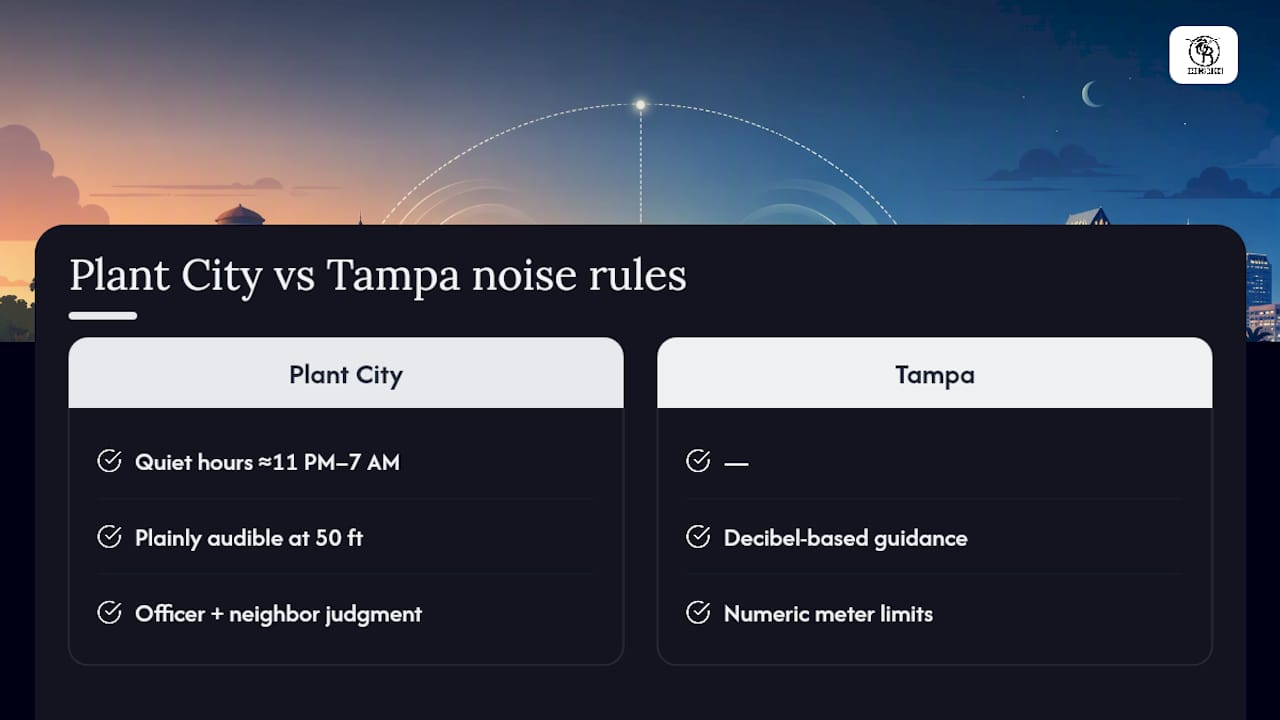
Quick fact: Plant City's enforcement model relies on the "plainly audible" standard rather than a fixed decibel ceiling, a contrast to nearby Tampa, which uses more formal decibel-based guidance in certain districts.
That contrast matters for planning. A DJ who has worked events in Tampa under a numeric limit may assume Plant City works the same way. It doesn't. You can't point to a meter reading and claim compliance if a neighbor a hundred feet away is still describing your first dance song word for word.
Who Enforces Noise Complaints and How to File One
Wedding noise complaints in Plant City start and usually end with the police, not the county. Here's how the process typically unfolds:
- Contact Plant City Police Department's non-emergency line. This is the correct first call for a neighbor with a noise concern or a host wanting to confirm they're within bounds. The Hillsborough County Environmental Protection Commission regulates industrial and commercial noise sources and rarely responds to residential or event complaints.
- An officer is dispatched to assess audibility. They'll typically stand near the reported property line and judge whether the sound is plainly audible, sometimes cross-checking with the complainant's account.
- A verbal warning usually comes first. For a first complaint with no prior history, officers commonly ask the host or DJ to lower the volume rather than issuing anything formal on the spot.
- Documentation follows if the pattern continues. Repeat calls, refusal to lower volume, or a second complaint the same night are what typically escalate a warning into a citation.
The whole cycle, from a neighbor's call to an officer standing at your venue's edge, often plays out within 20 to 40 minutes depending on patrol availability. That's a short window to fix a speaker angle or cut your subwoofer level, which is exactly why prevention matters more than reaction.
Penalties, Fines, and How Enforcement Escalates
Local reporting describes a tiered structure that starts modest and climbs fast if a host ignores warnings. A first-offense civil citation is often cited around $100, which stings but rarely derails an event budget. The real risk sits in what happens next.
- Repeat violations at the same event or venue have been reported escalating into the $250 to $500 range.
- Persistent noncompliance can lead to equipment impoundment in more serious cases, which is a fast way to end a reception early.
- Refusal to comply with an officer's direct request can shift the matter from a civil citation into criminal territory under Florida Statute 877.03, the state's disorderly conduct law.
That statute doesn't exist specifically for weddings, but it's the mechanism officers can reach for when a host or vendor becomes combative or simply won't turn the volume down after being asked more than once. Most weddings never get anywhere near that outcome. The pattern that leads there is almost always the same: an ignored first warning, a second complaint, and an escalating confrontation with responding officers.
Agricultural Exemptions and Why They Don't Cover Your DJ
Plant City sits in the heart of Hillsborough County's agricultural belt, and Florida's Right to Farm Act protects farm operations from a lot of nuisance complaints, including some noise generated by customary farming equipment. Tractors, irrigation pumps, and crop dusters running on schedule are shielded from the kind of noise disputes that might otherwise tie up a working farm in court.
Weddings held at agritourism venues sometimes assume that protection extends to their event. It doesn't.
- Right to Farm protections cover agricultural production and processing activities, not entertainment.
- Amplified music, DJ equipment, and live bands at a reception are not agricultural operations under any reading of the statute.
- A venue located on or near working farmland still has to meet the same audibility and quiet-hours standards as any other property in the city.
If you're booking a barn or rural venue for its scenic charm, don't assume the farmland around it buys you extra volume.
Do Private Weddings Need a Noise or Event Permit?
Most private weddings in Plant City don't require a special noise or event permit. City guidance confirms that private parties generally fall outside the permit requirement that applies to larger public gatherings, though every event still has to stay within the ordinance's noise limits regardless of permit status.
A handful of situations change that answer:
- Events held in public parks, on public rights-of-way, or in downtown entertainment districts often require separate approval.
- Attendance thresholds tied to certain public-space bookings can trigger permit requirements that a backyard or private venue reception wouldn't face.
- Zoning conditions or conditional-use approvals attached to a specific venue's site plan can layer on extra restrictions, like a hard music cutoff time or a required speaker orientation, even without a formal citywide permit.
That last point catches people off guard. A venue's own zoning paperwork can be stricter than the city ordinance itself, so ask directly what conditions apply to the property you're booking.
A Sound-Management Checklist That Actually Prevents Complaints
Most noise complaints trace back to a handful of fixable problems: speakers aimed the wrong direction, no defined curfew, and no one on-site responsible for handling a complaint if one comes in. Fix those three things and you eliminate most of your risk.
- Orient speakers away from property lines. Angling line arrays and subwoofers inward, toward the dance floor rather than outward toward neighbors, cuts perceived audibility more effectively than simply turning the whole system down.
- Set a written curfew and stick to it. Put an amplified-music end time in your vendor contract, not just a verbal agreement with your DJ.
- Run a scheduled sound check, not a guess. Test levels at the property boundary during setup, before guests arrive, so you know what "plainly audible" looks like from outside your own event.
- Notify neighbors ahead of time. A short note or knock on the door days before the event, letting neighbors know the date and expected end time, turns a potential complaint into a heads-up conversation instead.
- Assign a named on-site contact for complaints. If an officer arrives, having someone who can immediately adjust sound levels resolves the situation faster than searching for whoever is running the soundboard.
- Keep a log. Note your sound check times and any neighbor conversations. If a dispute ever escalates, that paper trail matters.
Pro Tip: Rent a basic sound meter for the night if your venue sits close to residential lots. Reading 70 to 75 decibels at your own dance floor tells you nothing about what a neighbor hears 50 feet away, so check the boundary itself, not the stage.
What Local Noise Disputes Teach Every Host
Plant City's agricultural character has produced its own noise flashpoints over the years, with agritourism venues and event spaces near residential areas drawing repeated complaints from neighbors unaccustomed to weekend crowds and amplified sound. Those disputes rarely start with a single loud night. They build after a venue hosts high-impact events week after week without adjusting its approach.
- Repeated complaints against the same address can prompt a zoning or permit review, not just a citation.
- Neighbors who feel ignored after one complaint tend to escalate faster the second time, sometimes involving city commissioners directly.
- Hosts and venues that proactively communicate, notify neighbors, cap volume at a set hour, and respond quickly to a complaint, largely stay out of that cycle entirely.
The lesson for a one-time wedding host is simple: you're not the only event that neighborhood has seen, and how you handle sound shapes whether the next couple gets an easier or harder reception from the same residents.
How Origins Ranch Balances Celebration and Compliance
We've built our own house rules around the same principles this guide lays out, because we've seen what happens when a venue treats noise compliance as an afterthought. Every event at Origins Ranch gets a scheduled sound check during setup, checked at the property boundary rather than guessed from the dance floor.
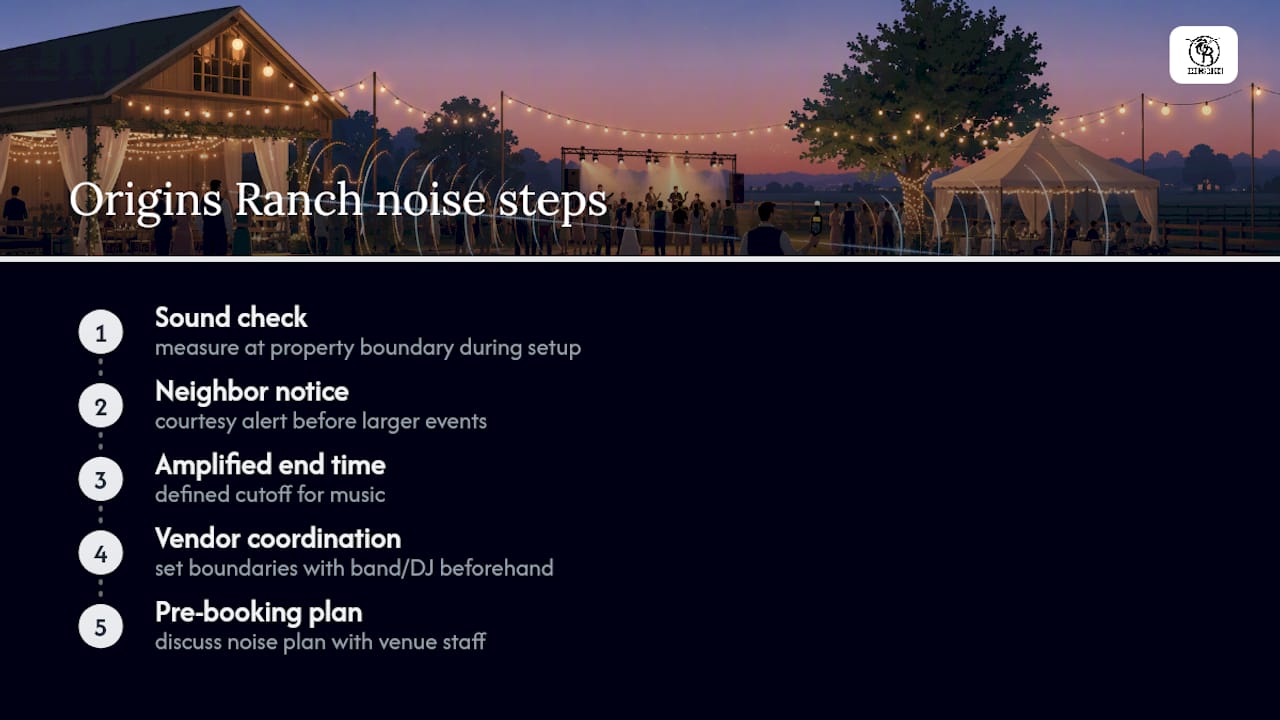
We also send a courtesy notice to neighboring properties ahead of larger events, a habit that has spared more than one couple an awkward conversation with a patrol officer at 10:45 PM. Our house rules include a defined amplified-music end time and clear vendor coordination so your band or DJ knows the boundaries before they ever plug in.
If you're planning a wedding and want to talk through a noise plan before you book anything, we're glad to walk through it with you. Compliance shouldn't be the thing that stresses you out on your wedding day, and it doesn't have to be.
— Origins
Plan Your Plant City Wedding Without the Noise Stress
Origins Ranch handles the sound-management groundwork most couples don't think about until a neighbor calls the police, so your celebration stays focused on the people in the room, not the volume knob. Our barn venue was built for exactly this balance: room to celebrate loudly enough to matter, with the speaker orientation, scheduled sound checks, and on-site coordination that keep an amplified reception inside Plant City's audibility standard.
Every booking includes support from a team experienced in managing event sound, so you're not left guessing whether your DJ's setup will draw a complaint at 11:15 PM. Browse our event gallery to see how past celebrations have used the space, then check our packages and pricing to start a conversation about your date. If you're a veteran or active-duty service member, ask us about Weddings For Warriors when you reach out. Request a consultation today and let's map out a sound plan alongside your booking.
Sources
- Plant City knowledgebase (noise / party guidance)
- Hillsborough County EPC — Noise program
- Quiet hours in Plant City, FL (CityRuleLookup)
- IFAS Extension — Right to Farm and agricultural noise considerations
- Plant City, FL Code of Ordinances — Municode Library
FAQ
At What Point Can You Call the Police for a Noise Complaint?
You can call as soon as noise is disturbing you, but Plant City officers typically judge complaints against the "plainly audible" standard at roughly 50 feet from the property line rather than a fixed volume trigger.
What Time Do Quiet Hours Start in Plant City?
Local guides report quiet hours running from approximately 11:00 PM to 7:00 AM, the window when enforcement of amplified sound tends to get stricter.
What Time Can You Legally Make Noise Again in Florida?
Rules vary by city, but in Plant City the stricter quiet-hours window generally lifts at 7:00 AM, after which normal daytime noise levels are typically tolerated.
Does My Wedding Need a City Noise Permit in Plant City?
Private weddings on private property generally don't require a special city noise or event permit, though the event still must stay within standard noise limits.
Who Do I Call if a Wedding Nearby Is Too Loud?
Contact the Plant City Police Department's non-emergency line first; the county's Environmental Protection Commission handles industrial and commercial noise, not residential or event complaints.