
A typical quinceañera day runs from morning hair and makeup through an evening reception, and most families should plan for 8 to 12 hours total, according to Quinceanera Decor. The flow is consistent from family to family: getting ready, ceremony, portraits, a reset window, then a reception with a set program before open dancing and send-off. Below, we break that flow into copy-ready hour-by-hour templates you can hand straight to your vendors.
TL;DR:
- Most quinceañeras require 8 to 12 hours from start to finish, with the reception alone lasting around 5 to 6 hours.
- Building 15 to 30 minute buffers between major events helps prevent delays and cascading schedule issues.
- Having vendors arrive 1 to 2 hours before guest arrival ensures smooth setup without last-minute rushes.
- Treating the timeline as a flexible guide rather than a strict schedule minimizes stress caused by small delays.
- A single-site venue like Origins Ranch reduces setup complexity and minimizes time lost moving between locations.
Table of Contents
- What Is a Realistic Quinceañera Timeline for the Full Day?
- What Do the Ceremony Traditions Mean, and How Long Do They Take?
- What Order Do Events Happen at the Reception?
- Who Should Arrive When on the Morning of the Quinceañera?
- How Do You Avoid Delays Cascading Through the Day?
- What Should Go on a One-Page Day-Of Checklist?
- What Happens After the Reception Ends?
- What Origins Ranch Has Learned From Hosting Quinceañeras
- How Origins Ranch Simplifies Your Quinceañera Day
- Sources
- FAQ
What Is a Realistic Quinceañera Timeline for the Full Day?
Every quinceañera has its own personality, but the bones of the day rarely change. What changes is how much time you have to work with. We built three versions below so you can pick the one that matches your family's actual schedule instead of forcing a Pinterest-perfect timeline onto a day that won't cooperate.
The full-day template works best when the ceremony and reception happen at separate locations, or when your court is large enough that hair and makeup need real runway.
- 8:00 to 8:30 AM — Vendor load-in begins (hair, makeup, photographer arrives for candids)
- 8:30 to 11:30 AM — Hair and makeup for the honoree and court, staggered in 45 to 60 minute blocks per person
- 11:30 AM to 12:00 PM — Dress, shoes, and final touches
- 12:00 to 1:00 PM — Ceremony (Mass or blessing)
- 1:00 to 2:00 PM — Formal portraits with family and court
- 2:00 to 4:00 PM — Reset and travel to the reception venue
- 4:30 PM — Vendor and family arrival at the reception site
- 5:00 PM — Grand entrance
- 5:15 to 6:00 PM — Dinner service
- 6:00 to 6:45 PM — Traditional dances and ceremonies (vals, changing of shoes, crown)
- 6:45 to 7:00 PM — Cake cutting
- 7:00 to 10:00 PM — Open dancing
- 10:00 to 10:30 PM — Send-off
This mirrors the structure that photographers report families using most often, with getting-ready starting around 10:00 AM in some versions and shifting earlier only when the ceremony itself starts earlier, according to I Love Life Photography.
The compressed template fits into roughly 6 hours and works when the ceremony and reception share one site, or when the family wants a shorter, tighter event:
- Hair, makeup, and dressing: 3 hours (overlapping stations for multiple court members)
- Ceremony: 45 minutes
- Portraits: 45 minutes, taken immediately after the ceremony at the same venue
- Reception: 4 hours, with dinner, traditions, and dancing folded into back-to-back 30-minute blocks
The evening-only template skips a formal religious ceremony entirely and starts the clock at the reception:
- Getting ready: 2 to 3 hours before doors open
- Guest arrival and cocktail hour: 30 minutes
- Grand entrance through send-off: 5 to 6 hours, following the same reception sequence as the other templates
Whichever version you use, build 15 to 20 minute buffers between every major block. Families most often add extra time around portraits and hair and makeup for large courts, and drop time from the reset window when the ceremony and reception share a location.
What Do the Ceremony Traditions Mean, and How Long Do They Take?
Most of the day's symbolic moments happen at the Mass or blessing, though some families move one or two into the reception program instead. Here's what each one involves and how much time to block off.
- Changing of the shoes: the father swaps the honoree's flat shoes for heels, symbolizing her transition into young womanhood. Budget 3 to 5 minutes.
- Presentation of the last doll: a doll is given as a symbolic farewell to childhood, often presented by a younger sibling or godparent. Budget 3 to 5 minutes.
- Placing the tiara or crown: parents or godparents place the crown, marking the honoree as "queen" for the day. Budget 5 minutes, longer if there's a speech attached.
- Presentations and gifts: godparents or sponsors present symbolic gifts (a Bible, a ring, a bracelet). Budget 5 to 10 minutes depending on how many sponsors are involved.
Cultural and family traditions vary quite a bit here. Some families fold every ritual into the Mass itself; others save the shoe change and crowning for the reception so more guests can see it. Either approach works, but decide early and tell your DJ or ceremony coordinator which rituals happen where, so nothing gets scheduled twice or skipped by accident.
What Order Do Events Happen at the Reception?
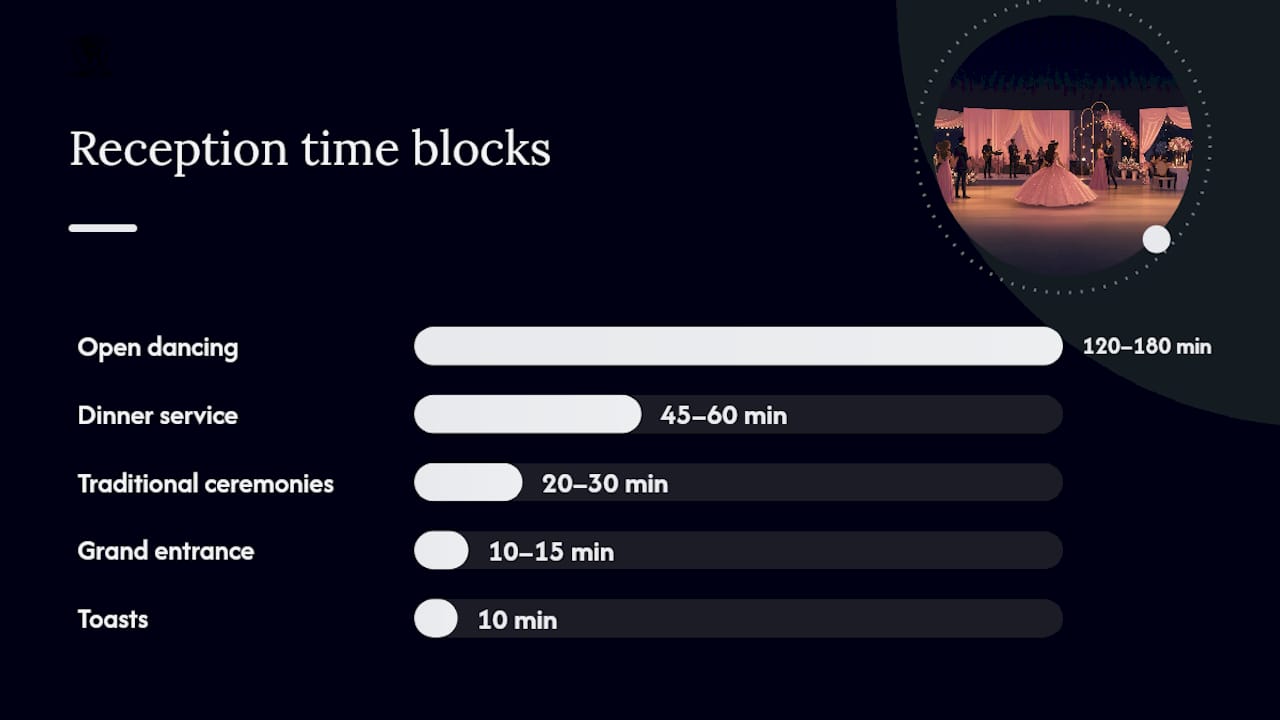
The reception has a standard shape that most DJs and planners recognize instantly, which makes it easy to hand off. The recognized sequence runs: Grand Entrance, Welcome Message, Dinner Service, Traditional Ceremonies, Father-Daughter Waltz, Mother-Daughter Waltz, Court Waltz, Toasts, Cake Cutting, Surprise Dance, and Dance Floor Opening, according to Quinceañeras Magazine. Here's how to allocate minutes to each:
- Grand entrance (10 to 15 minutes): the honoree and court are introduced, often with a choreographed walk-in.
- Welcome message (2 to 3 minutes): a short toast or blessing from a parent or padrino.
- Dinner service (45 to 60 minutes): plated service runs longer than buffet, so build accordingly.
- Traditional ceremonies (20 to 30 minutes): shoe change, last doll, crowning, if not done at the ceremony.
- Father-daughter and mother-daughter waltz (5 to 8 minutes each).
- Court waltz (5 to 10 minutes): the choreographed group dance many families rehearse for weeks.
- Toasts (10 minutes): keep this tight, two or three speakers maximum.
- Cake cutting (10 minutes).
- Surprise dance (5 minutes): a fun, often comedic choreographed number.
- Open dancing (remaining time): the longest block of the night, typically 2 to 3 hours.
A good DJ or MC treats the formal program as a wave, not a straight line. Hold the room's attention tightly through the entrance, dinner, and traditional dances, then release energy fast into open dancing so guests don't feel like they're sitting through a ceremony twice. Schedule dinner to start no more than 15 minutes after the grand entrance. Hungry guests get restless fast, and a delayed dinner service is one of the most common reasons reception timelines slip.
Pro Tip: Give your DJ a printed copy of the program with exact minute allocations, not just a list of events. DJs who know they have "10 minutes for toasts" keep speakers on track far better than DJs working from a vague outline.
Who Should Arrive When on the Morning of the Quinceañera?
Vendors should generally arrive 1 to 2 hours before guests do, giving them time to set up without rushing, per guidance from Eventifai. Morning logistics are where most day-of stress actually starts, not at the ceremony itself.
- Hair and makeup artists: budget 45 to 60 minutes per person; for a court of six or more, book two stylists working simultaneously or start two hours earlier than you think you need to.
- Photographer and videographer: have them arrive during hair and makeup, not after, so getting-ready candids and detail shots (dress, shoes, invitations) happen naturally.
- Florist: should arrive with the personal flowers (bouquet, corsages) at least an hour before the ceremony or first photos.
- Caterer: needs full access to the reception site 2 to 3 hours before guests arrive for kitchen setup and plating prep.
Confirm every vendor's arrival window the week before, then again the morning of with a quick text. Transport for the honoree and court should be arranged with 20 to 30 minutes of slack built in. Traffic and last-minute wardrobe fixes are the two things that eat that cushion first.
How Do You Avoid Delays Cascading Through the Day?
Photographers who work quinceañeras regularly recommend treating any printed timeline as a reference point, not a rigid contract, because small delays happen constantly and need somewhere to go without wrecking the rest of the day, according to Kyle Carnes Photography. That "somewhere to go" is the buffer.
- Build 15 to 30 minute buffers between every major transition, especially before and after portraits.
- Give every vendor a call time 30 to 60 minutes before they're actually needed, not right at the moment.
- Assign one single point person (a parent, madrina, or hired coordinator) to manage vendor questions on the day, so five people aren't texting the photographer at once.
Taking portraits before the ceremony compresses the evening and gets photos done while makeup is fresh, but it stretches the morning and adds guest-wait time before the ceremony starts. Taking them after the ceremony keeps the morning simpler but risks running late into cocktail hour if the ceremony itself runs long. Neither choice is wrong; the right one depends on your travel distance between locations and how much daylight you need for outdoor shots.
Pro Tip: Text your photographer and DJ the finalized timeline 48 hours ahead, not the morning of. A shared timeline everyone has seen in advance prevents the single most common day-of confusion: two vendors working from two different schedules.
What Should Go on a One-Page Day-Of Checklist?
Printable, single-page templates reduce stress because everyone (family, vendors, coordinator) works from one shared document instead of memory, according to QuinceNetwork. Keep it copyable and short enough to fit on one page.
Must-have checklist items:
- Vendor contact list with cell numbers (photographer, DJ, caterer, florist, venue contact)
- Arrival times for each vendor and each court member
- Backup contact if the point person is unreachable
- Copies of the reception program for DJ, photographer, and venue coordinator
Three compact timeline snippets to distribute:
- Vendor snippet: arrival time, setup deadline, and start-of-service time only.
- Family snippet: hair/makeup start, ceremony time, photo call time, reception arrival.
- DJ/MC snippet: minute-by-minute reception program from grand entrance through send-off.
The point person should carry the master timeline (all three snippets combined) and text the relevant snippet to each group 48 hours before the event, then again the morning of.
What Happens After the Reception Ends?
The party doesn't end the moment the last song plays. Most venues build in 30 to 60 minutes after guest departure for breakdown, and it helps to know this window exists before you're standing in it exhausted at midnight.
Cleanup typically starts the moment the send-off ends. Rented items (linens, centerpieces, arch décor) usually need to be packed and staged for pickup that night or the next morning, depending on your vendor contracts. If you're using a venue with in-house decor and table settings, this step shrinks considerably since the venue's own team handles the breakdown instead of your family.
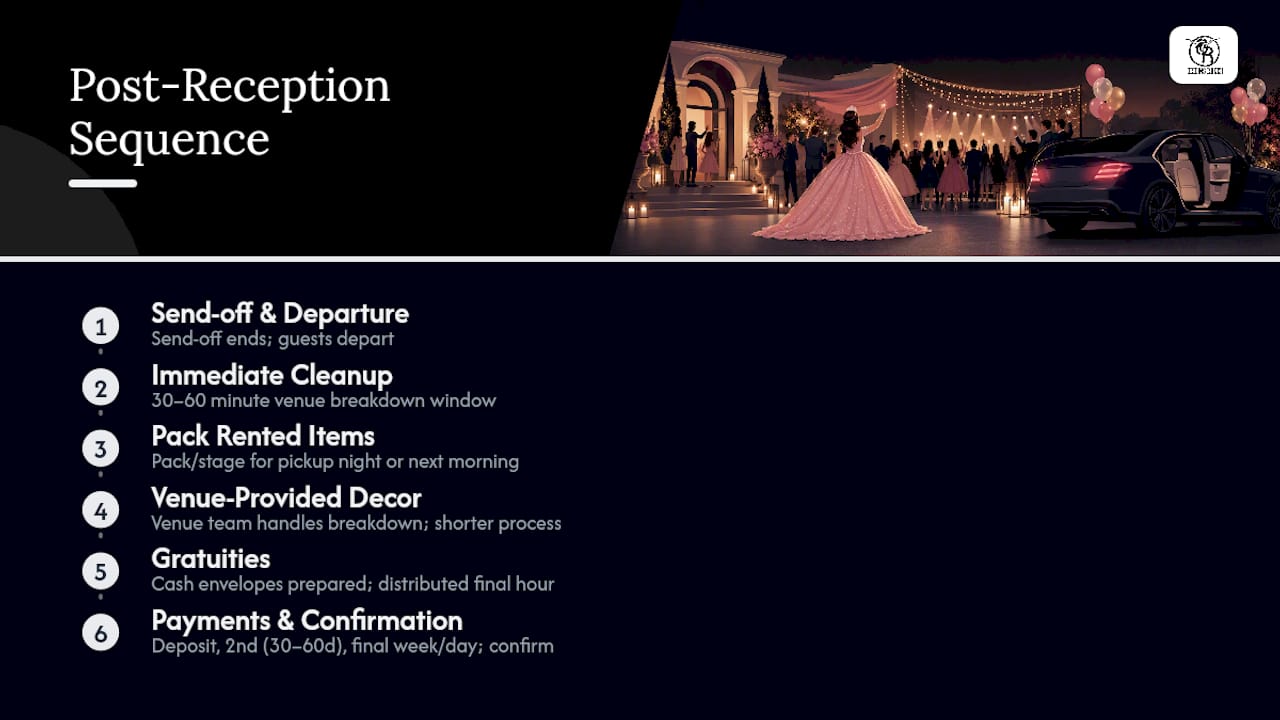
Vendor payments follow a fairly standard pattern: most contracts require a deposit at booking, a second payment 30 to 60 days out, and a final balance due either the week of the event or on the day itself. Tips for the DJ, photographer, and catering staff are typically handled in cash envelopes prepared in advance, distributed by the point person during the final hour so nobody's searching for an envelope at 11:00 PM. Confirm every final balance and gratuity expectation in writing at least a week before the event, not the day of, so the last hour of your quinceañera is spent saying goodbye to guests instead of settling invoices.
What Origins Ranch Has Learned From Hosting Quinceañeras
Most day-of delays we see trace back to one thing: too many people moving between too many locations. A single-site event solves that immediately. Experience running events has taught that a dedicated staging area for the court and an on-site point of contact prevent small hiccups from snowballing into a delayed grand entrance.
— Origins
How Origins Ranch Simplifies Your Quinceañera Day
Origins Ranch is the alternative to juggling two locations and five separate vendor arrival times for your quinceañera. Booking a single barn venue in Plant City means your ceremony, portraits, and reception can share one site, cutting the two-hour reset window out of your timeline entirely.
In-house table settings and decor allow florists and caterers to coordinate directly with venue teams, and indoor and outdoor spaces with full air conditioning provide photographers flexible portrait locations without a drive across town. If your family includes a veteran or active-duty service member, our founder's charity, Weddings For Warriors, was built specifically to help make celebrations like this possible. For families further along in planning, our tiara ceremony guide walks through timing that ritual within your program, and platforms like Jubiliq can help you build and share your day-of run sheet with every vendor at once. Check our quinceañera venue page for available dates and come see the barn for yourself.
Sources
The timelines and buffer recommendations above draw on real vendor practice: I Love Life Photography's family-tested hour-by-hour example, Quinceañeras Magazine's standard reception order, Eventifai's vendor-arrival guidance, and New Dawn Photo's planning-runway research.
- The Perfect Quinceañera Timeline (That Families Actually Use) — I Love Life Photography
- Quinceañeras Magazine
- How to create the perfect quinceañera day-of timeline — Eventifai
FAQ
How Long Do Quinceañeras Usually Last?
Most quinceañeras run 8 to 12 hours total when you count morning preparation through send-off, though the reception portion alone typically lasts 5 to 6 hours, according to Quinceanera Decor.
What Are the Basic Steps of a Quinceañera?
The day generally moves through hair and makeup, a religious ceremony or blessing, formal portraits, a reset or travel window, and a reception that includes a grand entrance, dinner, traditional dances, cake, and open dancing.
What Is the Typical Order of Events at the Reception?
The recognized sequence is grand entrance, welcome message, dinner, traditional ceremonies (shoe change, last doll, crowning), formal waltzes, toasts, cake cutting, surprise dance, and open dancing, per Quinceañeras Magazine.
What Should You Avoid Doing at a Quinceañera?
Avoid overpacking the schedule without buffers, skipping vendor call-time confirmations, and letting toasts or the welcome message run long, since those are the moments most likely to push dinner and dancing later than planned.