
TL;DR:
- Venue owners in Plant City must carry at least $1 million per occurrence and $2 million in total coverage, verified through proper certificates of insurance. They should review policies regularly to ensure coverage includes setup and teardown days, correct additional insureds, and complies with municipal requirements. Having tenants purchase TULIP policies helps close coverage gaps for outside events and reduces administrative burdens.
Every Plant City event venue needs, at minimum, Commercial General Liability (CGL), Property, Business Income/Interruption, Liquor Liability (if alcohol is served), and Workers' Compensation (if you have employees). If you host tenant-run events, a TULIP policy or a host-provided short-term event policy belongs in that stack too. Your single most important action right now: pull your active policies, confirm they meet Plant City's permit requirements under Chapter 50 of the City Code, and verify that your certificates of insurance (COIs) name the correct Additional Insured, include a waiver of subrogation, and cover setup and teardown days, not just the event date itself. Common municipal minimums run at least $1 million per occurrence and $2 million aggregate. If your current policy falls short on any of those points, contact your broker before your next booking.
Pro Tip: Call Plant City Parks & Recreation before you finalize any event contract. Permit applications under Chapter 50 require proof of insurance, and the review window can run 14–30 days. Starting that conversation early keeps a booking from turning into a compliance scramble.
Table of Contents
- Understanding your Plant City venue insurance needs: the core policies
- How Florida's weather and Plant City's local risks shape your coverage
- What your COIs must say: limits, wording, and the checklist that protects you
- Venue policy vs. TULIP: who covers what and how contracts assign responsibility
- Risk controls that lower premiums and prevent claims
- Event cancellation, force majeure, and business interruption: what actually pays
- Costs, underwriting factors, and realistic timelines for Plant City venues
- How to collect, verify, and track vendor COIs without losing your mind
- How Originsranch applies these practices as a Plant City barn venue
- When should you call a broker or specialty underwriter?
- Event cancellation and non-appearance coverage: a closer look
- Annual policy review checklist: when and what to update
- Legal consequences of operating without proper insurance in Plant City
- Key Takeaways
- What running a Plant City venue has taught us about insurance
- Useful sources and official references
- FAQ
Understanding your Plant City venue insurance needs: the core policies
Every coverage type serves a distinct purpose, and knowing what each one does helps you spot gaps before a claim does it for you.

Commercial General Liability (CGL) is the foundation. It covers bodily injury and third-party property damage that happens on your premises or as a result of your operations. A guest slips on a wet dance floor, a vendor's equipment damages a rented tent, a caterer's cart knocks over a display — CGL is what responds. Most Florida venues and municipalities expect limits of at least $1,000,000 per occurrence and $2,000,000 aggregate, and those standard Florida limits appear on virtually every venue contract and permit application you will encounter.
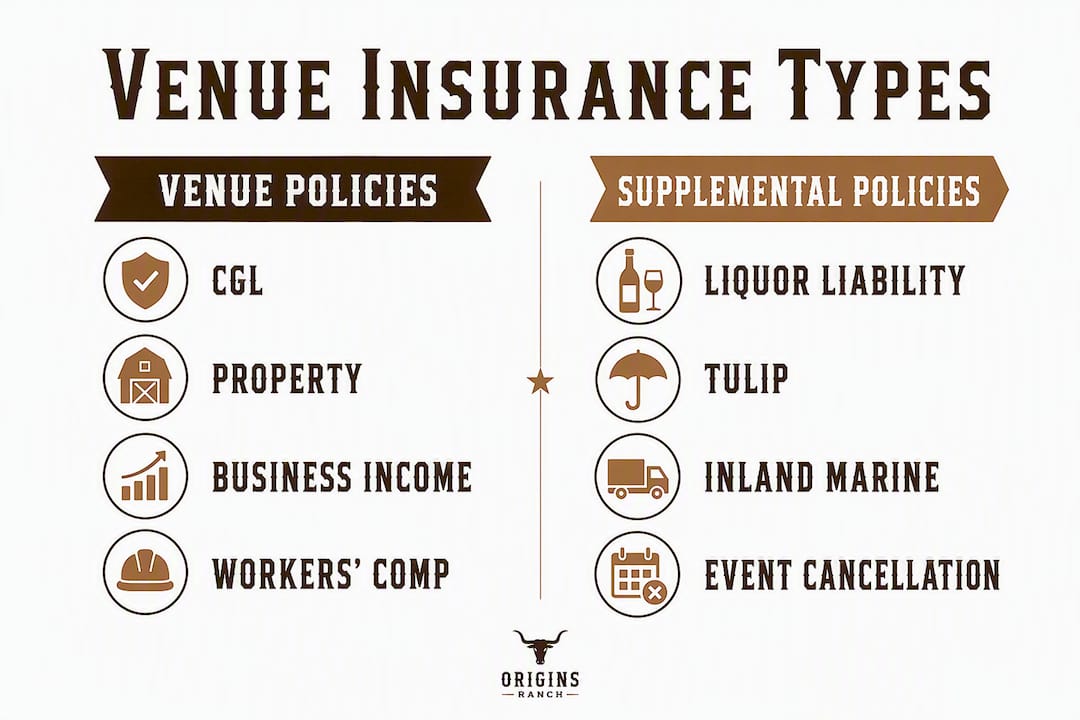
Property insurance covers your building, contents, and equipment. For a barn or rustic outdoor venue, the choice between a named-peril policy (covers only the perils listed) and an all-risk policy (covers everything not explicitly excluded) matters more than it does for a conventional commercial building. Wood-frame barns, open-air pavilions, and vintage structures often carry higher replacement costs and are more vulnerable to wind and water intrusion. An all-risk form is almost always the right call for rustic barn venues in Florida.
Business Income/Extra Expense coverage pays for lost revenue and ongoing expenses when a covered loss forces you to cancel or postpone events. If a tropical storm tears through your outdoor ceremony space two weeks before a booked wedding, this is the coverage that keeps your business running while repairs happen.
Liquor Liability is separate from CGL and required any time alcohol is sold or served at your venue. Host liquor liability is a narrower version that applies when alcohol is provided at no charge. If your venue permits outside caterers or bar services, your policy needs to address both scenarios.
Workers' Compensation is mandatory in Florida for most employers with four or more employees (construction industry thresholds differ). Misclassifying a regular staff member as an independent contractor does not eliminate your exposure — Florida regulators and courts look at the actual working relationship, not the label on a contract.
Specialty coverages worth discussing with your broker include Inland Marine (for movable equipment like sound systems and lighting rigs), Equipment Breakdown, Cyber Liability (if you collect payments or store client data online), and Pollution Liability if you run fuel-powered generators on site.
| Policy | Common Limits | Typical Venue Trigger |
|---|---|---|
| Commercial General Liability | $1M per occurrence / $2M aggregate | Guest injury, third-party property damage |
| Property (All-Risk) | Replacement cost value | Fire, wind, water damage to building/contents |
| Business Income | Actual loss sustained (varies) | Covered loss forces event cancellation or closure |
| Liquor Liability | $1M per occurrence | Alcohol-related injury or damage claim |
| Workers' Compensation | Florida statutory limits | Employee injury on premises or during event |
| Inland Marine | Scheduled value of equipment | Theft or damage to movable gear off-premises |
How Florida's weather and Plant City's local risks shape your coverage
Florida's climate is not a background detail for venue owners. It is an underwriting factor that directly affects what you buy, what gets excluded, and what you pay.
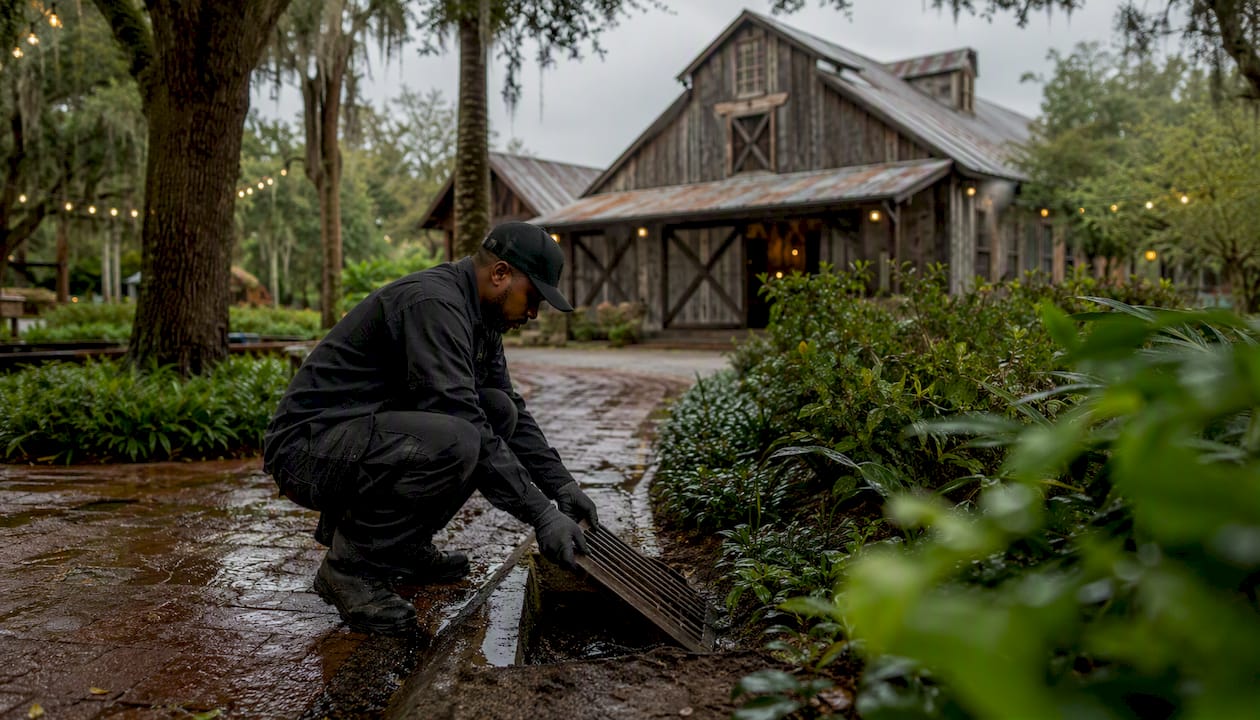
Hurricane and wind exposure is the biggest driver. Florida property policies commonly carry a separate wind or hurricane deductible, often expressed as a percentage of insured value rather than a flat dollar amount. A 2% wind deductible on a $500,000 barn means you absorb the first $10,000 of any wind claim out of pocket. Named-storm sublimits can reduce the maximum payout even further. Review these figures carefully, because the headline premium does not tell the whole story.
Flood coverage is not included in a standard property policy. If your venue sits in or near a FEMA-designated flood zone, a separate flood policy through the National Flood Insurance Program (NFIP) or a private flood carrier is not optional. Outdoor event areas, vendor tent zones, and parking fields are especially vulnerable during heavy rain events. Florida event venues with low-lying grounds should check their FEMA flood map panel before assuming standard property coverage is enough.
"Venues with unique structures and outdoor spaces need tailored coverage for weather-related damage and higher-risk guest activities. Do not rely on homeowner policies for business events — they commonly exclude commercial event activity entirely." — CPK Insurance, Florida commercial venue guidance
Mold and humidity are real exposures in Central Florida. Most standard property policies either exclude mold outright or cap mold-related remediation at a sublimit. If your venue has enclosed spaces with limited airflow, ask your broker about mold endorsements or a standalone mold remediation rider.
Seasonal demand also affects underwriting. Venues that cluster large events in spring and fall wedding seasons see higher foot traffic, more vendor activity, and more alcohol service during those months. Underwriters factor event frequency and peak-season attendance into pricing. Documenting your event calendar and average guest counts gives your broker the data needed to place coverage accurately.
Plant City's permitting process ties directly to your insurance. Under Plant City Code Chapter 50, special event permits require proof of insurance coordinated through the Parks & Recreation Department. The permit review window commonly runs 14–30 days, which means your COI needs to be in hand well before the event date, not the morning of.
What your COIs must say: limits, wording, and the checklist that protects you
A certificate of insurance is only as useful as the information on it. A COI that lists the wrong dates, omits an endorsement, or names the wrong certificate holder can leave you exposed even when a policy technically exists.
Standard minimums for municipal and venue permits in Florida run $1,000,000 per occurrence and $2,000,000 aggregate for CGL. The City of Tampa's special-events insurance requirements — a useful benchmark for comparable Florida municipalities — specify exactly those limits, require the city to be named as Additional Insured, and mandate a waiver of subrogation and severability of interest. Plant City's requirements follow the same general framework.
Critical endorsements to verify on every COI:
- Additional Insured: The venue (or municipality, if a city permit is involved) must be listed by name as an Additional Insured on the policy, not just on the certificate. The endorsement must be attached to the underlying policy.
- Waiver of Subrogation: Prevents the insurer from suing the venue after paying a claim on behalf of the insured. Without it, you can be drawn into litigation even after a claim is settled.
- Primary and Noncontributory: Confirms that the vendor's or tenant's policy responds first, before your own coverage is called on.
- Severability of Interest: Treats each insured separately so that one party's actions do not void coverage for another.
COI verification checklist — confirm all of these before every event:
- Certificate holder name and address match your venue's legal name and address exactly.
- Policy effective dates include setup days and teardown days, not just the event date.
- Per-occurrence and aggregate limits meet your venue's minimums ($1M/$2M or higher if required).
- Additional Insured endorsement is listed and references the correct form number.
- Waiver of Subrogation is noted on the certificate.
- Primary and Noncontributory language appears if your contract requires it.
- Insurer name and NAIC number are present; verify the carrier holds an A.M. Best rating of B+ or better.
- Authorized representative signature is present (not a stamped or digital placeholder without verification).
- Liquor Liability is listed separately if alcohol will be served.
- Policy type matches the exposure (CGL, not just a homeowner's or renter's policy).
Setup and teardown dates are the most commonly missed item. Insurers can and do deny claims that occur during load-in or breakdown if those days fall outside the policy's effective period.
Venue policy vs. TULIP: who covers what and how contracts assign responsibility
The distinction between a venue-owned policy and a tenant-obtained policy is one of the most misunderstood points in event venue operations. Getting it wrong creates coverage gaps that neither policy fills.
Your venue policy (the CGL, property, and related coverages you carry as the owner) protects your building, your operations, and your liability as the property owner. It is always on. It does not automatically extend to cover a tenant's event activities, the tenant's guests, or the tenant's vendors.
TULIP (Tenant User Liability Insurance Program) is a short-term, per-event policy that a tenant or renter purchases to cover their own event liability. K&K Insurance's TULIP program is one of the most widely used in the event industry. The facility owner is automatically listed as Additional Insured at no extra cost, and the policy is underwritten per event with attendance limits built in. That means the venue gets protection from the tenant's event without having to chase down a separate COI from every renter.
"TULIP and program-based solutions reduce administrative work for venues because the facility is automatically listed as Additional Insured and certificates are generated per event — no chasing, no gaps." — K&K Insurance, TULIP program guidance
Practical scenarios:
- Owner-run event (you organize, staff, and host): your venue policy is primary. No TULIP needed, but confirm your CGL covers the specific activities planned.
- Outside-hosted rental (a couple books your barn for their wedding): the renter should carry their own event liability policy or purchase TULIP. Your venue policy covers your premises and operations; their policy covers their event activities and guests.
Contract language that protects you: Every rental agreement should require the renter to (a) obtain event liability insurance with limits no less than $1,000,000 per occurrence, (b) name the venue as Additional Insured, (c) provide a COI no later than 14 days before the event, and (d) include setup and teardown dates on the policy. Understanding the venue owner's role in Florida events means knowing where your liability ends and your tenant's begins — and putting that boundary in writing.
Risk controls that lower premiums and prevent claims
Insurance pricing reflects the risk an underwriter sees. The good news: many of the controls that reduce claims also reduce premiums, and most of them cost far less than a single deductible.
Physical controls make the biggest difference for outdoor and barn venues. Non-slip surfaces at entry points and near water features, adequate lighting along pathways and parking areas, clearly marked emergency exits, and designated vendor load zones all reduce the frequency of guest injuries. For outdoor wedding setups, a staged power plan for generators (with grounded connections and covered cable runs) prevents both equipment damage and guest injury claims.
Operational controls are what underwriters ask about during renewal. Signed vendor contracts that require COIs before setup begins, a written alcohol service policy (trained and certified bartenders, no service to visibly intoxicated guests, last-call procedures), enforced guest capacity limits, and documented security staffing for larger events all signal to an insurer that you run a tight operation.
Documented processes carry real weight at renewal. Maintain a maintenance log with dated entries for inspections, repairs, and safety checks. Schedule annual fire-safety inspections and keep the reports on file. Some insurers offer premium credits for venues that can demonstrate a clean loss history backed by documented safety programs.
Pro Tip: Brokers who specialize in event or hospitality venues consistently point to two changes that move the needle most for rustic outdoor venues: (1) installing permanent, code-compliant lighting along all guest pathways, and (2) requiring vendors to submit COIs at least 14 days before setup. Both reduce claim frequency and give underwriters confidence that the venue is actively managed.
Event cancellation, force majeure, and business interruption: what actually pays
These three coverage types are related but not interchangeable, and confusing them is expensive.
Business interruption coverage (part of your venue's property policy) pays for lost revenue and ongoing expenses when a covered physical loss forces you to suspend operations. The key word is "covered." If wind damages your barn roof and you have to cancel three booked events while repairs happen, business interruption responds. If you cancel because of a pandemic or a non-physical disruption, most standard policies do not respond unless you have a specific endorsement.
Event cancellation insurance is a separate policy, typically purchased by the event host (not the venue), that covers their non-refundable deposits and expenses if the event cannot proceed. As a venue, you can require hosts to carry it, but it does not protect your revenue directly.
Common exclusions to know:
- Pandemics and communicable disease (commonly excluded post-2020 unless specifically endorsed)
- Pre-existing damage known before the policy period
- Named storms when a watch or warning was already issued before the policy was bound
- Cancellations due to low ticket sales or vendor no-shows unrelated to a covered peril
When a loss occurs, follow these steps:
- Document the damage immediately with photos, video, and written notes.
- Notify your insurer or broker within the timeframe specified in your policy (usually 24–72 hours for major losses).
- Preserve all evidence and do not begin permanent repairs until the adjuster has inspected.
- Track all extra expenses (temporary repairs, alternative vendor costs, staff overtime) with receipts.
- Gather supporting documents: rental agreements, deposit ledgers, vendor contracts, and any communications with affected clients.
Insurers will ask for all of those documents when processing a business interruption claim. Having them organized in advance shortens the claims process considerably.
Costs, underwriting factors, and realistic timelines for Plant City venues
Premium pricing for venue insurance is not a flat rate. Underwriters build a price from a combination of factors, and understanding those factors helps you present your venue favorably.
What drives your premium:
- Location and construction: A wood-frame barn in a hurricane-exposure zone costs more to insure than a masonry building in a lower-risk area. Flood zone designation adds further cost.
- Attendance: Higher guest counts mean more exposure. Underwriters want to know your maximum capacity and typical event size, making business event venue size considerations an essential factor in your coverage planning.
- Alcohol service: Liquor liability is one of the most significant premium drivers. Venues that serve alcohol, especially without trained bartenders or a written alcohol policy, pay more.
- Revenue base: Gross revenue is often used as the exposure base for CGL pricing. More revenue generally means more events and more exposure.
- Claims history: A clean loss history for three or more years is one of the strongest premium-reduction factors available.
- Security and safety documentation: Venues with documented safety programs and security staffing plans often qualify for better terms.
| Action | Recommended Timeline Before Event |
|---|---|
| Contact broker, begin application | 60–90 days before first event of the season |
| Submit underwriting information | 30–60 days before event |
| Receive and review policy/binder | 30 days before event |
| Collect vendor and renter COIs | 14–30 days before event |
| Submit COI to Plant City permit office | Per Chapter 50 permit timeline (allow 14–30 days for review) |
| Final COI verification | 7 days before event |
On cost ranges: Premiums vary too widely by venue size, construction, attendance, and coverage selections to quote a meaningful range here. What we can say is that the common municipal minimums of $1M/$2M create a baseline that most standard markets can accommodate. Specialty endorsements (wind, flood, liquor, equipment breakdown) add incremental cost, and each one is worth evaluating against the exposure it covers.
How to collect, verify, and track vendor COIs without losing your mind
COI management is one of those tasks that feels administrative until the day a vendor's policy turns out to be expired or missing a required endorsement. At that point, it becomes a legal problem.
The process, step by step:
- Request COIs at booking. Include COI requirements in every vendor contract and rental agreement. Specify the required limits, endorsements, and certificate holder information in writing.
- Verify the COI when you receive it. Do not assume a certificate is accurate. Call the issuing agent or check the insurer's online verification portal to confirm the policy is active and the endorsements are in place.
- Store certificates in a central location. A shared folder organized by event date works for small operations. A dedicated COI tracking spreadsheet or software works better as volume grows.
- Send reminders 30 days before the event. Policies expire. A vendor who submitted a valid COI six months ago may have let their policy lapse.
- Do a final verification 7–14 days before the event. Confirm that all COIs are current, limits are correct, and setup/teardown dates are included.
- Escalate immediately when a COI is expired, limits are insufficient, endorsements are missing, or the insurer's name does not match a recognized carrier. Do not allow setup to begin without resolution.
CSV fields for a compliance tracker:
Vendor Name, Contact Email, Contact Phone, Policy Type, Insurer Name, Policy Number, Per-Occurrence Limit, Aggregate Limit, Endorsements (AI/WOS/P&NC), Policy Start Date, Policy End Date, Setup Date Covered, Teardown Date Covered, Certificate File Link, Verification Status, Verified By, Verification Date, Notes.
Treating COI collection as a documented business workflow — with automated reminders, a tracker, and final verification 14–30 days before each event — reduces permit denials and legal exposure. Automated tools (some event management platforms include COI tracking modules) help at higher event volumes. Manual spreadsheets work fine for smaller operations as long as someone owns the process and follows it consistently.
How Originsranch applies these practices as a Plant City barn venue
Originsranch sits on property that was once a World Champion Horse Ranch, now transformed into a modern barn wedding and special event venue in Plant City, FL. The venue's structure — a wood-frame barn with both indoor and outdoor ceremony spaces — shapes every insurance decision we make.
The barn's construction means property coverage is written on an all-risk form with replacement cost valuation, not actual cash value. Wind and hurricane deductibles are reviewed at every renewal, and the venue's flood zone status is confirmed against current FEMA maps. Equipment coverage includes the sound and lighting systems that our founder Barry, a veteran DJ with over 20 years in the event industry, uses to run events in-house.
For every renter and outside vendor, Originsranch requires a COI that names the venue as Additional Insured, includes a waiver of subrogation, and covers the full rental access window including setup and teardown. Those requirements are written into every rental agreement, not left to a verbal conversation.
Our Weddings For Warriors program, which supports veterans and active-duty service members in having their dream weddings, is one reason we take venue operations and risk management seriously. Every event we host carries the weight of someone's most important day. That is not something we take lightly, and neither is the coverage that protects it.
Explore the venue's event spaces to see the full range of events we host and the exposures we plan for year-round.
When should you call a broker or specialty underwriter?
Not every venue owner needs a specialty underwriter, but some situations clearly call for one. Use this checklist to decide.
Bring in a broker or specialty underwriter when:
- Your venue hosts events with more than 300 attendees regularly
- You are in a FEMA flood zone or a coastal wind-exposure area
- You serve or permit alcohol at most events
- You need limits above $1M/$2M (some corporate or municipal clients require $5M or more)
- You have had a claim in the past three years
- You host events with participant activities (obstacle courses, equestrian activities, inflatables)
- Your venue structure is unusual (historic barn, open-air pavilion, mixed indoor/outdoor)
Have these documents ready before your first broker conversation:
- Three to five years of loss runs (claims history from your current insurer)
- Venue square footage, construction type, and year built
- Annual gross revenue and projected event calendar
- Maximum and typical guest counts
- Description of all alcohol service arrangements
- Current safety plan and any inspection reports
A specialty underwriter or program like TULIP can access markets that standard admitted carriers cannot reach, particularly for venues with unusual structures, high attendance, or complex liquor exposure. The admitted market works well for straightforward operations; specialty markets handle the rest.
"The difference between a standard market policy and a specialty program is not just price — it is whether the coverage actually fits the exposure. A barn venue in a Florida wind zone with regular alcohol service is not a standard commercial risk, and treating it like one leaves gaps." — Industry guidance, K&K Insurance TULIP program
Event cancellation and non-appearance coverage: a closer look
Event cancellation insurance and non-appearance coverage are distinct products that serve different parties, and venues often misunderstand which one they need.
Event cancellation insurance reimburses the event host for non-refundable expenses (deposits, vendor fees, catering costs) when a covered event cannot proceed. Covered causes typically include severe weather, venue damage, sudden illness of a key participant, or vendor failure. Hosts purchase this coverage; venues benefit indirectly when clients can recover deposits without disputing the venue's cancellation policy.
Non-appearance coverage is narrower. It covers financial loss when a specific named performer, speaker, or key participant cannot appear due to illness, injury, or death. It is most relevant for concerts, corporate events, and productions rather than weddings, though some wedding policies include a version of it.
For venue owners, the relevant product is business interruption coverage (discussed earlier), which responds to physical damage that forces a closure. Venues can also consider event cancellation coverage for their own owner-run events, particularly large community or seasonal events where non-refundable vendor commitments are significant.
When drafting rental agreements, include a clear force majeure clause that defines which events excuse performance, how deposits are handled in each scenario, and what documentation the client must provide to trigger any refund. A well-drafted clause reduces disputes and makes the claims process cleaner for everyone.
Annual policy review checklist: when and what to update
Insurance is not a set-it-and-forget-it purchase. A policy that fit your venue two years ago may have gaps today if your operations, revenue, or physical space have changed.
Review your policies annually, and also after any of these changes:
- You added or removed a structure (new pavilion, expanded parking, storage building)
- Guest capacity increased or your event calendar grew significantly
- You began offering new services (catering, bar service, equipment rentals)
- You hired employees or changed how you classify workers
- Your revenue grew by more than 20% year over year
- You experienced a claim or near-miss incident
- Your venue's flood zone designation changed on a FEMA map update
- A key vendor relationship ended and you took on their function in-house
Annual review checklist:
- Confirm replacement cost values on property coverage reflect current construction costs (rebuilding costs have risen significantly in Florida in recent years)
- Verify that all endorsements (Additional Insured, waiver of subrogation) are still in place and correctly worded
- Review liquor liability limits against your current alcohol service volume
- Confirm Workers' Compensation covers all current employees and classifications
- Check that business interruption limits reflect current annual revenue
- Update your event calendar and guest count projections for the underwriter
- Pull and review loss runs to confirm accuracy before renewal negotiations
- Confirm flood and wind coverage against current FEMA maps and any local zoning changes
Scheduling this review 60–90 days before your policy renewal date gives your broker time to shop the market if better terms are available.
Legal consequences of operating without proper insurance in Plant City
Operating a venue without required insurance is not just a financial risk. It carries legal and operational consequences that can shut down your business.
Permit denial and event cancellation: Under Plant City Code Chapter 50, proof of insurance is a condition of the special event permit. Without a compliant COI, the permit is not issued. Without the permit, the event cannot legally proceed on city property. For private venues, your rental contract and local ordinances may impose similar requirements.
Personal liability exposure: If a guest is injured at an uninsured event and files a lawsuit, the venue owner faces personal liability with no insurance to respond. Florida courts can pierce corporate protections in certain circumstances, particularly when required insurance was not maintained.
Vendor and client disputes: Renters and vendors who suffer losses at an uninsured venue have no insurance fund to draw from. Disputes go directly to litigation, which is slower, more expensive, and more damaging to your reputation than an insurance claim.
Regulatory penalties: Florida's Workers' Compensation law carries stop-work orders and significant fines for employers who fail to maintain required coverage. The Florida Department of Financial Services actively enforces compliance, and penalties can accumulate quickly.
Reputational damage: Word travels fast in the Plant City event community. A venue that cancels an event due to a permit or insurance failure, or that handles a guest injury without proper coverage, loses bookings. The cost of that reputational damage typically exceeds the cost of the insurance that would have prevented it.
The bottom line: the permit process exists to protect guests, vendors, and the community. Treating it as a formality rather than a genuine requirement is the most expensive mistake a venue owner can make.
Key Takeaways
A Plant City venue needs CGL, Property, Business Income, Liquor Liability, and Workers' Compensation at minimum, with COIs verified 14–30 days before each event to meet Chapter 50 permit requirements.
| Point | Details |
|---|---|
| Core policies required | CGL ($1M/$2M), Property (all-risk), Business Income, Liquor Liability, and Workers' Comp are the baseline for any Plant City venue. |
| COI verification timeline | Collect and verify all vendor and renter COIs 14–30 days before the event, including setup and teardown dates. |
| Florida-specific gaps | Standard property policies exclude flood and often sublimit wind; add separate flood and review wind deductibles annually. |
| TULIP for tenant events | Require renters to purchase TULIP or their own event liability policy naming your venue as Additional Insured. |
| Annual review trigger | Review all policies after any structural change, revenue growth above 20%, or new service offering. |
What running a Plant City venue has taught us about insurance
Here is an opinion that most insurance guides will not say plainly: the venues that get hurt by insurance gaps are rarely the ones that skipped coverage entirely. They are the ones that bought coverage without reading it. A policy that excludes mold, caps wind claims at a sublimit, and does not extend to setup days looks fine on a declarations page. It fails at the worst possible moment.
The practical lesson from operating a barn venue in Plant City is that the details matter more than the premium. We have seen vendors show up with COIs that listed the wrong certificate holder, policies that expired the day before setup, and liquor liability that covered the vendor's bar service but not the venue's exposure as the property owner. None of those situations were catastrophic because we caught them in advance. That only happens when COI review is a real process, not a checkbox.
The other thing worth saying: risk management and guest experience are not in tension. A venue with clear vendor rules, enforced capacity limits, and documented safety processes is a better venue, not a more restrictive one. Guests feel the difference between a venue that is organized and one that is improvising. So do underwriters.
If you are reviewing your coverage for the first time or updating after a period of growth, start with the permit requirements, work backward to the policy, and build a COI process that runs automatically. That sequence protects you, your clients, and every celebration that happens on your property.
Useful sources and official references
These primary sources are worth bookmarking for your own permit applications, COI language, and coverage research.
- Plant City Parks & Recreation — Special Events: The official permit application page for special events in Plant City. Start here for Chapter 50 requirements, application forms, and documentation checklists.
- City of Tampa Special Events Insurance Requirements (April 2026): A detailed municipal COI requirement document that provides concrete sample language for Additional Insured wording, waiver of subrogation, and coverage date requirements. Useful as a benchmark for comparable Florida municipalities.
- K&K Insurance — TULIP Program: The leading TULIP program for tenant-hosted events. Explains how per-event underwriting works, attendance limits, and how the facility is automatically listed as Additional Insured.
- SpecialEventInsurance.com — Florida Event Insurance: A marketplace for event liability policies with instant COI generation. Useful for renters and hosts who need quick proof of insurance that meets standard Florida venue requirements.
- CPK Insurance — Florida Commercial Venue Insurance: Florida-specific guidance on tailoring property and liability coverage for venues with unique structures and outdoor spaces.
- City of Plant City — Risk Management: The city's Risk Management department handles public claims and can clarify insurance requirements for events involving city property or coordination with city departments.
FAQ
What type of insurance does an event venue need?
An event venue needs Commercial General Liability, Property, Business Income/Interruption, Liquor Liability (if alcohol is served), and Workers' Compensation if employees are on staff. Most Florida venues also require vendors and renters to carry their own event liability policies or TULIP coverage.
What insurance do I need for an event in Plant City?
Event hosts in Plant City typically need a general liability policy with limits meeting or exceeding municipal minimums, naming the venue as Additional Insured. If alcohol is served, a separate liquor or host liquor liability endorsement is required.
Does your venue require vendors to have a COI?
Yes. Reputable venues require every vendor to provide a current COI before setup begins, with the venue named as Additional Insured, a waiver of subrogation, and policy dates that include setup and teardown days, not just the event date.
Do most wedding venues require liability insurance?
Most professional wedding venues require the event host to carry liability insurance or purchase a short-term event policy such as TULIP. Standard Florida venue requirements typically set minimum limits consistent with municipal requirements.
What is TULIP insurance and when should a venue use it?
TULIP (Tenant User Liability Insurance Program) is a per-event policy purchased by the renter that automatically names the facility as Additional Insured. Venues should require or recommend TULIP for outside-hosted rentals where the renter does not already carry their own event liability coverage.