
Plan your ceremony music by moment, not by favorite songs first. Map the prelude, processional, unity or signing window, recessional, and postlude, then either trim tracks to match your actual timing or hire live musicians who can adapt in real time. A string quartet buys you flexibility a playlist can't; a well-built playlist buys you budget room. Both approaches can work beautifully, and what follows is the moment by moment blueprint, timing math, and song ideas to build yours.
TL;DR:
- Timing the processional to 90 to 120 seconds is crucial to match aisle length and avoid abrupt stops or running out of music.
- Instrumental music is best for the prelude and unity moments to prevent lyrics from competing with reading or officiant speech.
- Hiring a single live musician for the main processional and recessional provides flexibility and emotional impact without large costs.
- Preparing backup tracks and crossfading playlists ensures seamless music flow despite venue acoustics or technical issues.
- Confirming licensing coverage and venue restrictions early prevents legal or logistical problems with music playback.
Table of Contents
- Ceremony Music Ideas: The Six Moments You Need To Plan
- What Music Works Best For The Prelude?
- How Should The Wedding Party Enter?
- How Long Should Your Processional Song Be?
- What Music Fits The Unity Ceremony Or Signing?
- What Songs Work For The Recessional And Exit?
- Should You Hire Live Musicians Or Use A Playlist?
- How Do You Choose The Right Ceremony Songs?
- What Sound Setup Avoids Dead Air On The Day?
- What Tools Help You Build A Ceremony Playlist?
- Origins Ranch's Take On Day-Of Music Logistics
- How Do Cultural And Religious Traditions Shape Ceremony Music?
- How Can You Personalize Your Ceremony Music?
- Do You Need A License To Play Music At Your Ceremony?
- Editorial Perspective: What Actually Makes Ceremony Music Work
- Let Origins Ranch Handle The Space, You Handle The Soundtrack
- Sources
- FAQ
Ceremony Music Ideas: The Six Moments You Need To Plan
Every ceremony, regardless of size or style, runs through six musical moments, and treating them as one long playlist is where most couples lose control of the day. The standard breakdown covers prelude, wedding party processional, main processional, unity or signing, recessional, and postlude, each with its own timing needs and emotional job to do.
Building your ceremony playlist moment by moment, rather than picking a stack of favorite songs and hoping they fit, keeps the pacing tight and prevents dead air. Here's the blueprint:
- Prelude: 20 to 30 minutes, 6 to 8 songs, ambient background mood
- Wedding party processional: 1 to 2 songs, roughly 2 to 3 minutes total
- Main processional: 90 to 120 seconds, one carefully chosen piece
- Unity or signing: 3 to 5 minutes, 2 to 3 backup tracks
- Recessional: 2 to 3 minutes, one high energy track
- Postlude: 10 to 15 minutes, 3 to 5 upbeat songs
| Moment | Typical Length | Songs Needed | Mood |
|---|---|---|---|
| Prelude | 20 to 30 min | 6 to 8 | Calm, ambient |
| Wedding party processional | 2 to 3 min | 1 to 2 | Warm, building |
| Main processional | 90 to 120 sec | 1 | Emotional peak |
| Unity or signing | 3 to 5 min | 2 to 3 | Neutral, unobtrusive |
| Recessional | 2 to 3 min | 1 | Joyful, immediate |
| Postlude | 10 to 15 min | 3 to 5 | Celebratory |
What Music Works Best For The Prelude?
The prelude is the wallpaper of your ceremony. Guests arrive, find seats, and settle in over roughly 20 to 30 minutes, so this is the one moment where music should support conversation rather than demand attention. Skip anything with a chorus loud enough to compete with small talk.
Instrumental arrangements tend to work better here than full vocal tracks, especially in an intimate barn or outdoor setting where sound travels differently than in an enclosed hall. A solo pianist, acoustic guitar, or string trio can cover this stretch beautifully if you've hired live musicians; a curated instrumental playlist does the same job for less.
Sample prelude picks across styles:
- "Canon in D" (Pachelbel) — classical staple, never feels out of place
- "River Flows in You" (Yiruma) — piano, gentle and unobtrusive
- "A Thousand Years" (instrumental cover) — familiar without lyrics competing
- "Clair de Lune" (Debussy) — elegant, works in any season
- "Perfect" (Ed Sheeran, instrumental) — modern warmth
- "Somewhere Over the Rainbow" (ukulele version) — light, casual venues
- "Sunrise" (Norah Jones, instrumental) — laid back afternoon ceremonies
- "The Notebook" theme (film score) — cinematic without being heavy
- "Fields of Gold" (acoustic cover) — rustic, outdoor feel
- "Photograph" (Ed Sheeran, string version) — sentimental backdrop
How Should The Wedding Party Enter?
The wedding party processional is your tempo bridge, moving guests from casual prelude mood into ceremony focus. Pace matters more than song choice here: each pair should walk at a steady, unhurried speed, and the music needs a consistent beat they can walk to without rushing.
For larger wedding parties, pick a track with a clear, even rhythm and let it repeat or loop if you have more pairs than the song length covers. For barns or outdoor aisles, live instrumentation like acoustic guitar or a string duo projects better than a phone speaker, while indoor venues with better acoustics can lean on a curated recording without issue.
Sample songs for the wedding party entrance:
- "Canon in D" (string quartet version)
- "A Sky Full of Stars" (instrumental, Coldplay)
- "Marry Me" (Train, acoustic)
- "Rather Be" (Clean Bandit, string cover)
- "Ho Hey" (The Lumineers, instrumental)
- "Signed, Sealed, Delivered" (light instrumental)
- "Best Day of My Life" (American Authors, cover)
- "Sunday Best" (Surfaces, instrumental)
How Long Should Your Processional Song Be?
The main processional is the moment every guest turns to watch, and it deserves more thought than most couples give it. Getting the timing wrong, either running out of song before you reach the altar or arriving with 40 seconds of music left, breaks the emotional arc you're trying to build.
Start with the math. Aisle timing runs on a simple formula: walking pace at a ceremonial speed covers roughly 1.5 to 2 feet per second, so a 60 foot aisle takes about 30 to 40 seconds to walk. Budget your processional piece for 90 to 120 seconds total to allow for a pause at the top of the aisle and the moment your partner sees you.
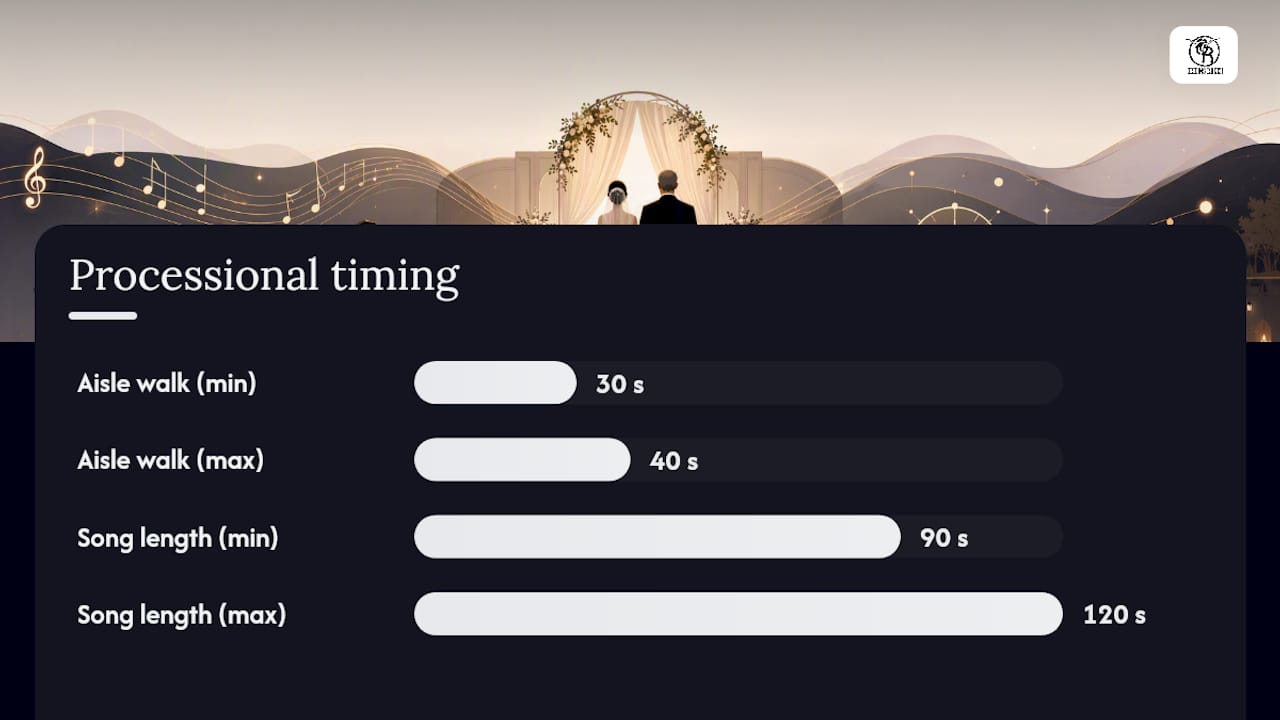
If your aisle is short, under 20 seconds, don't just pick a song and hope. Start the track at the chorus or loop a short instrumental phrase so the emotional peak lands exactly when you reach the altar, not thirty seconds after. Many couples make the mistake of choosing a song for its chorus alone; listen to the full arrangement and mark the exact start time in minutes and seconds so your DJ or musician can cue it precisely.
Curated processional picks:
- "Canon in D" (Pachelbel, classical)
- "A Thousand Years" (Christina Perri, piano version)
- "Marry Me" (Train, string arrangement)
- "Here Comes the Sun" (Beatles, instrumental cover)
- "The Luckiest" (Ben Folds, piano)
- "All of Me" (John Legend, orchestral version)
- "Songbird" (Fleetwood Mac, acoustic)
Instrumental covers of contemporary songs often read as more formal for a processional than the original vocal track, which is worth remembering if your ceremony leans traditional.
What Music Fits The Unity Ceremony Or Signing?
Unity rituals and marriage license signings run unpredictably. A candle lighting might take 90 seconds; a hand fasting or sand ceremony could stretch past five minutes depending on how many family members are involved.
Because you can't time this window precisely, prepare 2 to 3 background tracks rather than one song you hope lasts long enough. Instrumental or wordless music works best here, since lyrics compete with the officiant's words and can feel distracting during a quiet, reflective moment.
Set your playback to crossfade or loop automatically between tracks so there's never a silent gap while everyone waits for the next song to start.
Suggested tracks for unity or signing moments:
- "River Flows in You" (Yiruma)
- "Clair de Lune" (Debussy)
- "A Moment Apart" (ODESZA, instrumental)
- "Weightless" (Marconi Union)
- "Breathe Me" (Sia, piano instrumental)
What Songs Work For The Recessional And Exit?
The recessional is the opposite job of the processional: instead of building tension, it releases it. This is the one moment in the entire ceremony where you want the song to start immediately on the first beat, not fade in slowly. A slow build works against the energy you and your guests are feeling the second you're pronounced married.
Pick something upbeat with minimal ambiguity in its opening seconds. Lyrics matter less here since most of the recessional happens with applause and cheering drowning out the first verse anyway.
Once you're through the recessional, transition straight into a 10 to 15 minute postlude playlist so guests have something to move to as they head toward cocktail hour. This is not the moment to leave silence while everyone shuffles outside.
Recessional and postlude picks:
- "Signed, Sealed, Delivered I'm Yours" (Stevie Wonder)
- "Can't Stop the Feeling!" (Justin Timberlake)
- "Uptown Funk" (Bruno Mars)
- "I Wanna Dance with Somebody" (Whitney Houston)
- "Home" (Edward Sharpe & The Magnetic Zeros)
- "Sugar" (Maroon 5)
- "Best Day of My Life" (American Authors)
- "Walking on Sunshine" (Katrina and the Waves)
Should You Hire Live Musicians Or Use A Playlist?
Live musicians and recorded playback solve different problems, and the right answer usually depends on your budget and how much flexibility you need on the day.
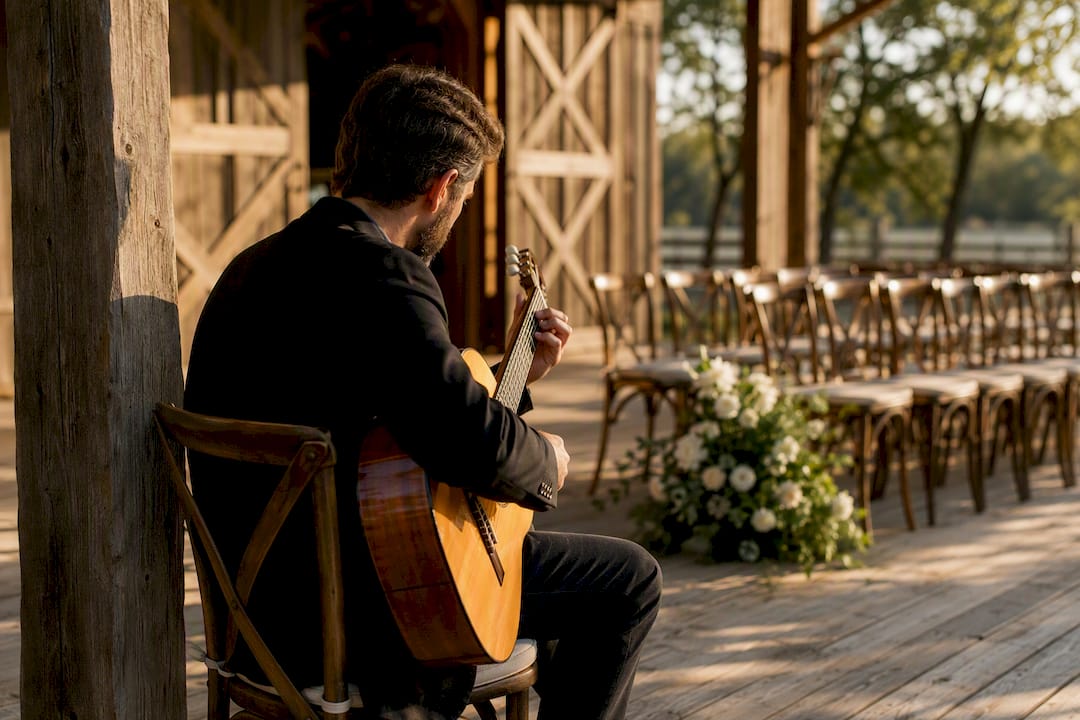
Live music adapts in real time. If your officiant runs long or the wedding party pauses for photos mid-aisle, a musician can extend a phrase or repeat a section without anyone noticing. That responsiveness tends to boost guests' sense of ambiance noticeably, and it's a big part of why string quartets and solo guitarists remain popular for outdoor and barn ceremonies. Expect to pay somewhere between $500 and $2,500 or more for a ceremony ensemble, depending on group size and your market.
Recorded playback costs far less and gives you complete control over the exact song, version, and edit you want. It's the practical choice for couples working with a tighter budget, and modern playback setups run reliably enough that the old fear of a laptop freezing mid-processional rarely comes into play anymore.
A hybrid approach often gets you the best of both: hire a musician for the main processional, where timing flexibility matters most, and lean on a curated playlist for the prelude and postlude, where a set track order works fine.
Quick decision checklist:
- Is your budget under $1,000 for ceremony music specifically? Lean recorded.
- Do you want a musician who can react if the ceremony runs long? Lean live.
- Is your venue outdoors with unpredictable acoustics? Live instruments often carry better.
- Want emotional impact at the altar without full ensemble cost? Consider a hybrid.
Pro Tip: Book one live musician for just the main processional and recessional, then use a professional playlist for everything else. It costs a fraction of a full ensemble and still gives you that live moment when it matters most.
How Do You Choose The Right Ceremony Songs?
Picking songs is only half the job. The other half is making sure they work logistically, which means checking lyrics, timing, and any restrictions your officiant or venue might have before you fall in love with a track.
Run every candidate through this checklist:
- Read the full lyrics, not just the chorus. A gorgeous melody can carry surprisingly dark or inappropriate lyrics once you actually listen closely.
- Match song length to your actual walking distance, using the aisle timing math above rather than guessing.
- Prepare a backup track for every moment in case a musician can't learn a piece in time or a song gets pulled from a streaming platform.
- Build a short do-not-play list alongside your must-play list, especially if a DJ or band is also handling your reception.
- Confirm any denomination or venue specific restrictions with your officiant. Some religious ceremonies restrict secular music during specific rituals, so ask early rather than assume.
Once your picks are set, hand your DJ or musicians a one-page music brief instead of a loose playlist link. A workable brief includes:
- Moment name (prelude, main processional, recessional, etc.)
- Exact track file name or streaming link
- Start time cue in minutes and seconds
- Fade in or fade out length
- Contact name and phone number for day-of questions
A must-play list of 10 to 20 songs, organized by moment, gives your vendor everything they need without back and forth text threads the morning of your ceremony.
What Sound Setup Avoids Dead Air On The Day?
A soundcheck the morning of your ceremony, or the evening before if your venue allows it, catches problems while you still have time to fix them. Include your DJ or musicians, a venue contact who knows the space's power outlets and acoustics, and one person from your wedding party who can relay last minute changes.
Set your playback software to crossfade between tracks automatically, and export your prelude and postlude playlists offline rather than relying on streaming, since barn and outdoor venues often have spotty cell signal. For outdoor or barn ceremonies, place microphones and speakers away from open sides where wind can distort sound, and always test at guest seated height, not standing height, since sound travels differently once chairs fill in.
- Confirm soundcheck attendees and time the morning of
- Export offline playlists; don't depend on live-streaming
- Set crossfade or auto loop for uncertain length moments
- Test mic and speaker placement at seated ear height
Pro Tip: Walk the ceremony space during soundcheck exactly where your seated guests will be, not from the front row. Sound that's perfect near the altar can be muddy or too quiet in the back rows.
What Tools Help You Build A Ceremony Playlist?
Apple Music and Spotify both let you build moment specific playlists, but export them offline before the ceremony rather than trusting venue wifi. Trimming tools built into most playback apps let you cut a song's intro or set a custom start point, which matters most for the main processional timing math above.
If you're working with live musicians instead, skip the app entirely and give them a cue sheet with the exact start times and fade lengths from your music brief. For licensing, check with your venue or DJ vendor about who holds a public performance license, since venues and professional DJs typically carry coverage that private playlists don't.
Origins Ranch's Take On Day-Of Music Logistics
Barry, the founder, spent over 20 years running sound as a DJ before the venue ever had its first ceremony, and that background shapes how music is handled day of. Barn venues carry sound differently than a hotel ballroom. High ceilings and open sides mean placement matters as much as volume, which is why we walk musicians and DJs through power access and setup timing well before guests arrive.
We coordinate directly with your musicians or DJ on arrival windows, soundcheck timing, and where equipment plugs in, so your vendors aren't guessing at logistics on the biggest day of your life. That same attention extends to our work with Weddings For Warriors, Barry's charity supporting veterans and active duty service members planning their weddings.
If you want a sense of what a music friendly ceremony setup looks like in a working barn space, our gallery shows real layouts from past events, indoor and out.
How Do Cultural And Religious Traditions Shape Ceremony Music?
Ceremony music carries different weight depending on the tradition you're honoring, and it's worth understanding those expectations before you build your playlist. Catholic Mass ceremonies often require specific liturgical music during communion and may restrict secular songs entirely during certain segments, so confirming with your priest ahead of time saves confusion later.
Jewish ceremonies frequently include traditional pieces like "Erev Shel Shoshanim" or klezmer style music during the processional, alongside the breaking of the glass moment, which sometimes carries its own musical cue. Hindu ceremonies often build music around specific rituals like the saptapadi, with live musicians playing traditional instruments such as the Sheena during key transitions.
Many Protestant and nondenominational ceremonies offer far more flexibility, allowing couples to mix contemporary songs with instrumental classics without restriction. Some officiants, particularly in more conservative denominations, ask that lyrics reference faith explicitly or avoid secular romantic songs during the unity moment specifically.
None of this means you have to choose between tradition and personal taste. Many couples blend a traditional processional piece tied to their faith with a contemporary recessional that reflects their personality as a couple. The key step is asking your officiant directly what's expected rather than assuming your first choice will be approved, since restrictions vary widely even within the same broader faith tradition.
How Can You Personalize Your Ceremony Music?
Your ceremony music doesn't have to sound like every other couple's playlist, and increasingly, it doesn't. Non-traditional song choices tied to a couple's actual relationship, the song from a first date, a line from a favorite film, a track that was playing when you got engaged, carry more emotional weight than a generic classical staple ever could.
The trick to personalizing without sacrificing formality is the arrangement, not necessarily the song choice itself. A pop song with a heavy beat drop might feel out of place walking down the aisle, but a string quartet cover or acoustic instrumental version of that exact same song can feel completely appropriate. This is where hiring live musicians pays off twice: they can often adapt a favorite song into a version that fits the moment's tone.
If you share a specific heritage, language, or family tradition, consider working one meaningful piece into the prelude or postlude rather than the main processional, where formality expectations tend to be higher. A song in a grandparent's native language during the prelude, for example, honors that connection without asking every guest to follow along during your walk down the aisle.
Small details count too. If a song played during your first dance at a previous milestone, or during the moment you got engaged, weaving an instrumental version into your unity ceremony ties your story together without anyone but the two of you fully realizing why that particular piece was chosen.
Do You Need A License To Play Music At Your Ceremony?
Most couples never think about music licensing until someone asks, and the honest answer is that responsibility usually falls on whoever is playing the music publicly, not the couple personally. Restaurants, venues, and professional DJs typically carry blanket licenses through performance rights organizations that cover public playback at events, which is one reason it's worth confirming this directly with your venue or vendor rather than assuming.
If you're hiring a DJ or live musicians, ask them directly whether they carry performance licensing coverage, since most established professionals do as a standard part of running their business. If your venue has its own sound system and in-house coordination, ask the same question there.
The bigger practical risk for most couples isn't legal, it's technical: streaming a personal playlist through a phone or laptop at a venue with weak wifi can cut out mid-song if the app tries to buffer live rather than play offline. That's a far more common ceremony day problem than any licensing issue, and it's solved simply by exporting your playlists offline ahead of time, as covered in the tech tips above.
Editorial Perspective: What Actually Makes Ceremony Music Work
Most wedding advice treats ceremony music like a taste test. Pick songs you love, the thinking goes, and the ceremony will feel personal. That's backwards. The couples whose ceremonies flow best aren't the ones with the most unique song choices; they're the ones who solved the timing math first and let personality fill in around it.
The conventional advice oversells song selection and undersells execution. A gorgeous processional song that runs 40 seconds too long, leaving you standing at the altar in silence, does more damage to the moment than a slightly generic song that's timed perfectly. Get the aisle math right before you fall in love with a track.
The second gap is trust in live musicians. Couples often assume live music is a luxury reserved for bigger budgets, when a single musician for just the processional and recessional often costs less than expected and solves the one problem a playlist can't: real time flexibility when the ceremony doesn't run exactly on schedule. Start there, not with the full playlist, and the rest of the day's music tends to fall into place with far less stress.
— Origins
Let Origins Ranch Handle The Space, You Handle The Soundtrack
The venue offers both indoor and outdoor ceremony spaces on the same property, so you're never locked into one acoustic setup if weather or timing changes your plans on the day. The team has coordinated with musicians and DJs for many ceremonies, from string quartets under the oaks to playlists inside a climate controlled barn, which means your vendors get a venue contact familiar with sound placement and timing, not one learning it for the first time.
Barry's background running sound for over two decades shows up in the little things: where we suggest speaker placement, how we time vendor arrival windows, and how we brief musicians on our specific layout before your guests ever sit down. Couples planning military weddings also work with us through Weddings For Warriors, Barry's charity supporting veterans and active service members.
If you're picturing your processional walk against a real barn backdrop, browse our 2025 and 2026 wedding gallery or reach out to check availability for your date.
Sources
- Wedding Ceremony Music: 80+ Song Ideas for Every Moment (Processional to Recessional) - Paperlust
- How to Choose Wedding Music: A Complete Guide - The Evore
- The Best Wedding Ceremony Songs for 2026 | Wedding Player
- How to Build the Perfect Wedding Playlist: A Genre-by-Genre Guide | Plan A Wedding
- Unique songs for a non-traditional walk down the aisle | Inside Weddings
FAQ
What Are Good Ceremony Songs?
Good ceremony songs match the moment's purpose: calm instrumentals for the prelude, an emotionally building piece timed to 90 to 120 seconds for the main processional, and an immediate, upbeat track for the recessional.
What Are Some Good Music Ideas For A Wedding Ceremony?
Build your ideas moment by moment rather than picking favorites first: try "Canon in D" or "River Flows in You" for the prelude, "A Thousand Years" or "Here Comes the Sun" for the processional, and "Can't Stop the Feeling!" for the recessional.
What Are The Top Songs For A Wedding Ceremony?
There's no single universal top ten since the right song depends on the moment, but "Canon in D," "A Thousand Years," "Here Comes the Sun," and "Signed, Sealed, Delivered" appear consistently across processional and recessional lists.
What Is The Best Celebration Song For A Recessional?
The best recessional song starts on the first beat with no slow build, since you want energy immediately after being pronounced married; upbeat tracks like "Uptown Funk" or "Walking on Sunshine" work well for this reason.
Should We Hire Live Musicians Or Use A Playlist?
Hire live musicians if you want real-time flexibility during an unpredictable ceremony, budgeting $500 to $2,500 or more; use a recorded playlist if budget matters more than adaptability, or blend both in a hybrid setup for your processional versus prelude and postlude.