
The industry standard formula is simple: plan for 1 drink per guest during the first hour of your reception, then 0.5 to 1 drink per guest for every hour after that. For a typical 4 to 5 hour reception with moderate drinkers, that works out to roughly 4 to 6 drinks per guest. At 50 guests, you're looking at roughly twice the number of drinks as guests, and at 100 guests, proportionally more.
TL;DR:
- A typical 4-5 hour wedding reception requires approximately 4 to 6 drinks per guest, with the total scaling proportionally for larger guest counts.
- Adjustments for lively or reserved audiences involve multiplying totals by 1.4 or 0.7, respectively, to better match actual drinking behavior.
- Converting total drinks into bottles requires dividing wine by five, spirits by fifteen, and awarding roughly 7 bottles of champagne for every 100 guests for toasts.
- Staffing recommendations suggest one bartender per 50 to 75 guests depending on the bar style, with additional staff needed for full open bars or larger groups.
- Planning should include a 15% buffer, careful venue delivery timing, and storage considerations to avoid shortages or spoilage during the event.
Table of Contents
- How Much Alcohol for a Wedding: A Quick-Reference Calculator
- What Bar Style Fits Your Wedding?
- How Do You Convert Drink Totals Into Bottles and Cases?
- How Many Bartenders Do You Need for a Wedding?
- What Else Do You Need Beyond the Bottles?
- What Should You Budget for Wedding Alcohol?
- What a Venue Operator Wants You to Know About Bar Planning
- Should You Adjust Alcohol Quantities for a Longer or Shorter Reception?
- What Should You Do With Leftover Wedding Alcohol?
- How Do You Account for Different Types of Wedding Guests?
- Why the Standard Formula Isn't the Whole Answer
- How Origins Ranch Helps You Plan the Bar for Your Big Day
- Where These Numbers Come From
- Sources
- FAQ
How Much Alcohol for a Wedding: A Quick-Reference Calculator
Once you know your guest count, the math scales in a straight line. Here's what the drinks-per-guest formula produces for common reception sizes, assuming a 4 to 5 hour party with a moderate crowd and a standard beer, wine, and spirits split.
| Guests | Total Drinks (4–5 hrs) | Wine Bottles | Beer (Bottles/Cans) | Spirits (750ml) | Champagne (Toast Bottles) |
|---|---|---|---|---|---|
| 50 | 200 | 20–25 | 60–75 | 3–4 | 7–8 |
| 75 | 300 | 30–38 | 90 | 5–6 | 10–13 |
| 100 | 400–500 | 40–50 | 120–150 | 7–8 | 13–17 |
| 150 | 600 | 60–75 | 180 | 10 | 20 |
| 200 | 800 | 80 | 240 | 14 | 25 |
Those figures already assume a mixed bar with wine carrying roughly 40% of consumption, beer 40%, and spirits 20%, which lines up with how a wine-only bar for 100 guests can run 50 to 60 bottles while a mixed bar drops closer to 24 to 38 wine bottles once beer and liquor absorb the rest of the demand.
Two adjustments matter before you place any order:
- Add a 15% buffer to every category. Planners consistently recommend this cushion because running dry at hour three is a much bigger problem than having three extra bottles of Cabernet.
- Round up to full cases, rather than buying partial cases, since stores typically sell full cases and some venues allow returns of unopened cases.
If your crowd runs livelier than average, multiply everything by roughly 1.4. If it's a quieter, older, or more reserved group, multiply by about 0.7 instead — a scaling approach wedding alcohol calculators build in for exactly this reason.
What Bar Style Fits Your Wedding?
The bar style you choose changes every number above, so pick this before you touch a spreadsheet.
- Beer and wine only. The most budget-friendly option and the easiest to staff. Works well for daytime or brunch weddings, or couples who simply don't want a full liquor tab.
- Modified full bar. Beer, wine, and a short list of 3 to 4 spirits (usually vodka, whiskey, tequila, rum). This is the most common choice for evening receptions.
- Full open bar. Every spirit, every mixer, a real cocktail menu. Guests drink more and expect more variety, so your totals climb accordingly.
- Signature cocktail bar. One or two house drinks plus beer and wine. Cuts liquor variety, speeds up service, and gives your reception a personal touch.
A beer-heavy crowd (think outdoor, casual, daytime) shifts to 50/30/20. A wine-heavy group, common at elegant evening affairs, runs closer to 25/55/20. A cocktail-forward wedding with a full open bar often flips to 30/30/40.
Season and time of day matter too. Summer afternoon weddings lean toward lighter wine, rosé, and beer; winter evening events pull more toward spirits and full-bodied red.
Pro Tip: A signature cocktail served only during cocktail hour cuts one hour of the main-bar drinking window, so subtract that hour before running your formula and calculate the cocktail hour separately — otherwise you'll double-count and over-order.
How Do You Convert Drink Totals Into Bottles and Cases?
Once you have a total drink count, converting it into a shopping list comes down to standard pour sizes.
- Wine: A 750ml bottle pours about five 5-ounce glasses. Divide your total wine drinks by 5 to get bottle count.
- Beer: One bottle or can equals one drink, so your beer drink total is your beer purchase count directly.
- Spirits: A 750ml bottle makes roughly 15 mixed drinks at a standard 1.5-ounce pour, according to A Practical Wedding's guidance. Divide spirit drinks by 15.
- Champagne toast: Pour 4 to 5 ounces per toast, which nets about 6 to 8 servings per 750ml bottle. Divide your guest count by 7 for a single toast round.
The champagne toast needs 100 guests ÷ 7 ≈ 15 bottles.
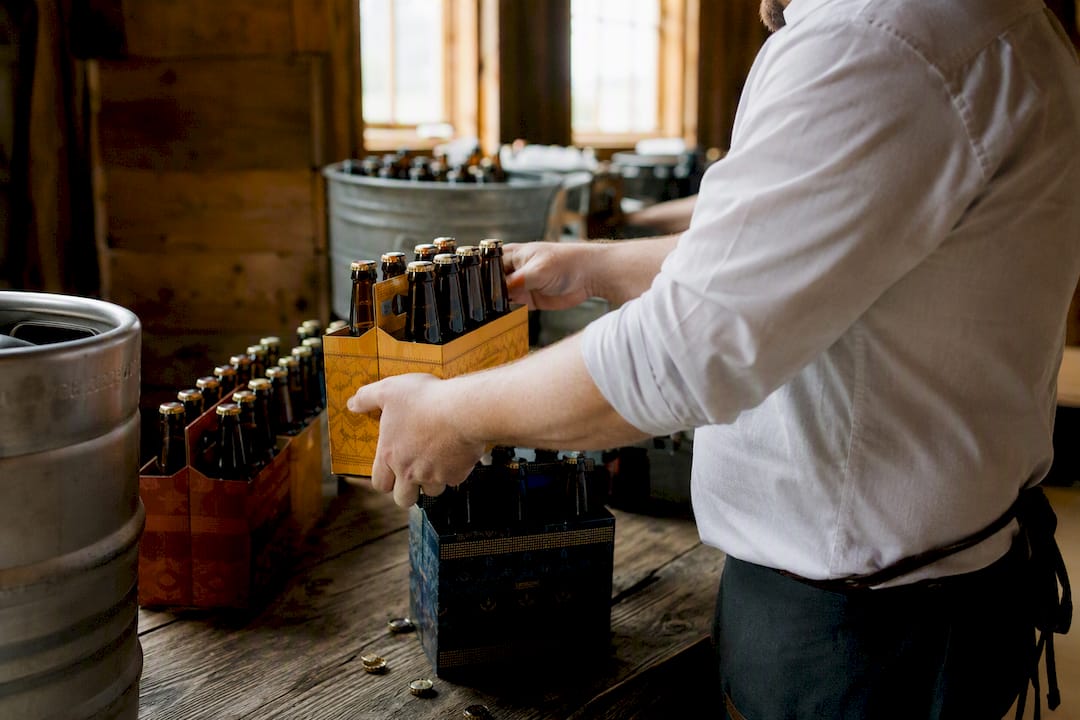
For beer specifically, bottled or canned six-packs simplify storage and let you return unopened cases at many retailers, while kegs only pay off for very beer-forward crowds of 150-plus, since half a keg going flat in the cooler is a real cost if your crowd skews toward wine and cocktails instead.
How Many Bartenders Do You Need for a Wedding?
Understaffing your bar is the single fastest way to turn a great reception into a line-management headache. The general ratio is 1 bartender per 75 guests for beer and wine service, tightening to 1 per 50 guests for a full cocktail bar, since mixed drinks take longer to build than a poured glass of Chardonnay.
- 150 guests, beer and wine: 2 bartenders is the standard recommendation.
- 150 guests, full open bar: 3 bartenders plus 1 barback to keep ice, garnishes, and stock replenished.
- 50 to 75 guests: 1 bartender usually covers beer and wine; add a second for a full bar.
- 200-plus guests: Two service stations often beat one long bar, cutting wait times in half.
A barback isn't optional once you cross into full-bar territory. They restock ice and mixers mid-shift so your bartender never leaves the station. Pre-batching your signature cocktails ahead of time also speeds service dramatically. One experienced bartender added early in your planning often reduces wait times enough to pay for itself in guest satisfaction alone.
What Else Do You Need Beyond the Bottles?
Ice gets forgotten more than any other bar item, and it's the fastest way to run a bar dry even when you bought plenty of alcohol. Plan for 1 to 1.5 pounds of ice per guest, covering both chilling bins and individual cocktail pours.
- Mixers: tonic, soda, juice, and simple syrup in quantities that match your spirits total, not your guest count.
- Garnishes: citrus, olives, herbs, enough for double what seems reasonable, since bartenders go through them fast.
- Glassware: rent rather than buy unless your venue supplies it, and always order 10% more than your guest count for breakage and double-pours.
- Storage and cleanup: a designated cool area for stock and a plan for empties before the night ends.
Pro Tip: *Confirm your venue's alcohol policy and your supplier's return policy before you buy a single case.
What Should You Budget for Wedding Alcohol?
Costs swing hard depending on how you source and serve. A DIY beer-and-wine bar for 100 guests typically runs in the low-to-mid hundreds per guest count bracket once you factor in ice, mixers, and rentals, while a DIY full bar with spirits pushes higher. A venue-run open bar package, priced per guest, usually lands at the top of the range since it bundles labor, glassware, and liability into one line item.
A few moves stretch your budget without shorting your guests:
- Choose a quality sparkling wine instead of Champagne for toasts; the price difference is significant and most guests can't tell mid-reception.
- Buy by the case rather than individual bottles, since case discounts at most retailers run 10 to 15%.
- Build a signature cocktail menu instead of a full liquor spread. Fewer bottles, faster pours, lower total spend.
- Confirm your return policy up front so unopened cases become refunds instead of leftovers gathering dust.
What a Venue Operator Wants You to Know About Bar Planning
At an outdoor or barn venue, heat and timing matter more than most couples expect. We recommend scheduling your alcohol delivery as late in the day as your supplier allows and storing cases in a cool, shaded spot until service starts, which protects both wine and beer from temperature swings that dull flavor and shorten shelf life.
Barry's rule after two decades running events: watch the dance floor, not the bar line. A packed floor with a short bar line means you're in good shape. A long line with an empty floor means it's time to open a second pour station or send out a round of pre-batched drinks.
- Coordinate delivery timing with your caterer so both trucks aren't fighting for the same loading window.
- Match your bar placement to your reception layout so guest traffic doesn't bottleneck.
- Review guest flow patterns before finalizing bar placement, since where people naturally gather changes how fast a bar empties.
Should You Adjust Alcohol Quantities for a Longer or Shorter Reception?
Duration changes your math beyond just multiplying the drinking-rate formula. A 3-hour reception with a tight timeline of dinner, toasts, and cake cutting leaves less actual drinking time than the clock suggests, since guests are often seated or distracted for 45 minutes to an hour of it. A 6-hour reception with an open dance floor and no formal program breaks tends to push consumption higher than a flat hourly formula predicts, because guests keep grabbing drinks between songs.
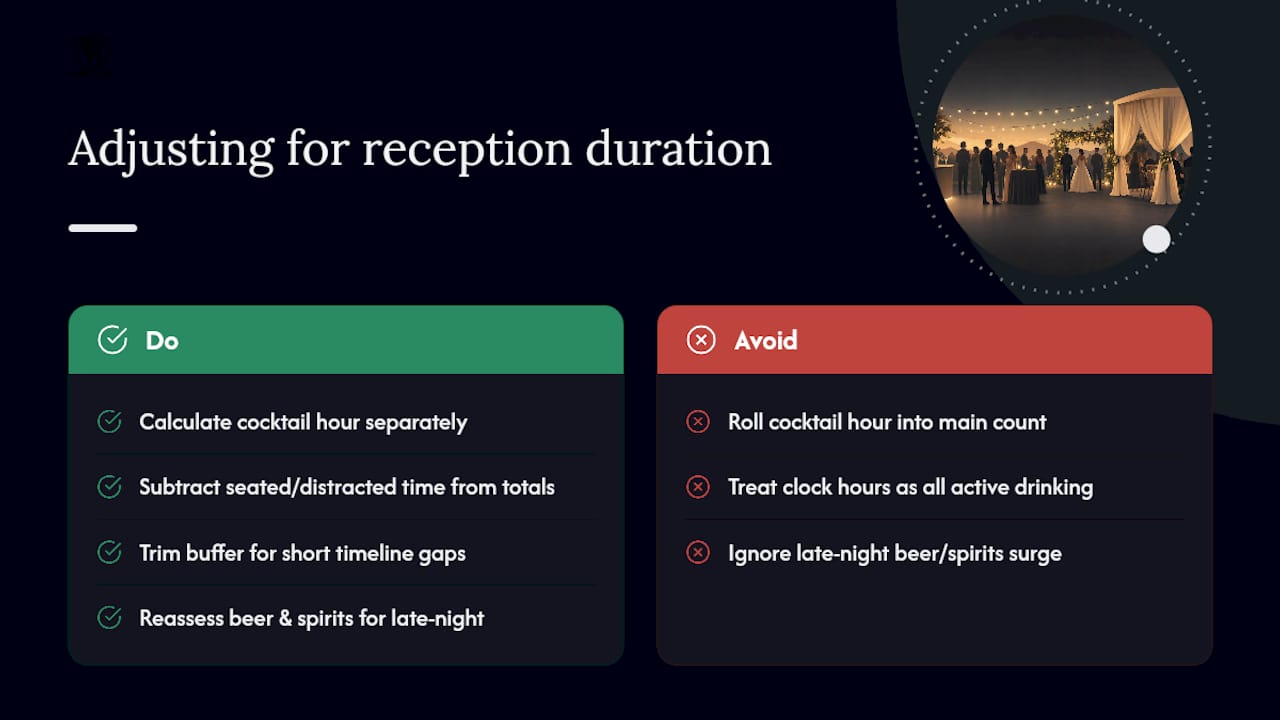
Cocktail hour deserves its own calculation, not a rollover into your main reception numbers. If guests get an hour of passed drinks before dinner, that's a full hour of the "first hour" rate applied separately, and your dinner-through-dance-floor block starts its own count at the lower 0.5 to 1 per hour rate.
Timeline gaps matter just as much as total hours. A reception with a long dinner service, an extended toast sequence, or a break for photos effectively pauses drinking demand, even though the clock keeps running. If your timeline includes a 30-minute lull for speeches, you can trim your buffer slightly rather than treating it as active drinking time.
Late-night receptions that run past the typical 5-hour window need a second look at your spirits and beer numbers specifically, since wine consumption tends to plateau while beer and mixed drinks often see a second wave once dancing kicks in. Build your shopping list around your actual minute-by-minute schedule, not just a flat guest-count-times-hours formula, and you'll avoid both a dry bar at hour four and a mountain of untouched Chardonnay.
What Should You Do With Leftover Wedding Alcohol?
Unopened bottles are your easiest win: most retailers and distributors will accept returns on full, unopened cases within a set window, so keep every receipt and confirm the policy before you buy, not after.
Opened bottles are trickier. Wine with a resealed cork holds for a few days in a cool spot but degrades fast once air gets in, so plan to use opened reds and whites within the week rather than saving them for a "someday" toast. Beer past the wedding date rarely improves, so factor that into how conservatively you round beer purchases versus wine.
Gifting leftovers to your caterer, planner, or venue staff is a common and appreciated move, though check your venue's policy first since some locations have rules about alcohol leaving the property. Donating unopened cases to a family member hosting a post-wedding gathering is another practical option that keeps good bottles from sitting in a closet for a year.
Never let leftover alcohol go to guests who are driving home that night, no matter how much is left in the bar. And if you're storing bottles for later, keep spirits and unopened wine somewhere temperature-stable. A hot garage or car trunk will ruin a bottle faster than most couples realize.
How Do You Account for Different Types of Wedding Guests?
The drinks-per-guest formula assumes a fairly even split of moderate drinkers, but real guest lists rarely work that way.
Non-drinkers deserve real planning, not an afterthought garnish tray.
Cultural and regional drinking patterns matter too. A wedding with a large contingent from a wine-forward region will burn through your reds and whites faster than the beer. A crowd with a strong beer culture flips that ratio, and you'll want to shift your split templates accordingly rather than defaulting to the standard 40/40/20 moderate mix.
Age skew also affects timing, not just volume. Younger crowds tend to drink steadily through a long dance-floor stretch, while an older guest list often front-loads drinking during cocktail hour and dinner, then tapers off well before the reception ends. Match your staffing and your pour rate to when your specific guests actually drink, not just how much they drink overall.
Why the Standard Formula Isn't the Whole Answer
The 1-drink-first-hour, 0.5-to-1-per-hour-after formula is a genuinely solid starting point, and every credible wedding alcohol calculator builds from it. Where conventional advice falls short is treating that number as the finish line instead of the starting line. A spreadsheet doesn't know your dance floor gets packed at 8:30, that half your guest list flies in from a wine region, or that your venue's loading dock sits in direct afternoon sun.
The real skill in wedding alcohol planning is running the calculator first, then adjusting for the specifics of your actual event: your guest demographics, your timeline gaps, your venue's climate and layout. Couples who treat the formula as gospel tend to either overspend on a buffer that's too generous or run short during exactly the hour their dance floor fills up.
The math gets you close. Local, practical knowledge closes the gap.
— Origins
How Origins Ranch Helps You Plan the Bar for Your Big Day
Origins Ranch is the venue that takes the guesswork out of bar logistics for your wedding day, not just the ceremony backdrop. Our team coordinates with your caterer and bar vendor on delivery timing, provides shaded, climate-controlled storage for your alcohol before service starts, and helps you stage your bar within a reception layout that keeps lines short and the dance floor full.
Whether you're planning a full open bar or a simple beer-and-wine setup, our onsite team has seen enough receptions to help you avoid the two biggest mistakes: under-ordering for your actual crowd and putting your bar in the wrong spot for your guest flow. And if you're a veteran or active-duty service member, our founder's charity, Weddings For Warriors, helps make your dream wedding possible with the same level of personalized attention every couple gets at Origins Ranch.
Ready to see how your bar plan fits into our space? Reach out and inquire about your date and we'll walk you through storage, staging, and vendor coordination together.
Where These Numbers Come From
The formulas and bottle counts throughout this guide draw from established wedding-industry calculators and expert guidance, including the LA Times' alcohol planning breakdown, A Practical Wedding's alcohol calculator, WeddingNotepad's calculator with party-style multipliers, and Bella Grace Vineyards' wine-specific reference. Plug your exact guest count, hours, and bar style into any of these tools for numbers tailored to your reception.
Sources
- How much alcohol do you need for a wedding? (LA Times)
- Wedding alcohol calculator + guidance (A Practical Wedding)
- Wedding Alcohol Calculator (WeddingNotepad)
- How much ice you need for a busy event (ChefsDeal)
- Wedding wine calculator and quick reference (Bella Grace Vineyards)
FAQ
How much alcohol do you need for 100 guests at a wedding?
For a 4 to 5 hour reception with moderate drinkers, plan for roughly 400 to 500 total drinks, which breaks down to about 40 to 50 bottles of wine, 120 to 150 beers, 7 to 8 bottles of spirits, and 13 to 17 bottles of champagne for toasting.
How much should you spend on alcohol for a wedding?
Costs vary widely by bar style and guest count, but a DIY beer-and-wine bar runs cheaper than a full open bar, and choosing sparkling wine over Champagne, buying by the case, and building a signature cocktail menu are the most effective ways to control the total.
What is the 2-2-2 rule for wedding alcohol?
There's no single agreed-upon definition of a "2-2-2 rule" in wedding alcohol planning; the more reliable and widely used standard is the 1-drink-first-hour, then 0.5-to-1-drink-per-hour formula covered throughout this guide.