
TL;DR:
- Effective wedding vendor coordination relies on a centralized registry, a reverse setup timeline, and staged confirmations to prevent last-minute chaos. Assigning one point of contact and using clear communication protocols ensures vendors stay informed and issues are resolved efficiently. Proper planning and early preparation result in a smooth, well-organized wedding day with minimal stress.
Wedding vendor coordination is the practice of managing timelines, communication, payments, and logistics across every professional you hire for your wedding day. Done well, it prevents the chaos that derails even the most carefully planned celebrations. The secret is not having more vendors. It is having better systems. A centralized vendor registry paired with a reverse setup timeline gives you a single source of truth every vendor works from. This guide walks you through how to coordinate wedding vendors using the same tools and protocols professional planners rely on.
What tools and systems do you need to coordinate wedding vendors?
The foundation of vendor management for events is a centralized registry. This is a single document, usually a spreadsheet, that captures every vendor's contact information, contract status, payment milestones, and notes. Without it, critical details live in your email inbox, your partner's texts, and a stack of paper contracts. That scattered approach is how things fall through the cracks.

A vendor registry and reverse timeline work together as your coordination backbone. The reverse timeline starts from your ceremony time and works backward, assigning each vendor a specific arrival and setup window. Your florist might arrive at 10:00 a.m., your caterer at 11:00 a.m., and your DJ at noon. Each window is based on how long that vendor needs to be ready before guests arrive.
Your wedding vendor coordination checklist should also include a multi-wave confirmation protocol. Reach out to every vendor at three checkpoints: 30 days out, 7 days out, and 48 hours before the wedding. Each wave has a specific purpose.
- 30 days out: Reconfirm date, time, venue address, and scope of services
- 7 days out: Confirm operational details like parking, load-in access, and contact names
- 48 hours out: Send a short confirmation request and escalate with a phone call if no response comes within 24 hours
A vendor packet sent 7–10 days before the wedding ties everything together. This PDF document includes a contact sheet, a logistics page, and a cue-based run of show. Every vendor gets the same packet, so no one is working from incomplete information.
Pro Tip: Build your vendor registry in Google Sheets from day one. It is free, shareable, and lets you update payment status or contact details in real time without emailing a new file to yourself every week.
Here is a quick look at the core tools and what each one does:
| Tool | Primary Purpose |
|---|---|
| Vendor registry spreadsheet | Tracks contacts, contracts, and payment status |
| Reverse setup timeline | Assigns arrival windows based on ceremony start |
| Multi-wave confirmation protocol | Reduces no-shows and last-minute surprises |
| Vendor packet (PDF) | Gives every vendor a complete logistics brief |
| Financial tracking spreadsheet | Monitors deposits, balances, and due dates |
How do you build a wedding day timeline all vendors will follow?
A working wedding timeline is not just a schedule. It is a coordination contract between you and every vendor on your list. Start building it at least six weeks before your wedding, and pull in input from your key vendors early. Your photographer knows how long family portraits take. Your caterer knows when food needs to leave the kitchen. Their input prevents the timeline from being unrealistic on paper.
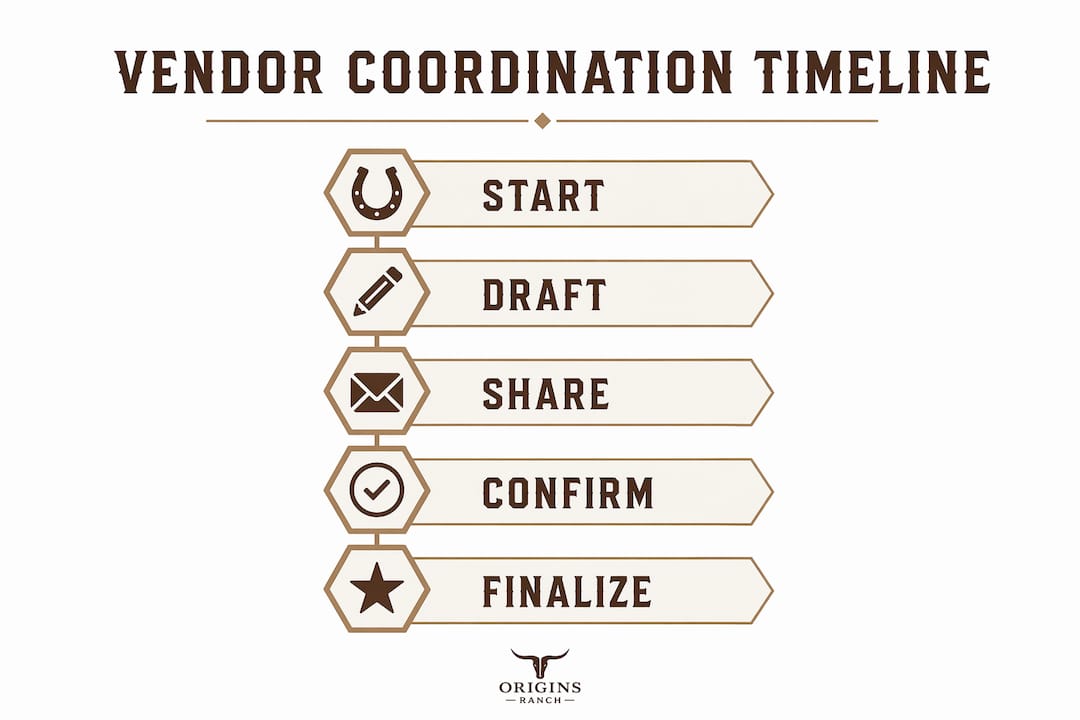
Share a draft with vendors 3–4 weeks before the wedding and send the final version 10 days prior. Use Google Sheets or a shared PDF so vendors can access the most current version without hunting through old emails. Lock the timeline 48 hours before the wedding and require explicit confirmations from every vendor at that point and again the morning of the event.
Here is a practical sequence for building your timeline:
- Set your ceremony start time as the anchor point
- Work backward to assign vendor arrival and setup windows
- Add buffer time between major transitions (cocktail hour to reception, dinner to dancing)
- Share the draft with vendors and collect their feedback
- Finalize the timeline and distribute the vendor packet 10 days out
- Collect 48-hour confirmations and resolve any conflicts before the wedding morning
One insight that separates good timelines from great ones: separate the timeline from management instructions. The timeline tells vendors what happens and when. A separate run of show document tells your point of contact who calls whom, what to do if something runs late, and how to handle transitions. Vendors follow the timeline. Your coordinator works from the run of show.
Pro Tip: Add 15-minute buffers after every major transition in your timeline. Ceremonies run long. Toasts run long. Dinner service runs long. Buffers absorb those delays without pushing your entire evening off schedule.
| Timeline Milestone | Recommended Timing |
|---|---|
| Begin building timeline | 6+ weeks before wedding |
| Share draft with vendors | 3–4 weeks before wedding |
| Distribute final vendor packet | 10 days before wedding |
| Lock timeline, collect confirmations | 48 hours before wedding |
| Morning-of confirmation check | Day of wedding |
What communication strategies prevent vendor confusion?
The single biggest communication mistake couples make is becoming the central contact for every vendor question on the wedding day. You will be getting dressed, taking photos, and greeting family. You cannot also be fielding calls about where the cake table goes. Assigning one point of contact for all day-of vendor questions is not optional. It is the difference between a calm wedding morning and a stressful one.
That point person is often a wedding planner, a venue coordinator, or a trusted friend who is not in the wedding party. Every vendor should have this person's name and phone number before the wedding day. Your vendor packet should make this crystal clear.
A vendor communication map takes this one step further. This document specifies who contacts whom for specific types of issues:
- Timing questions: Contact the day-of coordinator
- Venue access or setup issues: Contact the venue coordinator
- Contract or payment disputes: Contact the couple's designated representative (not the couple directly)
- Emergency situations: Follow the escalation protocol in the vendor packet
"Couples should avoid being the point of contact on the wedding day. Coordinating vendors through a dedicated contact reduces delays and conflicting answers." — Loving Rocks vendor coordination guide
Group texts work for general announcements, but never use them for contract changes or specific instructions. Those communications need to be written, individual, and confirmed. If a vendor does not respond to a confirmation wave within 24 hours, escalate to a phone call. Document the outcome in your vendor registry. This paper trail matters if a dispute arises later.
One underrated tool is a "Do Not Ask the Couple" list. Share it with your point of contact and your venue coordinator. It lists every question vendors are likely to ask and who should answer it instead. Your florist does not need to interrupt your first look to ask where the centerpieces go.
How do you handle payments, contracts, and last-minute changes?
Tracking vendor payments in a structured spreadsheet is the most practical financial habit you can build during wedding planning. Your spreadsheet should include the vendor name, category, deposit amount, deposit due date, final balance, final payment due date, contract signing status, and a notes column. Review it weekly in the months leading up to your wedding.
Missed deposits and late final payments create real booking risks. Some vendors will release your date if payment is not received by the contract deadline. Others will show up without the agreed services because the scope was never confirmed in writing. Both situations are avoidable with a clear payment tracking system.
Here is what to include in your vendor payment tracker:
- Vendor name and category (photographer, caterer, DJ, florist, etc.)
- Deposit amount and date paid
- Final balance and due date
- Contract signed (yes or no)
- Notes on any scope changes or special requests
Backup plans for critical vendor categories should be prepared before you need them. Think by category, not by individual vendor. If your DJ cancels two days before the wedding, you need a list of available DJs in your area, not a plan built around one specific person. Categories that need backup plans include hair and makeup, DJ or live music, transportation, officiant, and catering.
Pro Tip: During your 7-day confirmation wave, ask each vendor to reconfirm the exact scope of services in writing. A quick reply email works. This catches misunderstandings about add-ons, hours, or deliverables before they become day-of surprises.
Activate your backup plan during the confirmation waves, not on the morning of the wedding. If a vendor does not confirm at the 7-day mark and does not respond to your escalation call, start reaching out to your category backup immediately. Waiting until the day before is too late for most critical services.
Key takeaways
Coordinating wedding vendors successfully requires a centralized registry, a reverse setup timeline, staged confirmation protocols, and a single day-of point of contact working from a clear communication map.
| Point | Details |
|---|---|
| Build a vendor registry early | Track contacts, contracts, and payments in one shared document from the start. |
| Use a reverse setup timeline | Assign vendor arrival windows by working backward from your ceremony start time. |
| Confirm vendors in three waves | Reach out at 30 days, 7 days, and 48 hours to catch issues before the wedding day. |
| Assign one day-of contact | Keep vendors away from the couple by designating a single point person for all questions. |
| Prepare category-level backups | Identify backup vendors by service type so you can act fast if a cancellation happens. |
What we have learned after years of hosting weddings
After more than two decades in the event industry, I can tell you the couples who enjoy their wedding day the most are the ones who did the hard coordination work weeks before. The ones who struggle are almost always the ones who skipped the confirmation waves or never assigned a clear point of contact.
The shift to shared digital timelines changed everything. Emailing a PDF to twelve vendors and hoping everyone has the latest version is a recipe for confusion. A shared Google Sheet that updates in real time means every vendor is working from the same plan, always. That one change alone cuts the number of day-of questions dramatically.
The other thing I see couples underestimate is how seriously vendors take the point of contact role. When you tell a photographer or a caterer "call Sarah for anything on the day," they need to know Sarah has the authority to make decisions. Brief your point of contact thoroughly. Give them the run of show, the vendor packet, and the power to solve small problems without checking with you first. That is what lets you actually be present on your wedding day.
Investing a few focused hours in your wedding planning checklist and coordination systems six weeks out pays back tenfold in calm on the day itself. The magic of a great wedding is not luck. It is preparation that becomes invisible.
— Origins
How Originsranch supports your vendor coordination
At Originsranch, we have seen firsthand how the right venue partnership makes vendor coordination far less stressful. Our team in Plant City, FL has worked alongside photographers, caterers, florists, DJs, and more to bring hundreds of weddings to life in our barn venue. We know how vendors move, what they need, and how to keep everyone on schedule.

Our venue coordinators help you build your reverse timeline, manage vendor arrivals, and serve as the day-of point of contact so you never have to answer a logistics question on your wedding morning. Browse our wedding gallery to see how beautifully coordinated events come together at Originsranch. If you are a veteran or active duty service member, explore our Weddings For Warriors program. We would love to help you plan the day you deserve.
FAQ
What is a vendor registry for weddings?
A vendor registry is a centralized document, usually a spreadsheet, that tracks every vendor's contact information, contract status, payment milestones, and notes. It serves as the single source of truth for all coordination decisions.
How many times should you confirm wedding vendors?
Confirm vendors three times: at 30 days, 7 days, and 48 hours before the wedding. If a vendor does not respond to the 48-hour confirmation within 24 hours, escalate with a direct phone call.
Who should be the day-of point of contact for vendors?
A wedding planner, venue coordinator, or trusted individual who is not in the wedding party should handle all vendor questions on the day. The couple should not be reachable for logistics.
When should you start building your wedding vendor timeline?
Start building your vendor timeline at least six weeks before the wedding, share a draft with vendors 3–4 weeks out, and distribute the final version 10 days prior.
What vendors need a backup plan?
Prepare category-level backups for hair and makeup, DJ or live music, transportation, officiant, and catering. These are the services most difficult to replace on short notice if a cancellation occurs during confirmation waves.