
A rehearsal dinner is an intimate, invite-only event for the wedding party, immediate family, and officiant, usually held the night before the wedding right after the ceremony rehearsal. A welcome party is a broader, informal gathering that opens the wedding weekend to every guest, often the same night or the night before. One tightens family bonds and rehearsal logistics; the other builds warmth across a whole crowd of arriving guests.
TL;DR:
- Rehearsal dinners are small, formal events focused on thanking close participants and usually host 10 to 25 guests, typically after the rehearsal.
- Welcome parties are larger, casual gatherings designed to help out-of-town guests meet and often include dozens to hundreds of attendees.
- Booking both events at the same venue requires careful planning of setup, staffing, and noise rules to avoid logistical issues on back-to-back nights.
- For local weddings with a small guest list, a rehearsal dinner suffices, while destination or travel-heavy weddings generally benefit from adding a welcome party.
- Budget constraints and guest dynamics often lead couples to skip traditional events, replacing them with simpler gatherings or combining functions into one casual celebration.
Table of Contents
- Rehearsal Dinner vs Welcome Party: The Core Difference
- What a Rehearsal Dinner Actually Involves
- What a Welcome Party Actually Involves
- Key Differences at a Glance
- Which One Should You Host?
- Your Planning Checklist for Either Event
- What a Barn Venue Sees When Couples Book Both Events
- Our Take: Pick the Rhythm, Not Just the Event
- Host Both Events Without the Logistics Headache
- Sources
- FAQ
Rehearsal Dinner vs Welcome Party: The Core Difference
A rehearsal dinner exists to feed and thank the people who just walked through your ceremony choreography. It follows the rehearsal itself and traditionally gathers the wedding party, immediate family, and the officiant in a private room, home, or club close to the ceremony site, according to Emily Post. A welcome party serves a completely different job: it is the icebreaker that lets forty, eighty, or two hundred arriving guests meet each other before the main event, often with a looser format and local flavor, as planners quoted by Vogue point out.
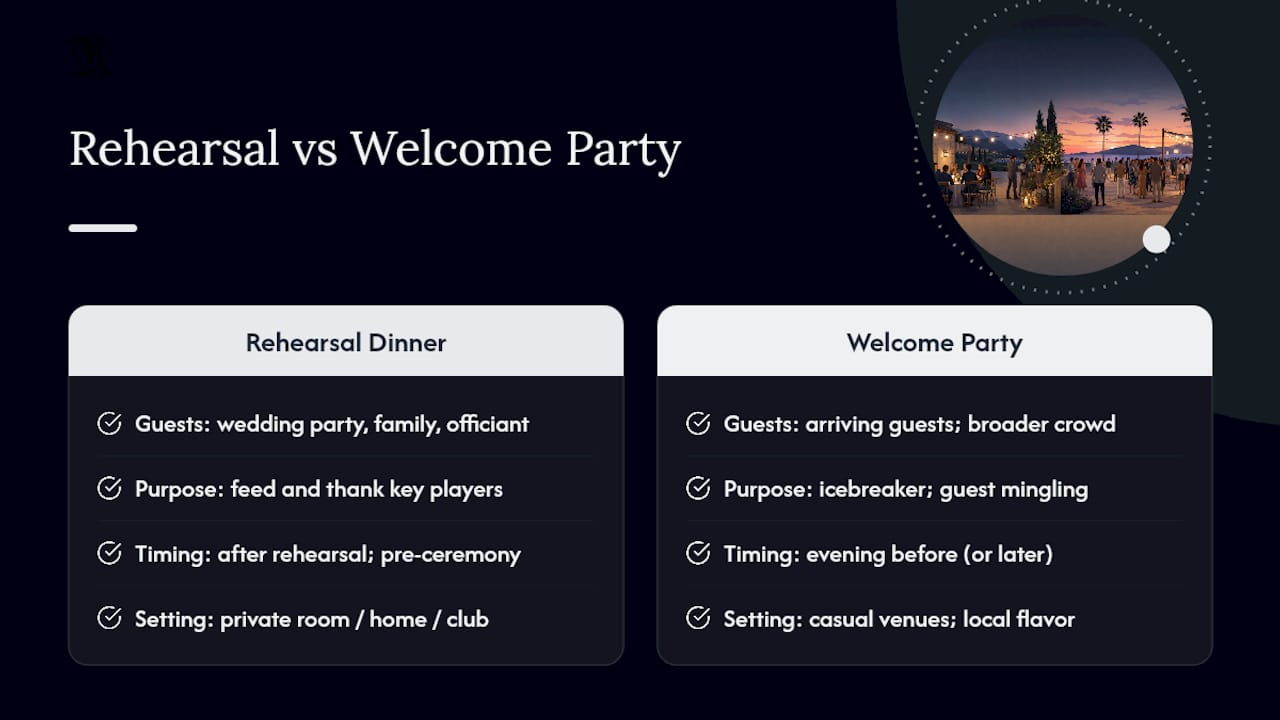
Timing usually separates the two. Couples with a smaller guest list often host only the rehearsal dinner. Those with lots of out-of-town travelers, a destination wedding, or a multi-day celebration frequently add a welcome party the evening before, sometimes even the same night as the rehearsal dinner in a later, more casual slot. Some couples skip the rehearsal dinner entirely and fold its handful of toasts into the welcome party instead, especially when budgets or guest counts make two separate events impractical.
What a Rehearsal Dinner Actually Involves
The rehearsal dinner is where the people closest to you get their real thank-you before the wedding day takes over. Traditionally, the groom's family hosts and pays, though that norm has loosened considerably. Couples now split costs with both families, cover it themselves, or ask the wedding party to contribute toward their own seats.
Guest lists start small and stay small on purpose. Brides recommends beginning with the wedding party and immediate family, plus anyone who took part in the rehearsal itself, like the officiant or a musician. Plus-ones and children are optional additions, decided by house rules rather than obligation.
A typical rehearsal dinner includes:
- 10 to 25 guests for an intimate version, though modern couples adjust that range based on family size and out-of-town needs
- A private dining room, family home, or small restaurant space, chosen for warmth over spectacle
- A two-to-three-hour seated or family-style meal
- Formal toasts and speeches, often from parents, siblings, and the wedding party
- A small gift exchange between the couple and their attendants
Pro Tip: Ask your officiant early whether they can attend the rehearsal dinner. Their schedule often fills fast during peak wedding months, and a missed invite reads as an oversight, not a snub.
What a Welcome Party Actually Involves
A welcome party solves a different problem: forty strangers from four different friend groups standing around a hotel lobby with nothing to say to each other. The welcome party gives them a reason to relax, eat, and start recognizing faces before the ceremony.
Guest lists run wide, typically covering every out-of-town guest and often the entire wedding roster. Some couples limit it to travelers only, skipping local guests who will see everyone again the next day. Venue and format tend toward the casual end: a cocktail reception, a backyard cookout, food trucks, or rotating food stations that let people mingle instead of sitting through a program.
Cost-conscious formats work well here because the guest count is bigger than the rehearsal dinner's:
- Dessert-and-drinks receptions instead of a full meal, a format Plan A Wedding highlights as a budget-friendly option
- A two-to-three-hour window, long enough to mingle without exhausting guests before the wedding
- Local specialty foods or drinks that give out-of-town guests a taste of the destination
- Light entertainment like a playlist or a small acoustic set, rather than a formal program
Skip the seated toasts here. This event runs on movement and conversation, not speeches.
Key Differences at a Glance
The two events split cleanly once you line them up side by side.
- Purpose: rehearsal dinner tightens rehearsal logistics and family closeness; welcome party builds group warmth across the whole guest list.
- Guest list size: rehearsal dinner runs roughly 10 to 25 people; welcome party can run into the hundreds.
- Formality: rehearsal dinner is seated and structured; welcome party is casual and mingling.
- Timing: rehearsal dinner follows the ceremony rehearsal, usually the night before the wedding; welcome party often runs the same evening in a later slot or the night before that.
- Activities: rehearsal dinner includes formal toasts and a gift exchange; welcome party favors food stations and open conversation.
- Hosting and cost: rehearsal dinner traditionally falls to the groom's family, though norms vary; welcome party costs get split more freely, sometimes by the couple, sometimes by both families together.
Pro Tip: If both events land on the same night, planner Marcy Blum's advice, cited by Vogue, is to style them distinctly. Give the rehearsal dinner its formal moment first, then let the welcome party open up later as a looser, drop-in gathering so guests don't feel like they're sitting through the same event twice.
Which One Should You Host?
Your guest list geography usually answers this question before your budget does. A local wedding with mostly nearby guests rarely needs a welcome party. A destination wedding or one with a heavy out-of-town guest count almost always benefits from one, since travelers arrive with nothing to do and no one to talk to.
Use these patterns as a starting point:
- Local wedding, small guest list: rehearsal dinner only, kept intimate
- Destination wedding or heavy travel: welcome party for everyone, rehearsal dinner for the inner circle
- Split or blended families: consider two smaller rehearsal dinners, or fold both families into one relaxed welcome party to avoid awkward seating politics
- Tight budget: skip the rehearsal dinner and host a casual welcome gathering, like a backyard barbecue or a taco bar, that covers both jobs at once
Rehearsal dinner alternatives include a post-rehearsal picnic, a laid-back brunch the morning of the wedding, or simply combining the rehearsal with the welcome party's later hours.
Your Planning Checklist for Either Event
Whichever event you're hosting, the planning steps run in the same order.
- Pick a host and set a budget before anything else. Hosting norms have loosened, so agree early on who's paying.
- Choose a venue that fits the guest count and mood. For catering formats and space options, settle this before sending invitations.
- Send invitations separately from your wedding invitations, especially for the rehearsal dinner's limited list. Clear invitation wording prevents guests from assuming they're invited to both events.
- Confirm the headcount two to three weeks out so catering numbers stay accurate.
- Finalize food and drink, whether that's a seated dinner or catering stations for a welcome party crowd.
- Settle etiquette questions early: grandparents are almost always included in the rehearsal dinner if they're part of the ceremony party, plus-ones are optional rather than automatic, and kids attend only if the couple explicitly says so.
What a Barn Venue Sees When Couples Book Both Events
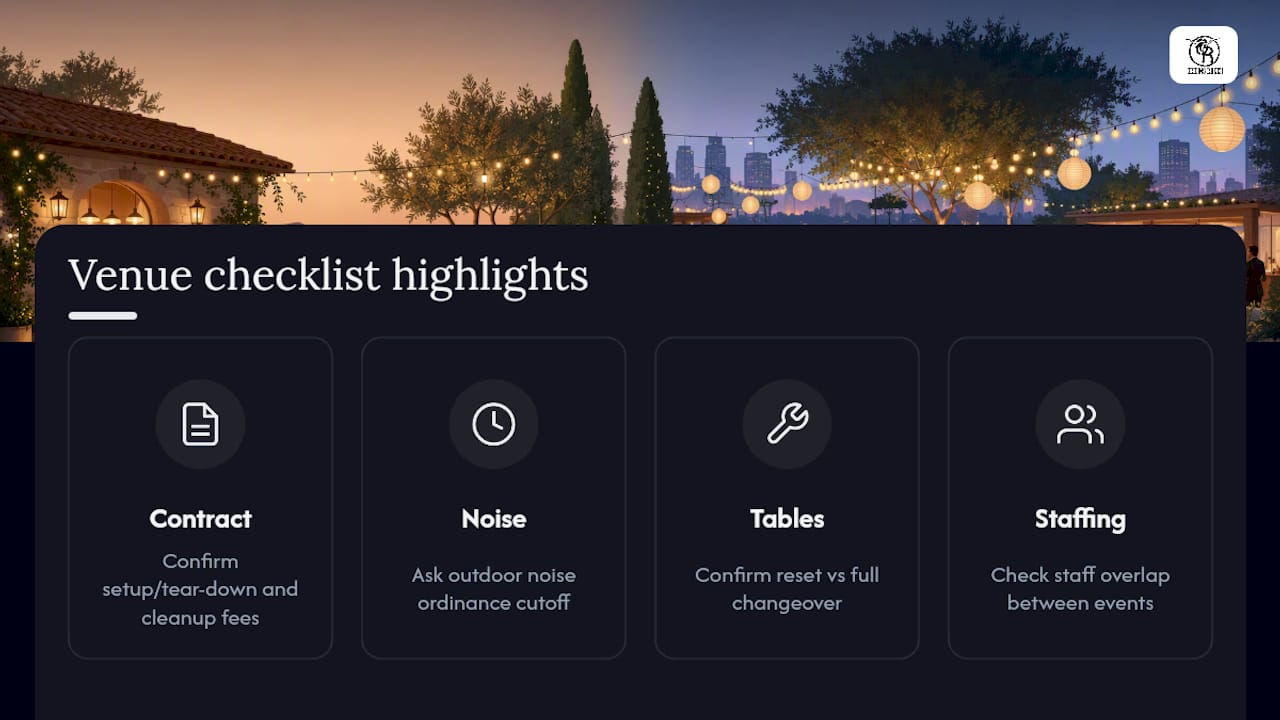
Booking a rehearsal dinner and welcome party at the same venue on back-to-back nights sounds efficient until the contract details surface. Set-up and tear-down windows, staffing coverage, and cleanup fees are common line items that can quietly derail a tight weekend timeline if they aren't confirmed in writing, a point echoed in venue planning guidance around multi-event bookings.
Ask specifically about noise ordinance cutoffs for outdoor spaces, whether tables get reset between events or need a full changeover, and how much staffing overlap the venue provides. A barn setting with both an indoor hall and an outdoor lawn often handles this well, since the rehearsal dinner can stay intimate indoors while the welcome party spreads out under string lights.
Our Take: Pick the Rhythm, Not Just the Event
Most couples do better asking how their weekend should feel, not which event they're "supposed" to have. If your guests are mostly local, keep it simple with a rehearsal dinner. If people are flying in, add a welcome party so no one spends their first night alone in a hotel room. Talk with family early about who's hosting and pace the weekend so no single night runs longer than guests have energy for.
— Origins
Host Both Events Without the Logistics Headache
Some venues offer both an intimate indoor space and a wide-open barn setting, so rehearsal dinners and welcome parties can happen back-to-back without renting two separate venues or coordinating two separate vendor teams.

Teams often walk through set-up windows, staffing, and noise cutoffs at the contract stage to avoid surprises when the rehearsal dinner wraps and the welcome party crowd starts arriving. Browse the event gallery to see how past couples laid out both nights, then reach out through our other events page to talk through your specific weekend timeline and get a quote for combining both celebrations under one roof.
Sources
- The Rehearsal Dinner — Emily Post
- Wedding Welcome Party Etiquette and Planning Advice | Vogue
- Who to Invite to Your Rehearsal Dinner: Everything You Need to Know — Brides
- Wedding Welcome Party Planning | Plan A Wedding
- Who to Invite to Your Rehearsal Dinner — Zola
FAQ
Who Traditionally Pays for the Welcome Party?
There's no fixed rule. Couples often cover it themselves, split it with both families, or one family volunteers to host it as a gift, unlike the rehearsal dinner's more established groom's-family tradition.
Are Grandparents Usually Invited to the Rehearsal Dinner?
Yes, grandparents are typically included in the rehearsal dinner guest list alongside immediate family and the wedding party, especially if they're playing any role in the ceremony.
What to Do Instead of a Rehearsal Dinner?
Couples on tighter budgets or timelines often replace it with a casual post-rehearsal gathering, like a backyard cookout or a relaxed brunch the morning of the wedding, or fold its toasts into an early welcome party.
Is It Rude Not to Have a Rehearsal Dinner?
No. Skipping a rehearsal dinner isn't considered rude; many couples replace it with a simpler gathering or combine its function into a welcome party instead, and etiquette guidance treats tradition as a guide rather than a strict requirement.