
TL;DR:
- Sending invitations 6 to 8 weeks before the wedding and setting a 3 to 4 week RSVP deadline ensures timely planning and accurate headcount.
- Consistency in guest policies and thorough proofing prevent confusion, delays, and logistical issues on the wedding day.
Follow these eight essential wedding invitation tips to get wording, addressing, timing, and RSVP handling right from the start: (1) send save-the-dates and invitations on a firm timeline, (2) include every required wording element, (3) address envelopes with full formal names, (4) set a clear RSVP method and deadline, (5) communicate your plus-one and children policy consistently, (6) follow a batching and proofing workflow before printing, (7) confirm postage weight before mailing the full run, and (8) match your wording tone to your venue. Emily Post and Paperlust are the two most-cited US etiquette authorities on these rules, and at Originsranch we see firsthand how invitation decisions ripple into catering counts, guest flow, and day-of logistics. Start today by confirming your RSVP deadline with your caterer, then finalize your wording.
- Send save-the-dates 6–12 months out; invitations 6–8 weeks before the wedding
- Include hosts, couple's names, date, time, location, dress code, and RSVP details
- Use full formal names and spelled-out street types on outer envelopes
- Set an RSVP deadline 3–4 weeks before the wedding
- Apply your plus-one and children policy uniformly across every guest
- Proof every line (spellings, times, addresses, links) before sending to print
- Weigh a fully assembled suite at the post office before mailing the batch
- Match formal or casual wording to your venue's character and ceremony style
Table of Contents
- When should you send save-the-dates and invitations?
- What should you put on the invitation?
- How do you address envelopes correctly?
- Managing guest lists, plus-ones, and children without hurt feelings
- Practical printing, proofing, and delivery tips
- How should you handle RSVPs and track responses?
- Where does registry information belong?
- How do you handle multilingual invitations?
- Are eco-friendly and digital invitations a good option?
- Key Takeaways
- What venue experience teaches us about invitation logistics
- Originsranch is ready to help you get this right
- Useful sources and references
- FAQ
When should you send save-the-dates and invitations?
Send save-the-dates 6–12 months before the wedding (longer for destination events), invitations 6–8 weeks before the date (10–12 weeks for destination), and set your RSVP deadline 3–4 weeks out. That window gives guests time to book travel and gives you time to finalize your caterer headcount.
- Confirm your wedding date and venue before ordering anything printed.
- Mail save-the-dates at least 6 months out; 9–12 months for destination or holiday-weekend weddings.
- Order invitations with enough lead time for your printer's turnaround (typically 2–3 weeks for digital, 4–6 weeks for letterpress).
- Mail invitations 6–8 weeks before the wedding; 10–12 weeks for destination events.
- Set the RSVP deadline 3–4 weeks before the wedding so your caterer and venue have time to finalize counts.
- Send B-list invitations 4–6 weeks before the wedding, never two weeks out, so those guests feel genuinely welcomed.
Pro Tip: Schedule a dedicated proofing day one week before you plan to send files to your printer. Build in a two-day buffer for corrections — small print runs can often turn around quickly, but letterpress and foil jobs rarely can.
What should you put on the invitation?
Every invitation must answer six questions: who is hosting, who is marrying, what is happening, where, when, and how to respond. Common mistakes include missing start times, vague location details, and no RSVP instructions. Get those six elements right and your guests have everything they need.
The venue's character shapes your wording tone as much as any etiquette rule. A house of worship calls for "the honour of your presence," while a rustic barn celebration fits "the pleasure of your company" or something even warmer and more personal.
| Element | Formal | Semi-Formal | Casual |
|---|---|---|---|
| Host line | Parents' full names | Parents' or couple's names | Couple's first names |
| Ceremony phrase | "the honour of your presence" | "the pleasure of your company" | "join us as we celebrate" |
| Time format | "half after four o'clock" | "4:30 in the afternoon" | "4:30 PM" |
| RSVP phrasing | "Kindly reply by" | "Please RSVP by" | "Let us know by" |
Short wording examples:
One firm rule from Emily Post: never include registry details on the main invitation. Place that information on a separate enclosure card or your wedding website.
How do you address envelopes correctly?
Address outer envelopes using full formal names, titles (Mr., Mrs., Ms., Dr.), and spelled-out street types — "Avenue," not "Ave." The inner envelope lists exactly who in that household is invited, which is how you communicate plus-one and children policies without printing a note on the invitation itself.

| Situation | Outer envelope | Inner envelope |
|---|---|---|
| Married couple | Mr. and Mrs. James Robert Nguyen | James and Sophia |
| Unmarried partners | Ms. Clara Reyes and Mr. David Park | Clara and David |
| Family with children | Mr. and Mrs. Thomas Okafor | Thomas, Amara, Eli, and Nadia |
| Guest with unknown plus-one | Ms. Lauren Simmons and Guest | Lauren and Guest |
For postage, a standard assembled suite often exceeds the weight of a single first-class stamp. Bring a fully assembled, sealed envelope to your local post office before mailing the full batch. Suites with thick cardstock, wax seals, or ribbon ties frequently require additional postage or hand-canceling to avoid damage through automated sorting machines.
Pro Tip: Ask your post office clerk to hand-cancel your invitations. It costs nothing extra and prevents the ink smearing and bent corners that automated machines cause on thick or square envelopes.
Managing guest lists, plus-ones, and children without hurt feelings
Consistency is the single most important rule. Applying your policy uniformly across every guest prevents the awkward conversations that come when one exception becomes five. Decide your rule before invitations go out, then communicate any personal exceptions privately and well in advance.
Decision checklist for plus-ones:
- Is the guest married, engaged, or living with a partner?
- Is the guest a member of the wedding party?
- Does your venue capacity allow it without cutting someone from the A-list?
- Are both families being treated the same way?
For children, omit their names from the outer envelope to signal they are not invited. Never print "adults only" on the invitation itself. Follow up personally with close relatives so they hear it from you, not from the envelope.
- Set your rule in writing before any conversation with family.
- Communicate exceptions one-on-one, never in a group text.
- If a guest asks about a plus-one, respond warmly: "We're keeping our celebration intimate and aren't able to extend plus-ones beyond committed partners. We'd love to have you there."
Pro Tip: If parents are contributing financially and pushing for additional guests, agree on a fixed number of "parent invites" early in planning. Putting a number in writing prevents the list from growing after invitations are ordered.
Practical printing, proofing, and delivery tips
Follow a batching workflow: finalize wording, get sign-off from both partners (and your venue coordinator if they're confirming location details), then send one proof to print before ordering the full run.
Assembly day goes faster with help. Recruit your wedding party or a few organized friends, set up a table with each component in its own pile, and work in an assembly line. Order at least 10–15 extra invitations beyond your guest count to cover addressing errors, late additions, and keepsakes.
Pro Tip: Proof every line aloud with a second person: names, date, day of the week, start time, full address, RSVP deadline, and any website URL. Eyes skip over familiar text; reading aloud catches what silent reading misses.
How should you handle RSVPs and track responses?
Offer one primary RSVP method and one backup. A printed RSVP card with a pre-addressed, stamped return envelope remains the most reliable option for older guests. A wedding website RSVP (through platforms like Zola or The Knot) works well as a parallel channel and makes tracking far easier.
Track responses in a shared spreadsheet with columns for name, RSVP status, meal choice, and any dietary notes. Update it the same day each response arrives. Set a calendar reminder three days after your RSVP deadline to follow up personally with non-responders. Your caterer and venue coordinator will need a confirmed headcount on a fixed date, so chasing late RSVPs promptly protects that deadline.
Where does registry information belong?
Registry details belong on a separate enclosure card or your wedding website, never on the main invitation. Printing registry information on the invitation itself implies the event is about gifts, which runs counter to longstanding US etiquette. A simple line on your wedding website or an information insert card handles it gracefully: "For gift ideas, please visit [our wedding website]."
How do you handle multilingual invitations?
When your guest list spans multiple languages, the cleanest approach is a bilingual invitation printed on a single card, with the primary language on top and the secondary language below, separated by a thin rule or white space. Keep both versions identical in content. For small numbers of guests who speak a different language, a separate insert card in their language is more personal than a full bilingual redesign of the main suite. Always have a fluent native speaker review the translated text before it goes to print.
Are eco-friendly and digital invitations a good option?
Recycled paper stocks, soy-based inks, and seed paper (which guests can plant after the wedding) are all widely available through US stationery vendors and reduce the environmental footprint of a traditional suite. Digital invitations through platforms like Paperless Post or Greenvelope are a practical choice for casual weddings, elopements, or when budget is tight. They also simplify RSVP tracking significantly.
One honest caveat: digital invitations can land in spam folders, and some older guests may not respond to them reliably. A hybrid approach works well for many couples: print invitations for family and older guests, digital for friends who prefer it.
Key Takeaways
Getting your invitations right comes down to one principle: confirm every logistical detail with your venue and caterer before anything goes to print, then follow US etiquette rules for wording, addressing, and timing without shortcuts.
| Point | Details |
|---|---|
| Lock in your timeline first | Mail invitations 6–8 weeks out; set the RSVP deadline 3–4 weeks before the wedding. |
| Six elements, no exceptions | Every invitation needs hosts, couple, date, time, location, and RSVP instructions. |
| Consistency on guest policies | Apply plus-one and children rules uniformly; handle all exceptions privately before invites go out. |
| Proof before you print | Read every line aloud with a second person; order 10–15 extras beyond your guest count. |
| Originsranch venue coordination | Originsranch reviews timeline and headcount deadlines with couples before invitations are finalized. |
What venue experience teaches us about invitation logistics
Invitations are not just stationery. They are the first operational document of your wedding day, and when the details are off, the effects show up at the venue. At Originsranch, we have seen catering headcount stress caused by RSVP deadlines set too close to the event, and we have watched seating charts fall apart because plus-one policies were not communicated clearly before invitations went out.
Barry, our founder and a veteran DJ with over 20 years in the event industry, built Originsranch's planning process around exactly this kind of coordination. The guest flow on your wedding day depends on accurate counts, and accurate counts depend on invitations that were sent on time with clear RSVP instructions.
Before you send anything to print, ask your venue coordinator to confirm: the final headcount deadline, the caterer's cutoff for meal selections, and whether your ceremony start time on the invitation matches the venue's scheduled setup window. Those three confirmations take ten minutes and prevent the most common day-of surprises we see.
Originsranch is ready to help you get this right
Planning invitations alongside venue logistics is one of the most detail-heavy parts of wedding planning, and it is exactly where Originsranch shines. Our team reviews timeline milestones, confirms headcount deadlines with our catering partners, and helps couples match their invitation wording to the character of our barn venue in Plant City, FL. Whether you are planning a formal ceremony or a relaxed country celebration, we coordinate the details so nothing falls through the cracks.
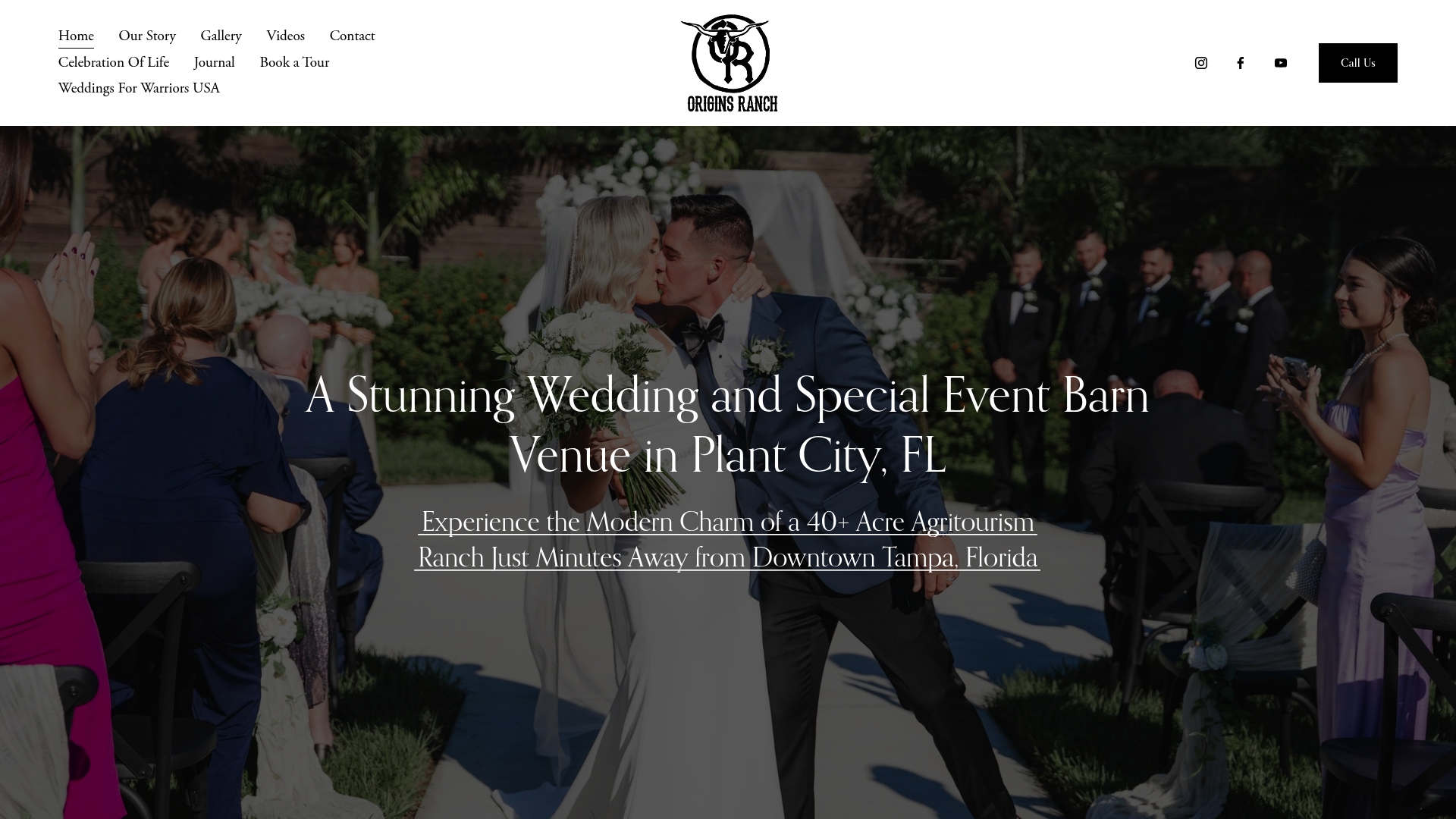
Veterans and active-duty service members can also learn about our Weddings For Warriors program, which is dedicated to helping military families have the wedding they deserve. Ready to see the space and talk through your timeline? Book your wedding day at Originsranch and let us help you plan every detail with care.
Useful sources and references
| Source | What it covers |
|---|---|
| Emily Post | Wording etiquette, assembly order, registry rules |
| Paperlust — Wedding Invitation Etiquette | Timeline, addressing rules, children policies |
| Brides — Common Invitation Mistakes | Top errors couples make with wording and timing |
| Brides — Guest List Guidance | Plus-one and adults-only policy consistency |
| WeddingTipsForBrides — Guest List | B-list timing and guest list structure |
| Vogue — Wedding Guest List | Guest count strategy and budget alignment |
FAQ
When should wedding invitations be mailed?
Mail standard invitations 6–8 weeks before the wedding and destination invitations 10–12 weeks out, with an RSVP deadline set 3–4 weeks before the event.
What should you never include on a wedding invitation?
Never include registry details on the main invitation. Place that information on a separate enclosure card or your wedding website, per Emily Post etiquette guidance.
How do you communicate a no-children policy?
Omit children's names from the outer envelope and list only the adults invited on the inner envelope. Follow up personally with close family members rather than printing any exclusionary note on the invitation itself.
How do you track RSVPs efficiently?
Use a shared spreadsheet updated the same day each response arrives, with columns for name, RSVP status, meal choice, and dietary needs. Follow up with non-responders within three days of your deadline.
Does Originsranch help with invitation timeline coordination?
Yes. Originsranch reviews headcount deadlines and vendor cutoffs with couples before invitations are finalized, helping ensure your RSVP timeline aligns with catering and venue logistics.