
TL;DR:
- Venue catering models include on-premise, off-premise, and hybrid options, each with different costs and logistics. The choice of service style, such as plated dinners, buffets, or stations, significantly impacts event flow and guest experience. Venue atmosphere influences menu selection and service method, requiring careful alignment with space, season, and visual style.
Venue catering options are defined by three primary service models: on-premise, off-premise, and hybrid catering. Each model determines how food is prepared, transported, and served at your event, and that single decision shapes everything from your budget to your guests' experience. Explaining venue catering options clearly means going beyond menu choices. It means understanding how catering models differ, how service styles like plated dinners, buffets, and interactive stations affect event flow, and how your venue's physical setup influences every choice you make. Whether you're planning a barn wedding in Plant City, FL, or a corporate celebration in a downtown ballroom, the right catering framework makes the difference between a good event and an unforgettable one.
What are the main types of venue catering and how do they differ?
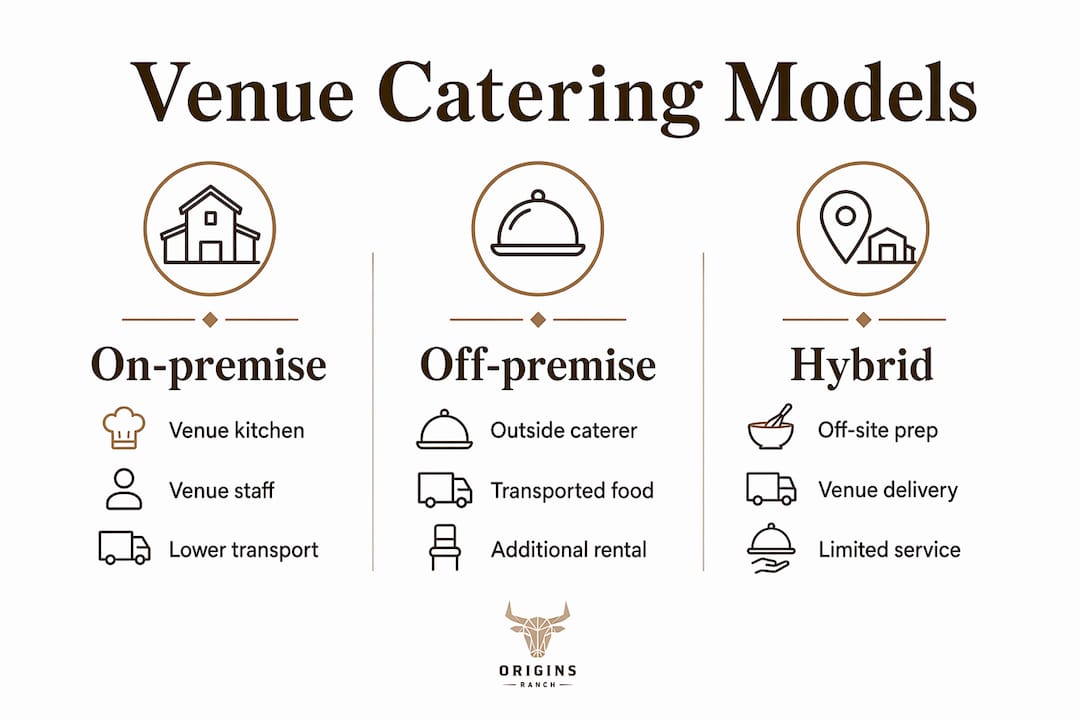
On-premise, off-premise, and hybrid catering are the three foundational models for event food service. Each one carries distinct logistical demands, cost structures, and guest experience outcomes.
On-premise catering uses the venue's own kitchen, staff, and equipment. The food is prepared and served entirely within the venue's infrastructure. This model is common at hotel ballrooms, country clubs, and established event centers. Because the venue controls the kitchen, service tends to be tightly coordinated. Costs are often bundled into the venue rental, which can simplify budgeting.
Off-premise catering brings an outside catering company to your venue. The caterer transports food, equipment, and sometimes staff to a location that may have limited or no kitchen facilities. This model gives you freedom to choose your caterer independently, but it adds logistical complexity. Off-premise venues can add 15–25% to your catering budget due to equipment rentals like chafing dishes, serving tables, and generators. That cost difference is real and worth factoring in early.
Hybrid or drop-off catering sits between the two. A caterer prepares food off-site and delivers it to the venue, with limited onsite support for setup and service. This model works well for smaller gatherings or venues with partial kitchen access. It trades some service polish for convenience and cost savings.
| Model | Food Prepared | Equipment | Best For |
|---|---|---|---|
| On-premise | At the venue | Venue-owned | Ballrooms, hotels, clubs |
| Off-premise | Off-site, transported | Rented or brought in | Unique or rustic venues |
| Hybrid | Off-site, delivered | Minimal onsite setup | Smaller or casual events |
One detail most couples overlook is the "preferred caterer" list. Preferred caterers reflect logistical compatibility as much as food quality. Venues favor caterers who know their loading dock access, kitchen power capacity, and service flow. Choosing a caterer outside that list at a venue with limited infrastructure can cause delays that no amount of good food will fix.
Pro Tip: Ask your venue coordinator about kitchen power capacity and loading access before you finalize any caterer. These two factors determine whether your preferred caterer can actually operate smoothly at that location.
How do catering service styles affect event flow and guest experience?
The three dominant service styles are plated dinners, buffets, and interactive stations. Each one creates a different rhythm for your event and suits different types of gatherings.
Plated service
Plated service delivers individual courses directly to each seated guest. It signals formality and works best for structured programs with speeches, toasts, or award presentations. Because servers control the pace, plated dinners keep guests in their seats during key moments. The tradeoff is staffing. Plated service requires more servers per guest than any other style, which raises labor costs. It also demands a precise guest count finalized at least 14 days before the event. Without an accurate headcount and seating chart, timing breaks down and dietary accommodations become difficult to execute.
Buffet service
Buffets give guests freedom to choose their food and move at their own pace. This style works well for larger groups where managing individual courses would be impractical. Buffets reduce per-server costs but require more table space and careful traffic planning to avoid bottlenecks. They suit casual or semi-formal events where mingling is encouraged. The downside is that buffets can disrupt formal program timing if guests are still in line during speeches.
Interactive stations
Interactive stations are the fastest-growing catering trend in 2026. A station might feature a carving station, a taco bar, a pasta chef, or a dessert display. Stations promote natural conversation and give guests a sense of personal choice. Randy Peters Catering notes that stations work especially well for events where guest interaction is a priority. They require more floor space than buffets and need trained staff at each station, but the energy they create is hard to replicate with a seated dinner.
| Style | Formality | Staffing Need | Best For |
|---|---|---|---|
| Plated | High | High | Formal dinners, structured programs |
| Buffet | Medium | Moderate | Large groups, casual receptions |
| Stations | Medium to high | Moderate | Mingling-focused, themed events |
Understanding how service style shapes guest flow is one of the most underrated decisions in event planning. The wrong style for your program creates friction that guests feel even if they can't name it.
Pro Tip: Map your event timeline before choosing a service style. If you have 30 minutes of toasts planned, plated service keeps guests seated. If your event is designed for mingling, stations or a buffet will serve you better.
How does venue atmosphere influence your catering choices?
Venue atmosphere directly guides menu strategy. The physical environment, the season, and the visual character of your venue all shape what food feels right and what service style will land well with guests.
Outdoor venues like beach settings or open fields favor lighter, chilled menus. Heavy sauces and hot dishes lose their appeal in summer heat, and food safety becomes a real concern. Historic ballrooms, by contrast, suit plated multi-course meals with formal table settings. The architecture signals a certain expectation, and your catering should honor it.
Rustic barn venues occupy a unique middle ground. They carry warmth and character that pairs naturally with farm-to-table menus, hearty comfort foods, and station-style service. At Originsranch in Plant City, FL, the venue's barn heritage and open spaces create an atmosphere where rustic venue ambiance and personalized catering choices feel completely at home together. A grazing table or a Southern-style buffet fits that setting far better than a formal plated dinner.
Key factors to assess when matching catering to venue atmosphere:
- Kitchen access: Does the venue have a full commercial kitchen, a prep area, or no kitchen at all? This determines which caterers can realistically serve your event.
- Seasonal conditions: Outdoor events in florida summers require heat-safe menus and covered food stations.
- Visual theme: A rustic barn calls for different presentation than a modern rooftop or a waterfront pavilion.
- Guest movement: Open floor plans support stations and buffets. Tight seating arrangements favor plated service.
Pro Tip: Review your venue's catering policies and preferred provider list at your first site visit, not after you've fallen in love with a caterer who can't operate there.
What logistical and dietary factors matter most when choosing catering?
Logistics and dietary planning are where catering choices either hold together or fall apart. Getting these details right protects your guests and your event timeline.
The most time-sensitive logistical requirement is the final guest count. Plated service requires a finalized headcount and seating chart at least 14 days before the event. That deadline exists because caterers must order precise quantities, assign dietary accommodations to specific seats, and brief service staff on the flow. Missing that window creates a cascade of problems on the day.
Dietary needs have moved from an afterthought to a core planning priority. Caterers must have documented procedures for handling gluten-free, vegan, and allergen-sensitive requests. Documented means written, communicated to kitchen staff, and confirmed with the client before the event. A verbal assurance is not enough. Mattison's, a well-regarded event caterer in Sarasota, FL, emphasizes that tailored menus reflecting guest preferences are the clearest way to signal care and professionalism to every person at the table.
Common logistical mistakes to avoid:
- Booking a caterer before confirming venue kitchen capacity and power supply.
- Skipping a tasting for large events where menu quality directly affects guest satisfaction.
- Failing to communicate dietary restrictions to the caterer in writing at least three weeks out.
- Choosing a service style without mapping it against the event program and timeline.
- Ignoring rental costs for off-premise venues, which can add significantly to the final bill.
Aligning catering with vendor coordination early prevents the most common day-of surprises. Caterers, venue staff, and event planners need a shared timeline that accounts for setup, service windows, and breakdown.
Pro Tip: Build your catering timeline directly into your event program. Assign specific windows for cocktail hour, dinner service, and dessert so your caterer and DJ or emcee are working from the same schedule.
Key Takeaways
Choosing the right catering model and service style requires aligning your venue's infrastructure, event program, and guest needs before committing to any single approach.
| Point | Details |
|---|---|
| Know your catering model | On-premise, off-premise, and hybrid each carry distinct costs and logistics. |
| Match service style to event flow | Plated suits formal programs; stations and buffets work better for mingling-focused events. |
| Venue atmosphere shapes the menu | Rustic, outdoor, and ballroom venues each call for different food styles and presentation. |
| Lock in guest counts early | Plated service requires a finalized headcount at least 14 days before the event. |
| Document dietary needs in writing | Verbal assurances are not enough; caterers need written procedures for every dietary restriction. |
What we've learned from watching catering choices play out
After years of hosting weddings and special events at Originsranch, we've seen one pattern repeat itself more than any other. Couples and planners fall in love with a catering style before they've thought through the event's actual rhythm. They choose stations because they look beautiful on Instagram, or they choose plated service because it feels formal and impressive. Then the event arrives and the timeline doesn't match the service style, and guests feel the friction even if they can't explain why.
The most successful events we've hosted start with a simple question: what do we want guests to feel during dinner? If the answer is "connected and social," stations or a buffet will serve that goal. If the answer is "settled and present for the program," plated service is the right call. That question cuts through the noise faster than any trend or budget conversation.
We also believe strongly in early collaboration. When the caterer, the venue team, and the couple sit down together before contracts are signed, the whole event gets better. The caterer learns the kitchen setup. The venue team learns the menu flow. The couple learns what's actually possible within their space. That conversation prevents the surprises that show up at 6 p.m. on the wedding day.
Catering sets the tone for the entire event and should reflect the couple's personality, the season, and the venue's character. At Originsranch, we've seen farm-to-table grazing tables feel completely at home in our barn space. We've also seen elegant plated dinners work beautifully under our string lights. The venue doesn't dictate one single approach. It opens a range of possibilities, and the best catering choice lives somewhere inside that range.
— Origins
Plan your perfect event at Originsranch
Originsranch is a barn wedding and special event venue in Plant City, FL, where rustic charm meets modern elegance. Our spaces are designed to accommodate a range of catering styles, from intimate plated dinners to lively interactive stations, so your vision has room to breathe.
Whether you're planning a wedding reception, a milestone celebration, or a private gathering, our team works closely with you to align your catering choices with the venue's character and your event's goals. Explore our wedding day experience to see how we bring it all together, or browse our other event options for gatherings of every kind. We'd love to help you create something truly memorable at Originsranch.
FAQ
What are the three main venue catering models?
The three primary models are on-premise, off-premise, and hybrid catering. On-premise uses the venue's kitchen and staff; off-premise brings an outside caterer with their own equipment; hybrid delivers prepared food with minimal onsite support.
How much more does off-premise catering cost?
Off-premise catering can add 15–25% to your catering budget due to equipment rentals and transport logistics. On-premise venues often include linens, glassware, and kitchen tools, which improves overall cost efficiency.
When do I need to finalize my guest count for plated service?
Plated service requires a finalized guest count and seating chart at least 14 days before the event. This deadline allows caterers to order precise quantities and assign dietary accommodations to specific seats.
How do I handle dietary restrictions with my caterer?
Dietary needs like gluten-free, vegan, and allergen-sensitive requests must be documented in writing and confirmed with your caterer at least three weeks before the event. Verbal assurances are not a reliable substitute for written procedures.
What catering service style works best for a barn wedding?
Interactive stations and buffets suit barn wedding atmospheres well because they encourage mingling and complement the relaxed, social energy of rustic venues. Plated service can also work beautifully if your program includes structured toasts or a formal dinner sequence.