
TL;DR:
- Accessible wedding venues integrate physical features, service practices, and clear communication to ensure inclusivity for all guests. Essential elements include step-free routes, proper restroom dimensions, and accessible parking, along with trained staff and detailed information. Planning ahead and securing written commitments help create a welcoming experience that respects diverse needs.
Wedding venue accessibility is the comprehensive provision of physical features, service adjustments, and communication practices that enable every guest, regardless of mobility, sensory, or cognitive challenges, to fully participate in the celebration. Explaining wedding venue accessibility goes beyond ramps and restrooms. It covers the full spectrum of inclusive hospitality, from ADA-compliant parking bays to assistive listening devices to quiet rooms for neurodivergent guests. The industry term for this standard is inclusive venue design, and understanding it before you book protects your guests and your investment. This guide gives you the criteria, the questions, and the confidence to choose a venue where everyone belongs.
What are the essential physical accessibility features in wedding venues?
Physical accessibility is the foundation of any inclusive wedding venue. Step-free entry to every space used during the event, including the ceremony room, reception hall, and gardens, is the non-negotiable starting point. Without it, guests using wheelchairs or mobility aids are excluded before the day even begins.
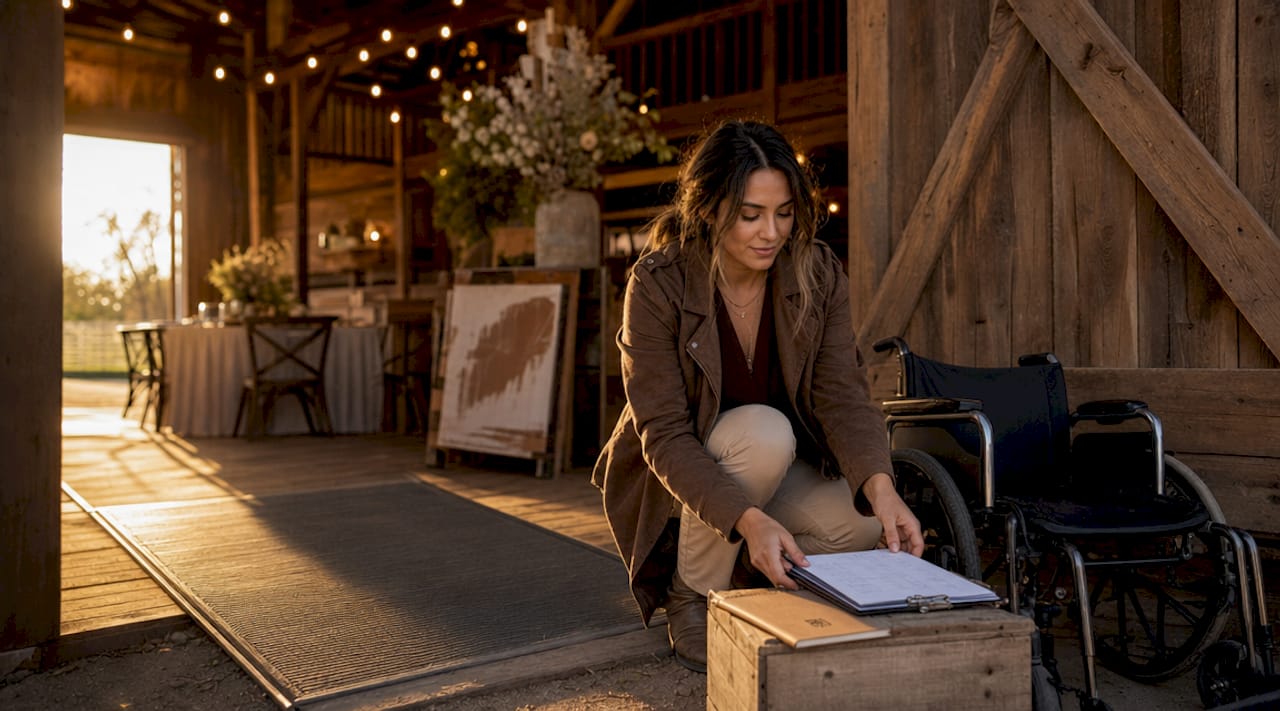
Specific measurements matter here. Minimum door widths of 800mm and aisle widths of 900mm are the industry standard for wheelchair clearance. Accessible restrooms require a 1500mm turning circle, grab rails, and a lowered sink. These numbers are not suggestions. They reflect the real space a power wheelchair or mobility scooter needs to move safely.
Parking is another critical factor that couples often overlook until the day of the event. Accessible bays must be located close to the main entrance, wide enough for ramp deployment, and clearly marked. A venue with beautiful grounds but a distant parking lot creates a barrier before guests even reach the door.
Outdoor surfaces deserve special attention. Gravel paths and sand are among the most common mobility obstacles at rustic and barn venues. Temporary flooring, plywood walkways, or paved paths solve this problem at a reasonable cost. Understanding how venue choice shapes guest experience at outdoor settings helps you ask the right questions before you sign a contract.
Pro Tip: Visit the venue in person and walk every path a guest in a wheelchair would travel, from the parking lot to the restroom to the dance floor. What looks accessible on a website often reveals gaps on a site visit.
The table below maps common accessibility features against three popular venue types to help you compare at a glance.
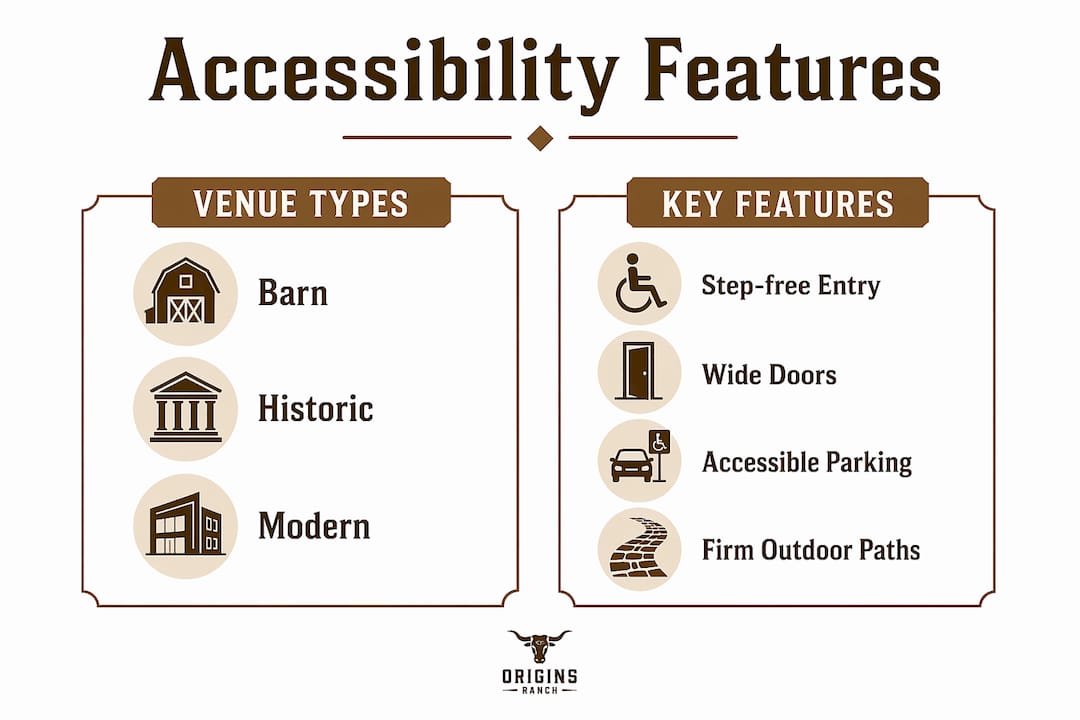
| Accessibility Feature | Barn Venue | Historic Building | Modern Event Hall |
|---|---|---|---|
| Step-free entrance | Often requires ramp addition | Frequently limited by structure | Standard in most builds |
| Accessible restrooms | Varies widely | Often retrofitted | Typically code-compliant |
| Firm outdoor pathways | Requires temporary flooring | Courtyard paving varies | Usually paved |
| Accessible parking bays | Depends on lot design | Often limited near entrance | Standard in most lots |
| Elevator or lift | Rarely applicable | Required if multi-floor | Standard if multi-floor |
How do service and communication practices enhance venue accessibility?
Physical features are only half the picture. Service-level accommodations and clear communication are what separate a venue that truly welcomes all guests from one that simply checks a legal box. Accessibility is a hospitality standard, not just a compliance requirement, and it directly influences booking decisions.
Older or historic venues often cannot make structural changes, but they are still expected to provide reasonable adjustments. Portable ramps, flexible seating arrangements, and assistive listening systems like induction loops all fall under this category. The ADA in the United States and the Equality Act 2010 in the UK both require these adjustments regardless of a building's age or heritage status.
Staff training is a factor that rarely appears on venue brochures but shapes the guest experience profoundly. Proactive venue staff who understand mobility needs, know where accessible routes are, and can assist guests without being asked make a measurable difference. A venue with perfect infrastructure but untrained staff will still fail guests in practice.
Transparency on venue websites is a competitive advantage. Publishing detailed accessibility information about parking, restroom locations, mobility routes, and what is not accessible signals professionalism and builds trust with couples during the research phase.
Here are the service-level practices every accessible venue should provide:
- Written accessibility information on the venue website covering parking, restrooms, and mobility routes
- Assistive listening devices available on request, including induction loops for guests with hearing aids
- Staff trained to assist guests with mobility, sensory, or cognitive needs without drawing attention
- Flexible seating arrangements that integrate wheelchair users with general seating, not at the back
- Accessible seating integrated with the main guest area to promote inclusion and social comfort
Pro Tip: Ask for written confirmation of every accessibility accommodation during the booking process. Verbal assurances are not enforceable on the wedding day.
What often-overlooked accessibility factors should couples consider?
Most couples focus on ramps and restrooms when planning accessible weddings. The factors below are just as important but rarely make it onto the standard checklist.
Sensory accessibility covers quiet rooms, advance warnings about loud music or fireworks, and designated low-stimulation areas. Neurodivergent guests, including those with autism spectrum disorder or sensory processing differences, benefit significantly from these provisions. A quiet room costs nothing to designate but can make the difference between a guest staying for the whole reception or leaving early.
Emotional and social accessibility is another dimension that gets overlooked. Seating arrangements for guests attending alone, guests with anxiety, or guests who need to be near an exit require intentional planning. Reviewing your wedding guest flow layout with accessibility in mind reveals these gaps before the day arrives.
Transportation and drop-off logistics matter for guests with limited mobility. A venue with no covered drop-off point, no shuttle service, and distant parking creates real hardship. Dietary accommodations communicated clearly by the venue or caterers also fall under inclusive hospitality, particularly for guests with medical dietary needs.
Here are the most commonly overlooked accessibility factors and the adjustments that address each one:
- Gravel or sand paths — Lay temporary firm flooring or plywood walkways before the event.
- No quiet room — Designate a low-traffic room with seating and reduced noise as a retreat space.
- Loud surprise elements — Notify guests in advance about fireworks, live bands, or cannon salutes.
- Distant drop-off points — Arrange a covered, close-proximity drop-off zone for guests with mobility needs.
- Segregated wheelchair seating — Integrate accessible seating within the main guest layout, not at the perimeter.
- Unclear dietary options — Confirm with the caterer that accessible menu options are labeled and communicated.
- Supplier access timing — Verify that accessibility equipment like portable ramps arrives and is installed before guests do.
How can couples and planners evaluate a venue's accessibility?
Evaluating a venue's accessibility requires more than reading its website. Written confirmation of accessibility promises protects you and holds venue staff accountable on the wedding day. Verbal assurances disappear. Documented agreements do not.
Start with a structured site visit. Walk every route a guest with a mobility device would use, from the parking lot through the entrance to the ceremony space, restrooms, and reception area. A venue may have a ramp at the front door but still lack accessible routes due to gravel paths or inaccessible restrooms near the reception hall. The full route matters, not just the entrance.
Ask venue coordinators these specific questions during your evaluation:
- Are all ceremony and reception spaces on the same level, or is there a lift?
- What is the surface material on outdoor paths, and can it be upgraded for the event?
- Are accessible restrooms located near the reception area, not just near the entrance?
- Do you have portable ramps available if a step is unavoidable?
- Are assistive listening devices available, and how are they requested?
- What accessibility training have your staff received?
- Can all accessibility commitments be documented in the contract?
Familiarizing yourself with wedding venue terminology helps you interpret the answers accurately. Terms like "step-free access" and "level access" have specific meanings that differ from "accessible entrance."
Pro Tip: Build a custom accessibility checklist based on your actual guest list. A guest using a power wheelchair has different needs than a guest with low vision or a guest with anxiety. One checklist does not fit all.
Negotiating reasonable adjustments with historic or rural venues is possible. Most venues will accommodate requests for temporary flooring, portable ramps, or reserved seating when asked in writing during the booking process. The key is asking before you sign, not after.
Key takeaways
Accessible wedding venues require physical features, service practices, and written commitments working together to deliver a genuinely inclusive experience for every guest.
| Point | Details |
|---|---|
| Physical standards are specific | Doors need 800mm clearance, aisles 900mm, and restrooms a 1500mm turning circle. |
| Service matters as much as structure | Staff training, assistive devices, and flexible seating shape the real guest experience. |
| Sensory needs are often missed | Quiet rooms and advance noise warnings support neurodivergent guests at no significant cost. |
| Get everything in writing | Documented accessibility commitments in contracts are the only enforceable protection on the day. |
| Evaluate in person | A site visit walking every guest route reveals gaps that venue websites and brochures never show. |
Why accessibility should be a non-negotiable from day one
We have worked with hundreds of couples at Originsranch, and the pattern is consistent. Couples who treat accessibility as a checklist item at the end of the planning process almost always encounter a problem on the wedding day. A guest arrives and the portable ramp was never ordered. The quiet room was repurposed for catering storage. The accessible restroom is on the opposite side of the building from the reception.
The venues that get this right treat accessibility as a hospitality value, not a legal obligation. That shift in mindset changes everything. It means the coordinator asks about guest needs during the initial walkthrough. It means the contract specifies exactly which accommodations will be in place and when. It means staff know the accessible routes without being asked.
We also want to say something that most venue guides skip. Accessibility is not just about guests who use wheelchairs. A veteran with PTSD who needs a quiet space, an elderly grandmother who cannot stand for long periods, a child with sensory sensitivities, all of these guests deserve the same thoughtful planning. At Originsranch, our founder Barry's work with Weddings For Warriors has shown us firsthand that inclusive planning honors every person in the room.
The couples who ask the hard questions early, who walk the routes, who get the promises in writing, are the ones who tell us afterward that every single guest felt welcome. That is the goal. Not compliance. Welcome.
— Origins
Plan your inclusive wedding at Originsranch
At Originsranch in Plant City, FL, we believe every guest deserves to feel at home from the moment they arrive. Our venue was built with guest comfort and accessibility in mind, from firm pathways across our grounds to thoughtfully designed facilities that accommodate a range of needs. We work closely with each couple to understand their guest list and plan accordingly, because no two weddings are the same.
Browse our venue gallery to see how we set up spaces for inclusive, beautiful celebrations. If you are a veteran or active duty service member, explore our Weddings For Warriors program, dedicated to making your dream wedding a reality. We would love to show you around and talk through how we can make your day perfect for every single guest.
FAQ
What does wedding venue accessibility include?
Wedding venue accessibility covers physical features like ramps, wide doorways, and accessible restrooms, as well as service accommodations such as assistive listening devices, staff training, and sensory provisions for neurodivergent guests.
What are the minimum door and aisle widths for an accessible venue?
Industry standards require a minimum door width of 800mm and aisle width of 900mm to accommodate wheelchair users, along with a 1500mm turning circle in accessible restrooms.
How do i confirm a venue's accessibility before booking?
Visit the venue in person, walk every route a mobility device user would travel, and request written confirmation of all accessibility accommodations in the contract before signing.
Can historic or barn venues be made accessible?
Yes. Reasonable adjustments such as portable ramps, temporary firm pathways, and assistive listening systems are expected even in older or structurally limited venues.
What sensory accessibility features should a wedding venue offer?
A fully accessible venue provides a designated quiet room, advance notice of loud elements like fireworks or live bands, and low-stimulation areas to support guests with sensory sensitivities or neurodivergent needs.