

1 Corinthians 13:4-8 remains the most commonly chosen wedding passage, and it pairs well with a shortlist of four or five other verses that cover unity, commitment, and blessing: Ecclesiastes 4:9-12, Genesis 2:24, and Song of Solomon 8:6-7. Pick one longer reading and one short line for your program, then confirm the exact translation and any liturgical rules with your officiant before printing anything.
TL;DR:
- Most couples choose 1 Corinthians 13:4-8 for its focus on patience, kindness, and enduring love, making it ideal as the main reading.
- Genesis 2:24 and Mark 10:9 are foundational verses emphasizing the covenant of marriage and work well as short readings or benedictions in most ceremony styles.
- Outside the main reading, Ruth 1:16-17 and Song of Solomon 8:6-7 add emotional and poetic depth, especially for personalized or outdoor ceremonies.
- Match your chosen verses to your ceremony tone, guest familiarity, and translation preference, with modern translations like NIV or ESV for clarity and traditional versions like KJV for poetic rhythm.
- Limiting scripture readings to three or four well-chosen passages prevents ceremony fatigue, especially when incorporating them into vows, programs, or speeches.
Table of Contents
- Quick List: Top 12 Wedding Bible Verses
- Wedding Scripture Readings Organized by Theme
- Short Bible Verses for Programs, Invitations, and Signs
- How to Choose the Right Verse and Bible Translation
- Where Scripture Fits Best in Your Ceremony
- Faith-Centered Ceremonies at Originsranch
- Where These Verses Come From: Context Worth Knowing
- Personalizing Your Wedding Verses Without Losing Their Meaning
- Common Mistakes Couples Make With Wedding Scripture
- What Each Popular Verse Actually Means
- Bringing Scripture Into Speeches and Toasts
- Our Take on Choosing Wedding Scripture
- Sources
- FAQ
Quick List: Top 12 Wedding Bible Verses
If you need to hand your officiant or program designer a working list today, start here. Each entry gives you the reference, the theme in a few words, and where it tends to work best in a ceremony.
- 1 Corinthians 13:4-8 — patience, kindness, enduring love. Best as the main reading.
- Ecclesiastes 4:9-12 — partnership and mutual strength. Strong for a reading or vows introduction.
- Genesis 2:24 — the covenant of leaving and cleaving. Fits well right before the vows.
- Ruth 1:16-17 — loyalty and devotion. Powerful as a personal reading, especially for blended families.
- Song of Solomon 8:6-7 — passionate, poetic love. Works as a reading or a printed program line.
- Colossians 3:14 — love that binds everything together. Ideal for programs or signage.
- Mark 10:9 — the union God has joined. A clean, short benediction line.
- Psalm 127:1 — building a home on faith. Good for a blessing or a toast.
- Numbers 6:24-26 — the priestly blessing. Traditional choice for a closing benediction.
- 1 John 4:7-12 — love rooted in God's nature. Suited to a longer reading in faith-centered services.
- Romans 12:9-10 — sincere love and honor. Works well in vows or a reading.
- Philippians 1:9-11 — love growing in knowledge and insight. A thoughtful choice for a parent's reading or blessing.
This list mirrors what most popular verse compilations recommend, and it gives you enough range to build a full ceremony without repeating a single tone twice. Keep a printed copy of this shortlist in your planning folder. It saves you from scrambling two weeks out when your officiant asks what you have chosen.
Wedding Scripture Readings Organized by Theme
Different moments in a ceremony call for different tones. A verse that soars during a formal reading can feel too heavy for a program footer, and a line perfect for signage can feel thin if stretched into your main reading. Grouping by role makes the choice easier.
Love
- 1 Corinthians 13:4-8 reads beautifully aloud because of its rhythm and repeated structure, and it needs no introduction from your officiant.
- 1 John 4:7-12 leans more theological and works best when your officiant adds a brief line of context before reading it.
- Song of Solomon 8:6-7 uses vivid, poetic imagery ("set me as a seal upon your heart") that lands well outdoors or in an intimate setting.
Unity and covenant
- Genesis 2:24 is the foundational marriage verse in scripture, and it is denomination-neutral enough to use in almost any ceremony style.
- Mark 10:9 echoes that same covenant language in fewer words, which is why it also works as a short benediction.
- Ecclesiastes 4:9-12 reinforces partnership through the well-known "two are better than one" passage, and its everyday language reads naturally even for non-religious guests.
Commitment and vows
- Ruth 1:16-17 carries emotional weight, especially in blended families or when one partner is adopting the other's children, but its intensity means it should stand alone rather than get trimmed into a program line.
- Romans 12:9-10 offers practical, action-oriented language ("outdo one another in showing honor") that some couples fold directly into their vows.
Blessing and benediction
- Numbers 6:24-26 is the traditional priestly blessing, and its formal, elevated language suits a closing benediction from a pastor or officiant.
- Psalm 127:1 works well when a parent or family elder gives a blessing, since it speaks to building a household on faith.
Joy and thanksgiving
- Psalm 118:24 is short enough to read from memory and fits naturally right after the vows, as the couple turns to face their guests.
- Philippians 1:9-11 suits a reading from a parent or close friend who wants to speak to the couple's growth together.
Verses like Ecclesiastes 4:9-12, Genesis 2:24, and Mark 10:9 tend to emphasize partnership and covenant rather than romantic feeling alone, which is worth knowing if you want your ceremony to lean more theological than sentimental.
Short Bible Verses for Programs, Invitations, and Signs
Print space is limited, so short verses do more work per word. These six show up often on programs, welcome signs, and invitation footers:
- Colossians 3:14 ("Above all, put on love") — ideal for a program header or welcome sign.
- Psalm 118:24 ("This is the day the Lord has made") — a joyful line for the front of a program.
- Mark 10:9 ("What God has joined together") — pairs well with a photo on signage.
- 1 John 4:19 ("We love because he first loved us") — a strong closer for a toast or invitation footer.
- Proverbs 3:3-4 ("Let love and faithfulness never leave you") — reads well on a guest book table sign.
- Romans 12:10 ("Be devoted to one another in love") — fits neatly under a couple's monogram.
Bold the reference and italicize the verse text so guests can scan it quickly, and always note the translation abbreviation (ESV, NIV, KJV) in small print beneath the quote. Short, memorable lines like these perform especially well in print precisely because their brevity gives them a strong tonal close, which is exactly what a program cover or closing toast needs.
How to Choose the Right Verse and Bible Translation
Start with a short checklist before you fall in love with a single verse:
- Ceremony tone. Is your wedding formal and liturgical, or relaxed and personal? A traditional Catholic Mass calls for different readings than a backyard ceremony.
- Reader comfort. Some readers stumble over King James phrasing. If your reader is nervous, choose a modern translation.
- Length. Match the verse length to its role. Save longer passages for the main reading and short lines for programs or benedictions.
- Theological weight. Verses like 1 John 4:7-12 carry doctrinal depth that may need a brief introduction from your officiant.
- Family expectations. If grandparents grew up on the King James Version, a familiar cadence during the reading can mean more to them than a modern paraphrase.
On translation, the NIV and ESV both use clear, modern English that reads naturally to guests who did not grow up in church. The KJV and RSV carry a poetic, traditional cadence that many couples still want for verses like Genesis 2:24 or the Song of Solomon. If your ceremony includes a doctrinally sensitive reading, a more literal translation avoids paraphrasing away theological nuance. There is no single "correct" choice here. Choosing the right verse is genuinely subjective, and reading a passage aloud in two or three translations before deciding is one of the most useful things you can do.
If your service is Catholic or another formal liturgical tradition, expect specific rules. Catholic weddings typically require an Old Testament reading, a New Testament reading, and a Gospel reading, with at least one that directly addresses marriage; during the Easter season, the Old Testament reading is replaced with a passage from Acts or Revelation. Talk to your officiant early if you are planning a formal service, since lectionary rules can limit which verses are even allowed.
Pro Tip: Once you finalize your readings, print the exact translation for each reader and rehearse the passage aloud once during your rehearsal. This catches pacing issues and unfamiliar pronunciations before the real ceremony, a habit worth adopting from officiant coordination guides.
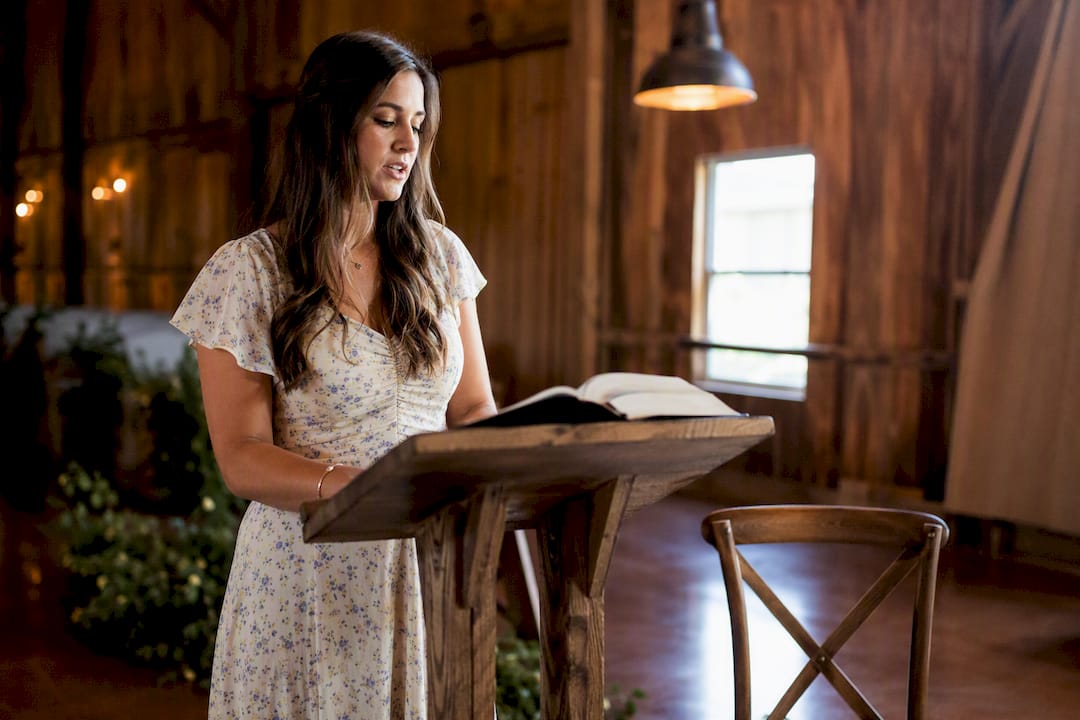
Where Scripture Fits Best in Your Ceremony
The right verse in the wrong spot can fall flat. These placement patterns work across most ceremony styles:
- Traditional formal service: Open with Genesis 2:24 or Ecclesiastes 4:9-12 as the main reading (2 to 3 minutes), follow with vows, then close with Numbers 6:24-26 as the benediction.
- Short civil ceremony: Skip the long reading and use a single short verse, like Mark 10:9, right before the vows for a clean 30-second moment.
- Outdoor or barn ceremony: Song of Solomon 8:6-7 works beautifully read aloud outdoors, paired with Psalm 118:24 as a joyful closing line once the couple faces their guests.
- Family-inclusive ceremony: Ruth 1:16-17 as a reading from a parent, followed by Colossians 3:14 printed on the program for guests to take home.
A long reading paired with a short benediction gives the ceremony emotional weight without dragging on the timeline, since pairing a longer passage with a shorter closing line keeps guests engaged rather than restless. If your reader is a family member rather than a professional speaker, give them a brief written introduction line to say before the verse. It steadies nerves and gives guests context.
Faith-Centered Ceremonies at Originsranch
Originsranch has hosted faith-centered barn ceremonies since transforming a former World Champion Horse Ranch into our Plant City venue, and scripture placement comes up in nearly every planning conversation we have with couples. Our founder, Barry, brings over 20 years in the event service industry to that process, and his charity, Weddings For Warriors, has helped veterans and active-duty service members build ceremonies that reflect their faith without cutting corners on the details that matter to them.
One couple we worked with chose 1 Corinthians 13 as their main reading, delivered by the groom's grandfather under our barn's exposed beams, and paired it with Colossians 3:14 painted on a welcome sign near the entrance. The pairing tied the ceremony's spoken moment to something guests carried with them visually all evening. If you are coordinating readers and an officiant for your own service, our guide to working with your pastor or officiant walks through the logistics that make readings run smoothly.
Where These Verses Come From: Context Worth Knowing
Several of the most popular wedding verses were never written with weddings in mind, and knowing their original context adds weight to how you present them.
1 Corinthians 13 was written by Paul to a fractured, quarreling church in Corinth, not to a bride and groom. He was describing what love looks like inside a community falling apart, which is part of why the passage translates so powerfully to marriage. It was never meant as romantic poetry; it was meant as a corrective.
Genesis 2:24 comes from the creation narrative, describing the very first marriage, and Jewish and Christian traditions alike have treated it as the foundational marriage text for thousands of years. Jesus himself quotes it directly in Mark 10:9, which is why the two verses so often appear together.
Ruth 1:16-17 was spoken by a widowed Moabite woman to her mother-in-law, not between spouses at all. Its power at weddings comes from its portrait of chosen loyalty crossing every boundary of culture and convenience, which resonates with couples building blended or multicultural families.
Song of Solomon has a more complicated history. Jewish and Christian scholars have read it as literal romantic and physical love poetry, and separately as an allegory for divine love, for centuries. Either reading supports its use at a wedding, but knowing both layers gives the verse more depth when your officiant introduces it.
Personalizing Your Wedding Verses Without Losing Their Meaning
You do not have to use a verse exactly as printed. Many couples adapt scripture into their vows, combine two short passages into a single reading, or ask a family member to paraphrase a passage in their own words before the formal reading.
Combining verses works best when the passages share a clear theme. Pairing Ecclesiastes 4:9-12 with Mark 10:9, for example, builds a natural progression from partnership to covenant without feeling forced. What does not work is stitching together verses from unrelated books just because both mention love. That reads as scattered rather than intentional.
If you want to adapt language for gender-neutral phrasing or modern cadence, do it with a light hand. Changing "man" and "wife" to "partner" in a reading is common and rarely controversial, but rewriting entire verses can feel jarring to guests who know the original phrasing. When in doubt, keep the verse itself intact and add your personal touch in the introduction line your reader speaks beforehand.
If your ceremony is formal or liturgical, check with your officiant before adapting anything. Some traditions require the text to be read exactly as printed in the approved translation.
Common Mistakes Couples Make With Wedding Scripture
The biggest mistake is choosing a verse for its sound rather than its meaning, only to discover during rehearsal that the reference does not actually say what you thought it said. Read the full passage in context, not just the line you have seen on a wedding blog.
A close second is picking a translation without checking how it reads aloud. Some KJV phrasing that looks beautiful on paper trips up nervous readers when spoken. Rehearse it before you commit to print.
Overloading the ceremony with too many readings is another common misstep. Three or four scripture moments, spread across a reading, vows, and a benediction, is usually plenty. Stacking six or seven passages back to back tests your guests' patience and dilutes the impact of each one.
Skipping the officiant conversation causes real problems in formal settings. Choosing a verse that is not on the approved lectionary list, then finding out two weeks before the wedding that it needs to change, is avoidable with one early phone call.
Finally, printing a verse reference without checking the translation abbreviation leads to mismatched programs, where the printed reference does not match the version actually read aloud. Keep your translation choice consistent from the program to the officiant's script.
What Each Popular Verse Actually Means
1 Corinthians 13:4-8 describes love through action, not emotion. Patience, kindness, and the absence of envy are things you do, not things you feel, which is why the passage works as a standard for a marriage rather than just a mood.
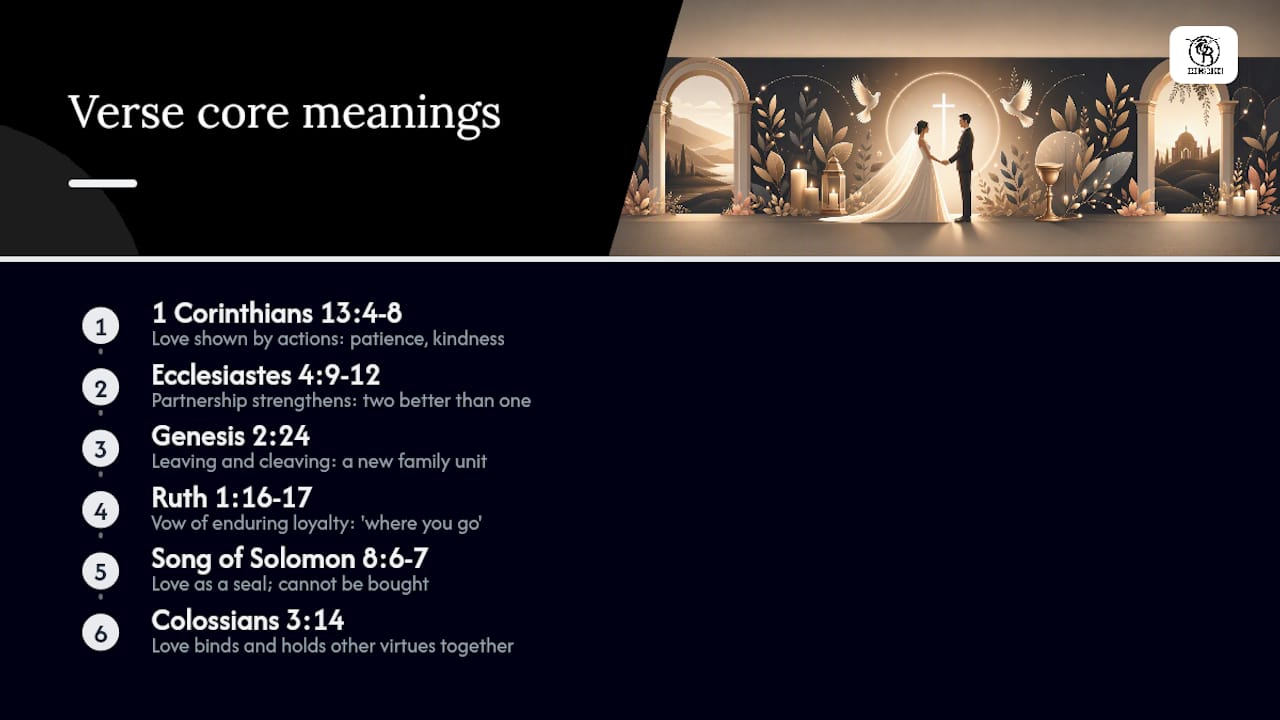
Ecclesiastes 4:9-12 argues that partnership makes people stronger through its "two are better than one" image and its warning that a rope of three strands is not easily broken.
Genesis 2:24 establishes marriage as a new family unit formed by leaving one household and joining another. That "leaving and cleaving" language remains central to Christian marriage theology today.
Ruth 1:16-17 is a vow of loyalty spoken in the face of loss, and its line "where you go, I will go" has become shorthand for devotion that outlasts convenience.
Song of Solomon 8:6-7 describes love as a seal, something permanent and identity-marking, and insists that love cannot be bought, which is why it resonates with couples emphasizing depth over material things.
Colossians 3:14 frames love as the thread that holds every other virtue together, which is exactly why it reads so well as a short, standalone program line.
Bringing Scripture Into Speeches and Toasts
Scripture is not limited to the ceremony itself. A well-placed verse in a best man's toast or a parent's speech can land just as powerfully as it does at the altar, sometimes more, because it comes as a surprise.
Keep toast verses shorter than ceremony readings. A wedding speech audience is holding drinks and expects brevity, so a single line like 1 John 4:19 or Proverbs 3:3-4 works better than a full passage. Introduce the verse briefly rather than reading it cold. A line like "there's a verse that's always reminded me of these two" gives the audience context in five seconds.
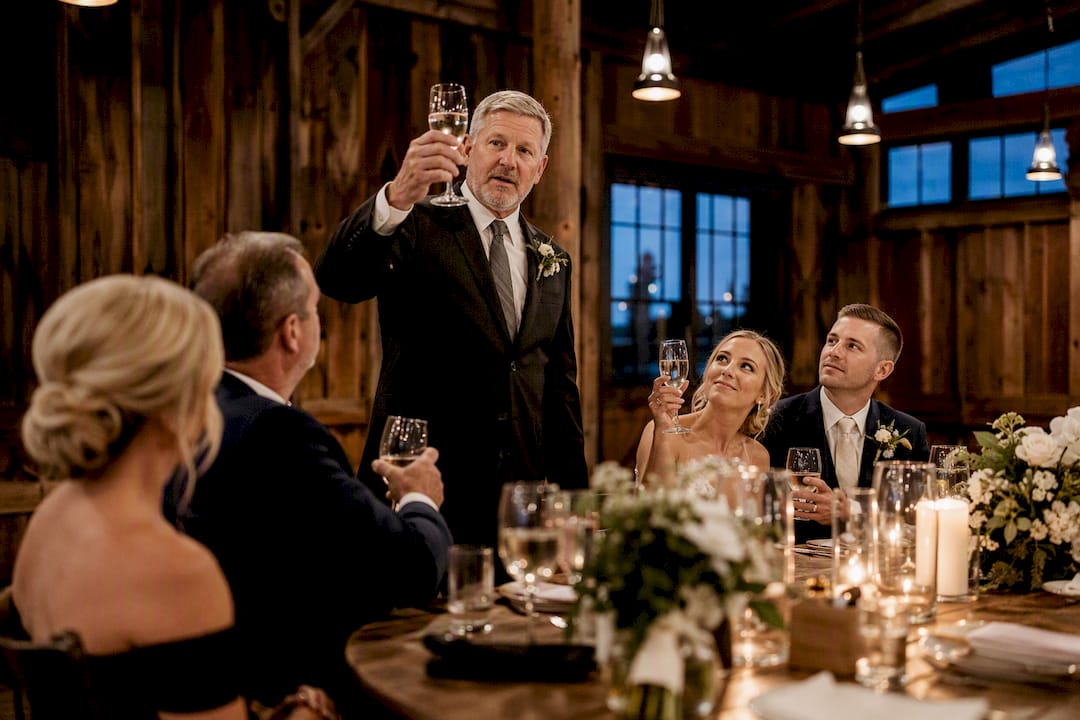
Parents giving a blessing during the reception can lean on Psalm 127:1 or Philippians 1:9-11, both of which speak naturally to watching a child build a life and a household. If your reception includes a toast, pairing a scripture line with the actual drink in hand adds a nice touch. Some couples work a short blessing into their reception toast lineup right before the glasses are raised, letting the verse set the tone before the celebration continues.
Our Take on Choosing Wedding Scripture
Most wedding-verse lists treat scripture like decoration, something to make a program look nicer or fill a quiet moment before the vows. That undersells what these passages actually do. The couples we have watched get this right are not the ones who found the prettiest verse. They are the ones who picked passages that matched how they actually talk to each other, then trusted an officiant or reader to deliver it without over-rehearsing the emotion out of it.
The conventional advice oversells 1 Corinthians 13 as a default choice, and undersells verses like Ruth 1:16-17 or Ecclesiastes 4:9-12 that carry just as much weight but require a little more thought to place well. If we had to prioritize one piece of advice, it is this: choose your translation before you choose your verse. A passage that sounds hollow in one translation can feel completely different in another, and that decision shapes everything downstream, from how your reader rehearses to how the words land with your grandparents in the third row.
— Origins
Sources
For readers who want the full lectionary lists or deeper compilations beyond this shortlist:
- 30 Inspiring Bible Verses for Weddings
- Readings for Celebrating Matrimony (diocesan lectionary guidance)
- Popular Wedding Bible Verses: 25 Meaningful Scriptures for Your Wedding Ceremony
FAQ
What is the best Bible verse about marriage?
1 Corinthians 13:4-8 is the most widely used wedding passage, though Genesis 2:24 is considered the foundational biblical text on marriage itself.
What is the most romantic Bible verse for a wedding?
Song of Solomon 8:6-7 is often cited as the most romantic choice, with its imagery of love as a seal set upon the heart that cannot be bought or extinguished.
What is a powerful prayer or blessing for a marriage?
Numbers 6:24-26, the traditional priestly blessing, is one of the most commonly used closing blessings in wedding ceremonies, valued for its formal, elevated language.
What are good Old Testament readings for a wedding?
Genesis 2:24, Ecclesiastes 4:9-12, Ruth 1:16-17, and Song of Solomon 8:6-7 are the most frequently chosen Old Testament readings, each covering a different theme from covenant to loyalty to romantic love.
Do I need my officiant's approval before choosing a verse?
Yes, especially for formal liturgical services. Catholic ceremonies require readings from an approved lectionary list, so confirm your choices with your officiant early in planning.