

TL;DR:
- Confirming the officiant's arrival time, ceremony length, and rehearsal attendance prevents delays.
- A single, coordinated entry into a shared vendor registry ensures smooth communication and reduces chaos.
Confirm your officiant's exact arrival time, setup window, and ceremony duration, then record all three in your central vendor registry today. That single action prevents the most common ceremony delays.
- Contact your officiant now to lock in arrival time, ceremony length, and rehearsal attendance.
- Open your vendor registry (a shared spreadsheet or planning app) and create a dedicated officiant entry.
- Set your ceremony start time as the fixed anchor for every other vendor's schedule.
Every other step in this guide builds from those three actions.
Table of Contents
- What should you confirm with your pastor or officiant?
- How do you build a centralized officiant entry in your vendor registry?
- How does a reverse timeline set the officiant's arrival window?
- What is the 3-Wave Confirmation Protocol for your officiant?
- Who runs the rehearsal, and what does the officiant need to know?
- Who is responsible for the marriage license?
- What happens on the wedding day, and who meets the officiant?
- What is your backup plan if the officiant is late or cannot make it?
- Copy-ready templates you can use right now
- Key Takeaways
- What we've learned coordinating officiants at Origins Ranch
- Originsranch is ready to help you coordinate your ceremony
- Useful sources for verifying marriage license rules
- FAQ
What should you confirm with your pastor or officiant?
Use this checklist before you send any other communication. Print it, forward it, or paste it into your planning app.
- Officiant's full legal name, phone number, and email
- Confirmed ceremony date, start time, and expected length
- Arrival time and setup time needed before the processional
- Who brings the marriage license to the venue and where it is stored after signing
- Rehearsal attendance: confirmed yes/no, and whether a separate rehearsal fee applies
- Microphone/AV needs and any accessibility requirements
- Payment amount, due date, and contract signature status
- Dress code, attire color, or religious vestment notes
- Any rituals, readings, or blessings that require props, candles, or additional setup time
- Emergency contact and preferred communication method (text vs. call vs. email)
How do you build a centralized officiant entry in your vendor registry?
Most weddings involve 8 to 15 vendors, each operating on a separate schedule and payment timeline. A single officiant entry in your centralized vendor registry keeps that complexity from becoming chaos.
| Field | What to Record |
|---|---|
| Full name and title | Legal name as it appears on credentials |
| Primary contact | Cell phone and email; note preferred method |
| Availability confirmed | Date, ceremony start time, rehearsal date |
| Service scope | Ceremony only, rehearsal included, script writing |
| Fee and payment schedule | Total fee, deposit paid, balance due date |
| Contract status | Signed / unsigned / pending |
| Special requirements | AV needs, attire, ritual props, accessibility |
| Emergency contact | Name and phone of backup contact |
One source of truth means no conflicting timelines and no lost confirmation emails buried in an inbox. When your planner, venue coordinator, and officiant all reference the same document, last-minute surprises shrink dramatically.
Pro Tip: Record the officiant's emergency contact and preferred communication channel in the registry on day one. If your primary contact goes unanswered 48 hours before the wedding, you need a direct path to reach them, not a voicemail box.
How does a reverse timeline set the officiant's arrival window?
Ceremony start time is the anchor for your entire day. An officiant who runs 45 minutes instead of an assumed 20 will cascade delays into photography, catering, and the reception. Confirm the exact ceremony length early and build your timeline backward from there.
Here is a sample reverse timeline anchored on a 4:00 PM ceremony start:
| Time | Who | Action |
|---|---|---|
| 2:00 PM | Venue | Ceremony space open for vendor access |
| 2:30 PM | Musicians / DJ | Sound equipment setup begins |
| 3:00 PM | Officiant | Arrives, meets day-of point-of-contact |
| 3:15 PM | Officiant | Microphone check, position walk-through |
| 3:30 PM | Photographer | Ceremony space detail shots |
| 3:45 PM | Wedding party | Lines up for processional |
| 4:00 PM | All | Processional begins |
| 4:25 PM | Officiant | Pronouncement and kiss cue |
| 4:30 PM | All | Recessional, DJ starts exit music |
Share this table with every vendor. When everyone knows the fixed ceremony window, they can set their own prep schedules without asking you to repeat the same information five times.
What is the 3-Wave Confirmation Protocol for your officiant?
Three structured check-ins replace the anxiety of wondering whether your officiant has the right details. Systematic confirmations are what separate a smooth ceremony from a frantic one.
Wave 1: 30 days out
Confirm the big three: date, time, and fee. Ask the officiant to reply confirming all three in writing. This is also the moment to share a draft ceremony timeline and request a copy of their ordination or credentials if your county requires it.
Wave 2: 7 days out
Send operational details. Include:
- Exact arrival time and parking instructions
- Name and cell number of the day-of point-of-contact
- Rehearsal date, time, and location
- Final ceremony timeline (one clearly labeled document, not a revised version of an earlier draft)
- Any last-minute script or ritual changes, highlighted separately so the officiant does not have to hunt for updates
Wave 3: 48 hours out
A short, friendly confirmation text:
If no response arrives within 12 hours, call directly. If still no answer, activate your contingency plan (see Section 9).
Who runs the rehearsal, and what does the officiant need to know?
The planner and the officiant share the rehearsal, but they own different parts. The planner typically runs processional logistics: who walks with whom, walking pace, and where everyone stands. The officiant runs the ceremony portion: vow delivery, ring exchange, and the pronouncement sequence.
Prioritize these attendees: the full wedding party, any readers or ritual participants, the officiant, and the planner or venue coordinator. Rehearsing at the actual venue is preferable because it surfaces venue quirks like sound dead zones, uneven floors, or narrow aisles. If the venue slot is unavailable, hold the rehearsal off-site but make sure the officiant and planner attend together.
The officiant should share their final words with the DJ or musician before the rehearsal ends. That phrase is the recessional cue. Without it, the DJ is guessing, and the music either starts too early or too late.
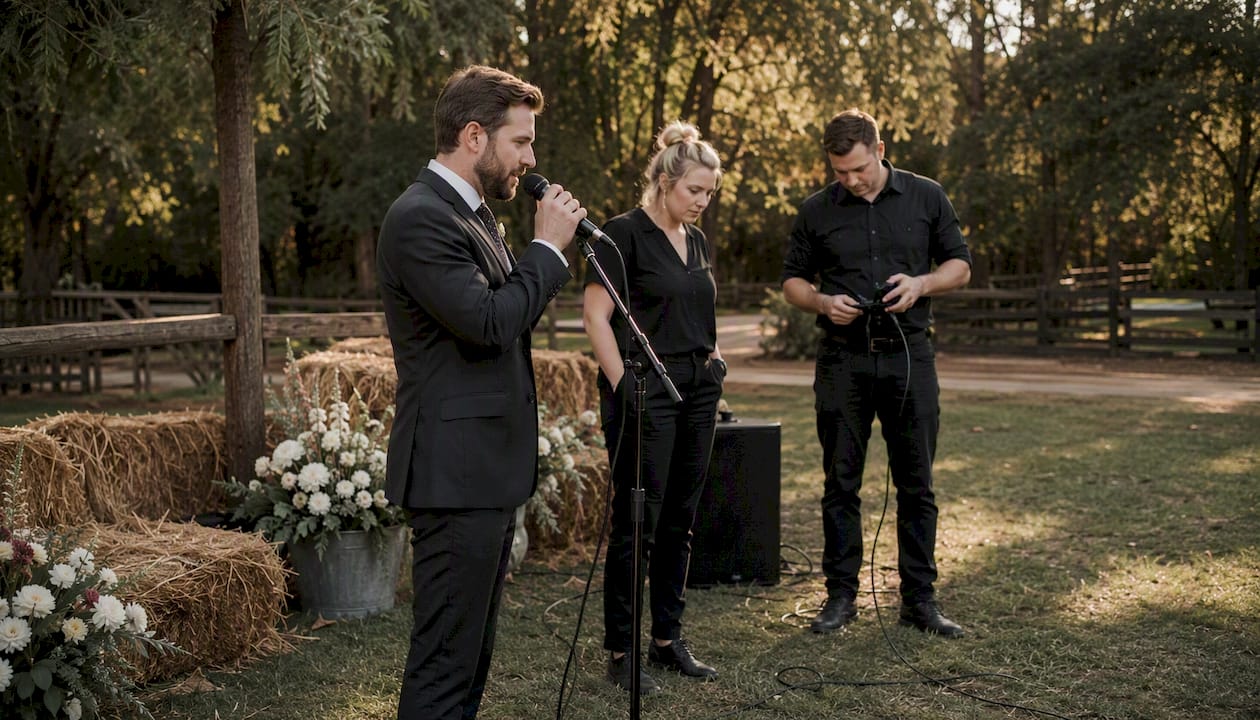
Pro Tip: Test the microphone at rehearsal with the officiant speaking at their natural ceremony volume, not a soundcheck shout. Check line-of-sight from the back row. Walk the processional at the actual pace, not a hurried run-through.
Distribute one clearly labeled final timeline at rehearsal, printed and in hand. If changes occur after that, send a short highlighted change note rather than a full revised document.
Who is responsible for the marriage license?
The officiant typically brings the marriage license to the ceremony, signs it immediately after the pronouncement, and files it with the county clerk within the required window (usually 3–10 days, depending on state law). Confirm this arrangement explicitly; never assume.
Key timestamps to track:
- Obtain the license from your county clerk at least 3–5 business days before the wedding (some counties have a waiting period after issuance).
- Hand the license to the officiant at the rehearsal or at the ceremony venue no later than 30 minutes before the start.
- Collect the signed license from the officiant before they leave the venue.
Pro Tip: Call your county clerk's office directly to confirm ID requirements, witness rules, and whether notarization is needed. Rules vary by county and change periodically. Do not rely on a general internet search for this.
What happens on the wedding day, and who meets the officiant?
Assign one day-of point-of-contact (POC) before the wedding day. This is the venue coordinator, planner, or a designated family member who knows the timeline cold.
Their duties:
- Meet the officiant at the venue entrance at the confirmed arrival time
- Walk them to the ceremony space and confirm microphone placement
- Hand over the marriage license and confirm the signing plan
- Communicate the seating cue (when guests are seated and the processional is ready to begin)
- Conduct time checks at 30 minutes, 15 minutes, and 5 minutes before the processional. See the benefits of a wedding event coordinator explained for how this role supports a smooth ceremony.
After the ceremony, the POC collects the signed license, photographs both sides for your records, and confirms the officiant knows the filing deadline. The venue coordinator role is built for exactly this kind of structured handoff, which is why having one on-site matters so much.
What is your backup plan if the officiant is late or cannot make it?
Three options, in priority order:
- Venue-hosted contact: Ask your venue whether they maintain a preferred vendor list that includes backup officiants. Originsranch keeps preferred vendor relationships that can help in exactly this situation.
Decision rule: If the officiant is more than 20 minutes late with no contact, activate option one. If no backup officiant is reachable within 30 minutes of ceremony start, proceed with option three and schedule a formal ceremony later.
Pro Tip: Store your backup contact list in the same registry entry as your primary officiant. One document, one place, no searching under pressure.
Copy-ready templates you can use right now
Registry entry template:
- Name: [Full legal name]
- Phone / Email: [Cell] / [Email]
- Preferred contact: [Text / Call / Email]
- Ceremony date and time: [Date], [Start time]
- Arrival time: [Time]
- Service scope: [Ceremony only / Rehearsal included]
- Fee: $[Amount] | Deposit paid: $[Amount] | Balance due: [Date]
- Contract signed: [Yes / No]
- Special requirements: [AV, attire, props]
- Emergency contact: [Name, phone]
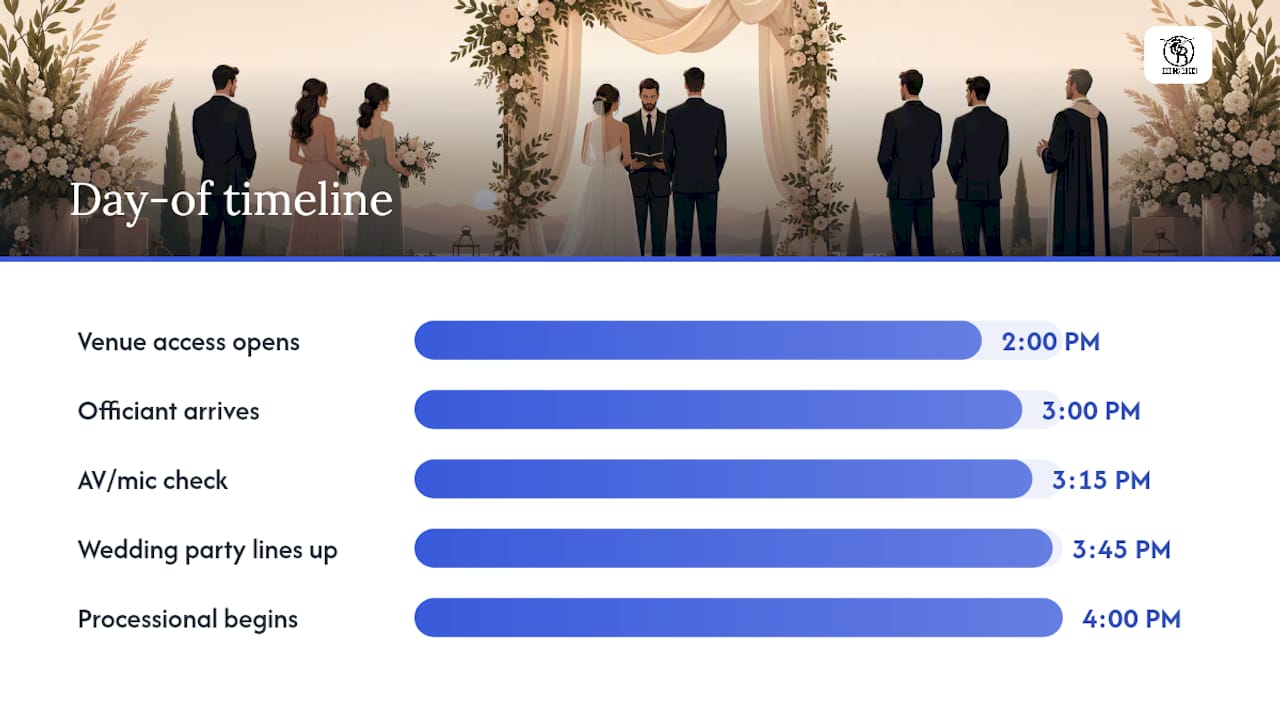
Sample reverse timeline (4:00 PM ceremony):
| Time | Milestone |
|---|---|
| 2:00 PM | Venue access opens |
| 3:00 PM | Officiant arrives |
| 3:15 PM | AV/mic check |
| 3:45 PM | Wedding party lines up |
| 4:00 PM | Processional begins |
| 4:25 PM | Pronouncement and kiss |
| 4:30 PM | Recessional |
Wave 1 message (30 days): "Hi [Name], we're confirming your services for [date] at [time] at [venue]. Total fee is $[amount], with balance due [date]. Please reply to confirm all details are correct."
Wave 2 message (7 days): "Hi [Name], here are your day-of details: arrival at [time], parking at [location], contact [POC name] at [phone]. Rehearsal is [date] at [time]. Final timeline attached."
Rehearsal order: Welcome and introductions → processional walk-through (twice) → officiant ceremony run-through → recessional → cue debrief with DJ and photographer.
Customize names, times, and venue details before sending. For a full step-by-step wedding checklist that pairs with these templates, couples can find one ready to adapt.
Key Takeaways
Coordinating your pastor or officiant well requires locking in ceremony timing early, running three structured confirmations, and assigning one person to manage the day-of handoff.
| Point | Details |
|---|---|
| Lock ceremony length first | Confirm exact duration with the officiant and record it in your vendor registry immediately. |
| Run the 3-Wave Protocol | Confirm at 30 days, 7 days, and 48 hours; escalate to a call if the 48-hour message goes unanswered. |
| Test AV at rehearsal | Have the officiant speak at ceremony volume during the mic check, not a quick soundcheck. |
| Assign one day-of POC | One person meets the officiant, hands the license, and runs time checks from arrival through recessional. |
| Originsranch supports this | Originsranch's on-site coordinator handles the officiant meet-and-greet, printed timeline handoff, and license logistics at the venue. |
What we've learned coordinating officiants at Origins Ranch
After years of hosting weddings at Originsranch, the pattern is consistent: the ceremonies that run beautifully are the ones where the officiant felt supported from the moment they arrived. That means someone waiting at the entrance, a printed timeline already in hand, and a microphone that was tested the night before.
The couples who struggle are almost always the ones who assumed the officiant "just knows" where to go and what to do. Officiants are talented at the ceremony itself. The logistics around it are the venue's and planner's job to own.
We have seen a 25-minute ceremony stretch to 50 minutes because the script was never confirmed. We have seen a recessional start with dead silence because no one told the DJ the final words. Both situations are entirely preventable with the systems in this guide.
The vendor coordination workflow we use at Originsranch puts the officiant at the center of the ceremony timeline, not as an afterthought. When the officiant is coordinated well, every other vendor falls into place around them.
Originsranch is ready to help you coordinate your ceremony
At Originsranch in Plant City, FL, our on-site team meets your officiant at arrival, delivers a printed timeline at rehearsal, and manages the marriage license handoff so you are not tracking paperwork on your wedding day. Our venue coordinator is your day-of POC, built into every event we host.

We are especially proud to support military couples through our Weddings For Warriors program, dedicated to helping Veterans and Active Duty service members celebrate their dream weddings with the care and honor they deserve.
Whether you need full day-of coordination or just a venue that runs like clockwork, we would love to be part of your day. Reach out to Originsranch to check your date and talk through what ceremony support looks like for your wedding.
Useful sources for verifying marriage license rules
Marriage license requirements vary by county and change periodically. Verify these items directly with your local county clerk:
- Wedding vendor coordination — systems planners use
- How to Send Timeline to Officiant: A Clear Wedding Ceremony Communication Guide
- What Wedding Planners Wish Wedding Officiants Knew… | AMM Blog
- Effective Communication & Coordination When Hiring a Wedding Officiant | Event Plan With ME
- Wedding Rehearsal FAQs
- How to Coordinate Wedding Vendors Like a Pro
For Florida couples, the Hillsborough County Clerk's office is the starting point for Plant City weddings. Confirm rules at least 60 days before your date, not the week before.
FAQ
Who is responsible for the marriage license at a wedding?
The officiant typically brings, signs, and files the marriage license, but the couple must obtain it from the county clerk in advance. Confirm this arrangement explicitly with your officiant during the 30-day confirmation wave.
How early should the officiant arrive before the ceremony?
Plan for the officiant to arrive about 60 minutes before the processional. That provides time for parking, a venue walk-through, microphone check, and a brief review of the timeline with the day-of point-of-contact.
What questions should you ask when hiring a wedding officiant?
Ask about ceremony length, rehearsal attendance and fees, script customization, ordination credentials, payment terms, and their protocol if they are running late. Record every answer in your vendor registry.
How does the 3-Wave Confirmation Protocol work?
Send three structured check-ins: at 30 days (confirm date, time, and fee), at 7 days (send operational details and final timeline), and at 48 hours (a short confirmation text with the POC's phone number). If the 48-hour message goes unanswered within 12 hours, call directly.
Can Originsranch help coordinate the officiant on the wedding day?
Yes. Originsranch's on-site coordinator meets the officiant at arrival, delivers the printed timeline, manages the marriage license handoff, and runs time checks through the recessional as part of the venue's day-of support.