
TL;DR:
- Using venue's preferred vendors provides familiarity and reduces logistical surprises on your wedding day.
- While they offer benefits like site knowledge and reliable performance, always interview vendors and verify if lists are advisory or contractual requirements.
Yes, using your venue's preferred vendors is generally a smart move — and venue familiarity is the single strongest reason why. Vendors who have worked a space before know its quirks, its staff, and its rhythms in ways that outside vendors simply don't on day one.
- In favor: Preferred vendors have already proven themselves at your venue. They know the load-in routes, the power circuits, the noise curfews, and the staff by name — which means fewer surprises on your wedding day.
- Caveat: The list is curated for venue compatibility, not necessarily for your personal style or budget. Some vendors may also pay a fee to appear on the list, which can affect pricing transparency.
Treat the preferred list as your starting point, not your final answer. Interview every vendor on it, ask how the list was created, and request an exception if someone you love isn't on it.
Table of Contents
- What is a preferred vendor list, and how does it differ from required lists?
- Why choosing vendors from your venue's preferred list pays off
- Drawbacks and trade-offs worth knowing before you commit
- How venues typically vet and build their preferred vendor lists
- Can you bring outside vendors, and how do you request an exception?
- How to decide: a quick scoring checklist
- Why venues like Originsranch build preferred vendor lists
- Key Takeaways
- A venue owner's honest take on preferred vendor lists
- Originsranch: a venue that works with you, not around you
- Useful sources
- FAQ
What is a preferred vendor list, and how does it differ from required lists?
A preferred vendor list is a venue's curated set of recommendations — vendors who have worked the space before, met the venue's standards, and earned a spot through consistent performance. Using them is almost always optional. Think of it as a trusted shortlist, not a mandate.
Where things get more serious is with approved or exclusive/required lists. Here's how the three types differ in practice:
- Preferred list: Advisory only. You may bring outside vendors, though the venue may ask for documentation.
- Approved list: A narrower pool. Your vendor must be on the list or formally approved before the event. Outside vendors are allowed but require vetting.
- Exclusive/required list: Mandatory. The venue contracts with specific suppliers (often for catering or AV), and you have no option to substitute. This is common with in-house caterers.
When you review a venue contract, watch for phrases like "all vendors must be selected from the approved list" or "outside vendors require prior written approval and an additional fee." Those are the signals that tell you whether you're dealing with a suggestion or a restriction. A contract that says "preferred vendors are recommended" gives you full creative freedom.
Pro Tip: Ask the venue coordinator directly: "Is this list advisory, or are there categories where we're required to use your vendors?" Get the answer in writing before you sign.
Why choosing vendors from your venue's preferred list pays off
The benefits of preferred vendors go well beyond convenience. They touch logistics, cost, and the overall feel of your day.
They already know the space
Preferred vendors carry site-specific knowledge that no amount of pre-event research fully replicates. A DJ who has played your venue before knows exactly which power circuits handle a high-draw rig without tripping a breaker. A florist who has set up in that ballroom knows the ceiling height, the natural light at 5 PM, and which service entrance keeps deliveries invisible to guests. That operational knowledge reduces day-of technical failures and guest disturbances in ways that matter when you're trying to be present for your own wedding.

Coordination happens faster
When vendors already share communication channels and respect each other's working styles, setup time shrinks and miscommunication drops. A pre-integrated team spends less time figuring out who does what and more time executing your vision. That's especially valuable during the compressed window between ceremony end and reception start.
Reliability is baked in
Venues curate these lists to protect their own reputation. A single bad event can damage a venue's standing in the community, so the incentive is always toward performance and consistency, not just familiarity. Preferred status is typically earned through repeated, high-quality work across multiple events at that specific location.
You may get perks you wouldn't find elsewhere
Vendor partnerships sometimes produce discounts, package upgrades, or bundled services that aren't available to couples who book those same vendors independently. It's worth asking each vendor directly: "Do you offer anything special for couples booking through this venue?"
For couples planning from out of town, the advantages of venue vendors are even sharper. When you can't visit every local florist or photographer in person, a vetted shortlist from a venue you already trust does a lot of the legwork for you.
Pro Tip: Ask for portfolio samples and a scoped deliverables list from any preferred vendor before you commit. Venue-compatible doesn't automatically mean style-compatible — confirm both.
Drawbacks and trade-offs worth knowing before you commit
No list is perfect, and understanding the downsides protects you from surprises.
Creative mismatch is real. A vendor earns preferred status by working well with the venue, not by matching your aesthetic. A photographer on the list might shoot in a style you don't love. Always review portfolios before booking, regardless of how glowing the venue's recommendation is.
Some lists aren't purely merit-based. Certain venues accept annual fees or per-client payments from vendors in exchange for a spot on the list. That doesn't make those vendors bad — but it does mean the list may not be a pure quality ranking. Ask the venue coordinator directly how vendors are selected and whether any pay to be included.
Availability can be tight. A small preferred pool means popular dates fill up fast. If you're booking a peak-season Saturday, your favorite photographer on that list may already be taken.
Red flags to watch for in contracts:
- A clause requiring all vendors to come from a single exclusive list with no exception process
- Mandatory fees for bringing outside vendors that aren't disclosed upfront
- No full contact details provided for listed vendors (name, license, insurance)
- Language that bundles vendor fees into the venue rental without itemizing them
When you spot any of these, ask for clarification before signing. A transparent venue will answer those questions without hesitation.
How venues typically vet and build their preferred vendor lists
The quality behind a preferred list depends entirely on how seriously the venue takes its vetting process. Strong venues treat it like a preferred supplier program — with documented criteria, periodic reviews, and accountability built in.
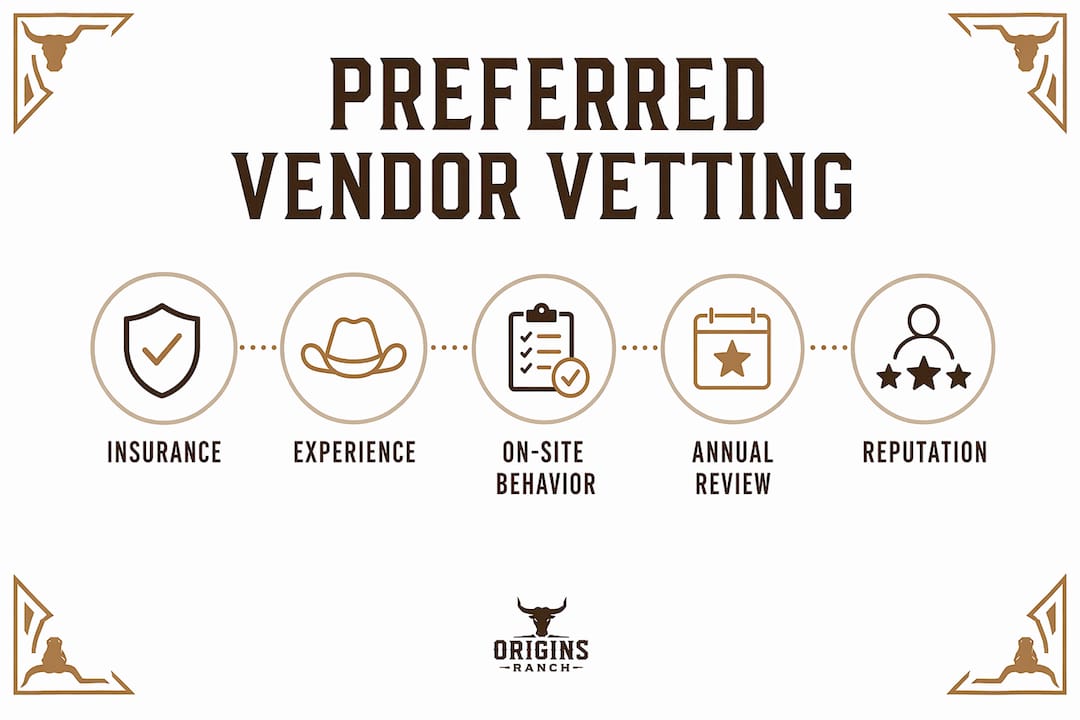
Here's what a thorough vetting process typically covers:
| Vetting Criterion | What Venues Check |
|---|---|
| Proof of insurance | General liability COI, naming the venue as additionally insured |
| Business license | Valid state or local license for the vendor's category |
| References | Feedback from prior events at the venue or comparable spaces |
| Equipment compatibility | Power draw, load-in dimensions, noise levels within venue limits |
| Staffing ratios | Adequate crew for the event size and timeline |
| Venue policy knowledge | Familiarity with load-in/out windows, alcohol service rules, noise curfews |
| Performance history | Consistent, high-quality results across multiple events |
Beyond the paperwork, most venues also look at how a vendor behaves on-site. Do they communicate proactively? Do they respect other vendors' timelines? Do they leave the space the way they found it? Those soft factors matter as much as the documents.
Lists are typically maintained by the venue's events manager or owner and reviewed at least annually. Vendors who generate complaints or fail to meet standards are removed. That ongoing accountability is part of what makes a well-maintained list worth trusting.
Can you bring outside vendors, and how do you request an exception?
Most venues will work with outside vendors if you approach the request the right way. Standard documentation is usually all it takes to get approval.

Policy types and what they mean for outside vendors
| Policy Type | What It Means | Outside Vendors Allowed? |
|---|---|---|
| Preferred list | Advisory recommendations only | Yes, freely |
| Approved list | Vendor must be vetted and approved | Yes, with documentation |
| Exclusive/required list | Specific vendors are contractually required | No (or very limited exceptions) |
What venues typically require to approve an outside vendor
- Certificate of Insurance (COI) naming the venue as additionally insured, with minimum coverage limits the venue specifies.
- Valid business license for the vendor's category in your state or county.
- Two to three references from comparable events, ideally at similar venue types.
- Day-of contact information — a named point of contact who will be on-site.
- Site walk-through agreement — many venues ask that outside vendors visit before the event to review load-in routes, power access, and venue policies.
How to request an exception
- Confirm the venue's policy type in writing before your conversation.
- Gather all required documents from your vendor in advance.
- Send a brief, professional request to your venue coordinator.
- Offer to have the vendor do a site walk-through.
- Ask whether an additional deposit or coordination fee applies and get that in writing.
Sample request email you can adapt:
Understanding how venue preferred supplier lists work in practice makes this conversation much easier to navigate.
How to decide: a quick scoring checklist
Three questions cut through most of the uncertainty when you're weighing whether to book from the preferred list or bring someone outside.
Quick rubric — answer yes or no:
- Fit: Does at least one vendor on the preferred list match your style, portfolio, and personality? Yes = lean toward the list. No = start the exception process.
- Logistics risk: Is your wedding date a high-traffic weekend, or are you planning from out of town? Yes = preferred list reduces risk significantly. No = outside vendors are more manageable.
- Budget alignment: Do the preferred vendors' pricing fit your budget without stretching it? Yes = strong case for the list. No = compare carefully before assuming outside vendors are cheaper.
Decision checklist before you book:
- Review every preferred vendor's portfolio and recent reviews independently
- Ask each vendor: "How many events have you done at this venue in the past year?"
- Confirm whether any vendor paid a fee to appear on the list
- Check vendor availability for your date before falling in love with their work
- Ask the venue for references from couples who used each vendor
- Review your wedding vendor selection priorities against each candidate
After scoring, your next steps are straightforward: book a venue walk-through, schedule vendor interviews, and prepare your exception packet if you need it. A solid step-by-step wedding checklist keeps all of this on track.
Why venues like Originsranch build preferred vendor lists
Venues don't curate vendor lists to limit your choices. They do it because their reputation lives or dies by how every event goes. One chaotic wedding — a DJ who can't find the right circuit, a caterer who runs out of food at 7 PM — reflects on the venue as much as the vendor. That's why venues are motivated to favor performance and reliability over short-term financial gain.
At Originsranch, that perspective comes with real depth. Our founder Barry brings over 20 years in the event service industry, including his own background as a professional DJ. He understands exactly what vendors need to execute flawlessly in a barn setting — the power requirements, the acoustics, the timing of a ceremony-to-reception transition. That firsthand knowledge shapes every recommendation we make.
The strategic role of venue staff in coordinating vendor teams is something couples often underestimate. When vendors and venue staff already know each other, setup conflicts disappear, load-in runs on schedule, and the couple gets to focus on the people they love rather than logistics.
What Originsranch looks for in every vendor on our list:
- Proven experience at barn-style venues with specific knowledge of outdoor-to-indoor transitions
- Valid COI and business license, current and on file
- Consistent communication and professionalism across multiple events
- Willingness to collaborate with other vendors rather than work in silos
- Respect for venue policies, including noise curfews and load-out windows
We also welcome why venues partner with entertainment companies as a lens for understanding how these relationships serve couples, not just venues.
Key Takeaways
Using a venue's preferred vendor list gives you a vetted, pre-integrated team that reduces day-of risk — but it works best when you interview vendors for style fit and ask how the list was built.
| Point | Details |
|---|---|
| Preferred vs. required | Preferred lists are advisory; approved and exclusive lists carry contractual weight — know which you're dealing with. |
| Strongest benefit | Preferred vendors know site-specific logistics (power, load-in, staff) that reduce day-of failures. |
| Key caveat | Some vendors pay to appear on lists; always ask how the list was created before trusting it blindly. |
| Outside vendors | Most venues approve outside vendors with a COI, business license, and references — ask early. |
| Originsranch approach | Originsranch maintains a performance-based list and welcomes exception requests for vendors couples already love. |
A venue owner's honest take on preferred vendor lists
Preferred vendor lists get a bad reputation sometimes, and I understand why. Couples worry they're being steered toward vendors who paid for placement, or that their creative vision will get squeezed into a box. That concern is fair — and it's exactly why transparency matters so much.
The lists we build exist for one reason: to protect your day. When a vendor walks into Originsranch for the first time on your wedding morning, there's a learning curve. Where's the power? Which entrance keeps the florals away from guests? How does the venue team communicate during setup? A vendor who already knows those answers isn't just convenient — they're a genuine asset to your experience.
Here's how to get the most out of any venue's preferred list:
- Preserve your creative vision by treating the list as a starting pool, not a final roster. Interview every vendor for personality and portfolio fit, not just venue experience.
- Approach exception requests early. The best time to ask about an outside vendor is before you sign the contract, not two weeks before the wedding. Venues are far more flexible when there's time to complete the approval process properly.
- Use the site visit strategically. Bring your outside vendor candidates to the walk-through. Seeing the space together answers questions faster than any email chain, and it shows the venue you're serious about a smooth event.
Originsranch: a venue that works with you, not around you
Planning a wedding means making hundreds of decisions, and vendor selection is one of the most personal. At Originsranch in Plant City, FL, our preferred vendor list is built on two decades of event experience and a genuine commitment to making your day go beautifully. Every vendor on our list has worked our barn, knows our team, and has earned their place through results.
We also know that your perfect wedding might include someone who isn't on our list yet — and that's completely fine. Our team is happy to walk you through the exception approval process, which typically requires a COI, business license, and a brief site walk-through. No surprises, no unnecessary hurdles.
Ready to see the space and request our preferred vendor list? Tour the ranch and let's start planning together. Whether you're booking a barn wedding, a quinceañera, or a military celebration through our Weddings For Warriors program, we're here to make it extraordinary.
Useful sources
- Why you should use a wedding venue's preferred vendor list — A practical breakdown of how preferred vendors improve event quality and reduce day-of risk.
- Ask the Expert: Do I Have to Use My Venue's Preferred Vendors? — Philadelphia Magazine's expert Q&A clarifying what "preferred" actually means and when you have a choice.
- Preferred Vendor List: What You Need to Know — Covers how lists are built, whether vendors pay for placement, and what questions to ask before signing.
- Should I Use My Wedding Venue's Recommended Vendors? — Especially useful for destination or out-of-town couples weighing the value of local venue recommendations.
- Wedding Vendor Selection Workflow — Originsranch's step-by-step guide to interviewing and selecting vendors with confidence.
- How to Coordinate Wedding Vendors Like a Pro — Practical coordination tips for couples managing multiple vendors at a barn-style venue.
FAQ
Why do venues have preferred vendors?
Venues build preferred lists to protect their reputation and ensure consistent event quality. Vendors on the list have a proven track record at that specific space, which reduces day-of coordination failures and reflects well on both the venue and the couple.
What does being a preferred vendor actually mean?
A preferred vendor has been vetted by the venue for insurance, experience, and reliable performance across multiple events. The designation is typically advisory — couples aren't required to use them, but the recommendation carries real weight.
What is the difference between a venue and a vendor?
The venue is the physical space where your event takes place; vendors are the service providers (photographers, caterers, DJs, florists) you hire to bring the event to life. At Originsranch, we're the venue — and our preferred vendor list connects you with the service professionals who know our space best.
Can I bring my own vendors if the venue has a preferred list?
Most venues, including Originsranch, will approve outside vendors who supply a certificate of insurance, a valid business license, and references. The key is asking early — before you sign the contract — so there's time to complete the approval process without pressure.
Do preferred vendors cost more than booking independently?
Not necessarily. Some preferred vendors offer package upgrades or discounts through their venue partnership that aren't available when booked independently. Always ask each vendor directly whether they offer any special pricing for couples booking through the venue.