
A food and beverage minimum is a dollar floor a venue requires you to spend on catering and drinks. If your order total doesn't reach it, you pay the difference as a shortfall fee, no exceptions. For a small wedding on a peak Saturday, that floor can be higher than your entire guest list would naturally spend.
TL;DR:
- Food and beverage minimums are set based on the venue and date, not guest count, with higher minimums on peak Saturdays and lower off-season or weekday rentals.
- Most contracts include in-house food, drinks, and rentals in the minimum, but outside vendors, corkage fees, and certain charges often sit outside that threshold.
- Actual total costs rarely match quoted minimums due to taxes, service charges, and gratuities, often increasing the final bill by 25 to 50 percent.
- Smaller weddings under 75 guests tend to pay higher per-person rates, and fixed staffing or rental costs can inflate expenses even if guest numbers are low.
- Negotiating for written clarity on what counts toward the minimum, flexible dates, and capped surcharges can significantly reduce surprises and hidden fees.
Table of Contents
- What Are Wedding Catering Minimums, Really?
- What Counts Toward the Minimum (and What Doesn't)
- The Real Numbers: Per-Person Costs and Sample Totals
- Reading the Banquet Event Order: Contracts, Shortfalls, and Hidden Fees
- How to Negotiate a Lower Effective Minimum
- A Venue Owner's View on Why Minimums Exist
- A Simpler Path: How Origins Ranch Approaches Catering Minimums
- Sources
- FAQ
What Are Wedding Catering Minimums, Really?
A food and beverage minimum protects the venue's revenue on a date it could have booked with a bigger, higher-spending event. The minimum is tied to the room and the date, not to your guest count, which is why a Saturday in October costs so much more to hit than a Tuesday in February.
Venues set these floors based on opportunity cost: the highest-demand dates carry the steepest minimums, while off-peak bookings are far more negotiable. That's a different concept from a guaranteed headcount, which is the number of guests you promise to pay for regardless of who actually shows up. You can meet a $10,000 F&B minimum with 60 guests ordering premium menus, or miss it entirely with 150 guests eating economically. The minimum cares about dollars spent, not seats filled.
What Counts Toward the Minimum (and What Doesn't)
Reading the fine print here saves couples real money. Most contracts count food and beverage purchases directly, but plenty of common wedding costs sit outside that number entirely.
Typically included:
- Plated dinners, buffet spreads, and passed appetizers
- Bar packages, whether hosted, cash, or a hybrid
- In-house rentals, when the contract specifically bundles them into F&B
Typically excluded:
- Outside-vendor buyouts (a food truck you bring in, a specialty dessert vendor)
- Corkage fees if you supply your own wine
- Cake-cutting fees and tasting-event charges, which vary by property
Taxes and mandatory service charges usually apply on top of whatever you spend, but whether they count toward the minimum itself is inconsistent from venue to venue. Ask for that in writing before you sign anything.
The Real Numbers: Per-Person Costs and Sample Totals
Per-person catering costs in 2026 typically run $85 to $175 depending on service style, with plated dinners costing more than buffets because they require more serving staff per table. Cocktail-style receptions with heavy passed hors d'oeuvres often land in the middle, since they trade sit-down labor for a higher volume of small dishes.
Here's how that scales with guest count on a mid-range buffet:
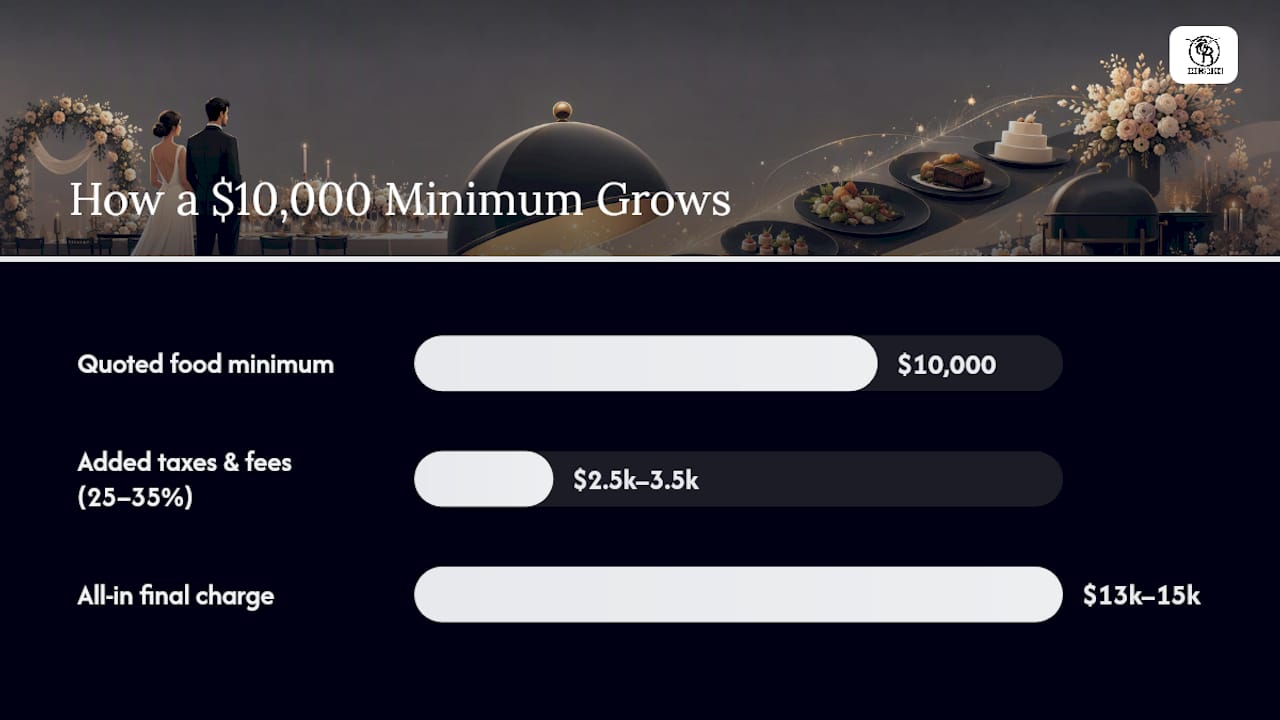
*All-in totals reflect the added 25 to 35 percent that taxes, service charges, rentals, and gratuity typically tack onto a base food quote.
Pro Tip: If your caterer quotes you $9,000 for food, don't assume that number is your budget. Multiply it by 1.3 to see what actually hits your card, then compare that figure to the venue's stated minimum.
That 25 to 35 percent gap is exactly why a quoted minimum can understate your final invoice by as much as 50 percent once every line item lands on the bill. A $10,000 minimum routinely becomes a $13,000 to $15,000 charge in practice. Guest count under 75 makes this worse, not better: fixed staffing and rental costs don't shrink with your list, so smaller weddings often pay a higher rate per plate just to clear the same minimum a bigger wedding would hit easily. Many caterers set separate minimum orders for small events to cover fixed costs, on top of whatever the venue requires.
Reading the Banquet Event Order: Contracts, Shortfalls, and Hidden Fees
The banquet event order (BEO) is where good intentions meet fine print. This document itemizes every charge tied to your event, and it's where shortfall math actually gets calculated.
If your total spend lands below the contracted minimum, the venue bills you for the gap, and in many contracts, the mandatory service charge applies to that shortfall too, not just to what you actually ordered. That's an easy detail to miss when you're skimming a 12-page agreement two weeks before your wedding.
Watch for these clauses specifically:
- Service charge vs. gratuity: A mandatory service charge of 18 to 22 percent is common, and contracts often state explicitly that it is not gratuity for staff. Tip separately if you want servers to actually see that money.
- Tax treatment: Confirm whether sales tax applies before or after the service charge, since some venues calculate it on the padded total.
- Payment timing: Final headcount and payment are usually due 7 to 30 days before the event, and disputing a final invoice after that point is far harder than catching an error beforehand.
Pro Tip: Ask your caterer to walk through a sample BEO from a wedding similar in size to yours. Seeing the real math on paper beats any verbal estimate.
How to Negotiate a Lower Effective Minimum
You have more leverage than most couples realize, especially before the contract is signed. Here's where to push.
- Ask exactly what counts. Get written confirmation of whether taxes, service charges, and rentals apply toward the minimum or sit on top of it.
- Shift your date or room. Off-peak months, Friday or Sunday events, and smaller rooms almost always carry lower minimums than a peak Saturday ballroom booking.
- Negotiate the headcount lock window. Push for a 7 to 10 day lock instead of 30, and ask for a permitted 10 percent downward adjustment if RSVPs come in lower than planned.
- Cap late-addition surcharges. Some contracts charge a premium for guests added after the lock date. Negotiate a flat cap instead of an open-ended penalty.
- Upgrade the menu instead of fighting the floor. If you're close to the minimum anyway, adding a passed dessert course or a specialty cocktail often costs less than a shortfall fee and gives guests something memorable. Menu ideas built for event planners can help you find upgrades that stretch your spend without inflating your headcount.
Pro Tip: Request an itemized all-in quote before you sign anything. Total the food, staffing, rentals, service charge, and taxes yourself, then compare that number to the stated minimum. Verbal estimates almost never match what the BEO shows later.
A Venue Owner's View on Why Minimums Exist
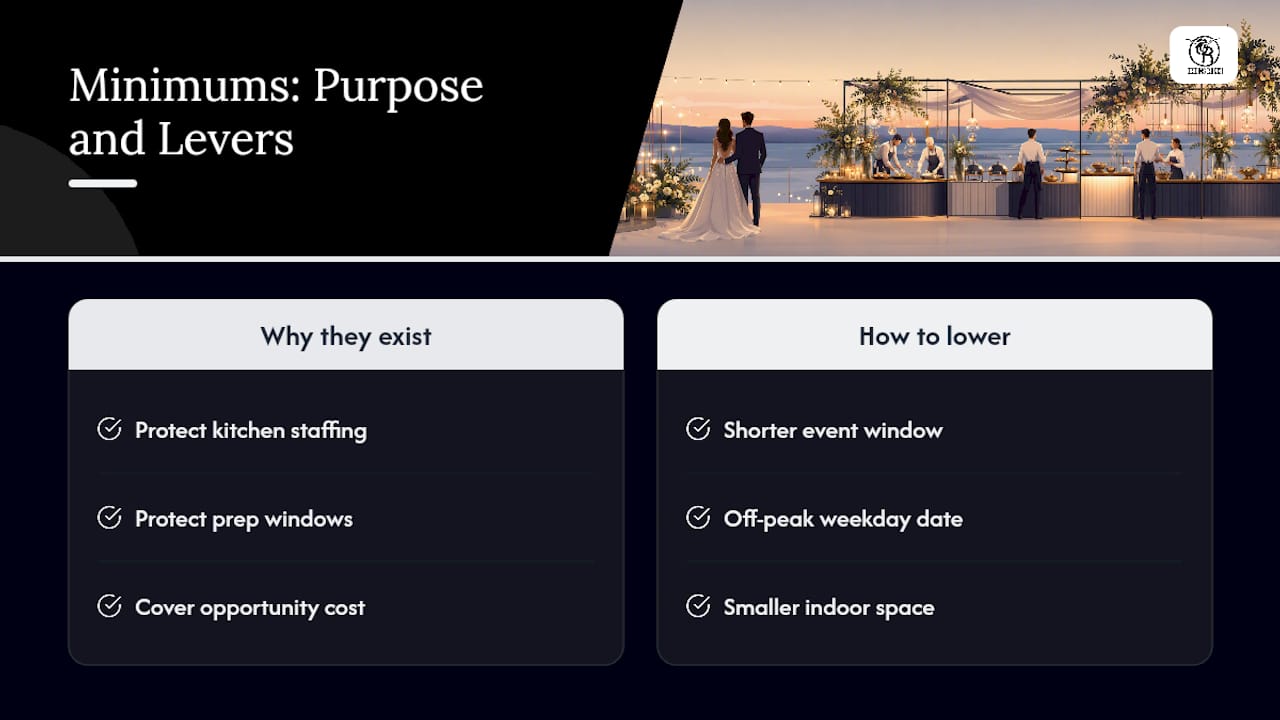
Minimums aren't a punishment. They're how a venue protects the kitchen staffing, the prep windows, and the opportunity cost of holding a date that could have gone to a bigger event. A Saturday in peak season only comes around so many times a year, and every venue has to plan its labor and inventory around whichever couple books it.
At a barn-style property, room choice and timeline matter even more than at a hotel ballroom. A shorter event window, an off-peak weekday, or a smaller indoor space instead of the full barn can bring the effective minimum down without touching the quality of your day.
— Origins
A Simpler Path: How Origins Ranch Approaches Catering Minimums
Origins Ranch is the alternative to guessing your way through a stacked banquet event order. Couples get a clear site fee, in-house catering options, and invoicing built around transparency rather than surprise charges buried on page nine of a contract.

If the math above has you nervous about hidden shortfall fees or a service charge disguised as gratuity, a venue with straightforward packages removes most of that risk before you ever sign. We built our barn wedding and event space in Plant City, Florida, around personalized attention, whether you're planning a full wedding, a quinceañera, or a smaller, intimate gathering. Through our founder Barry's charity, Weddings for Warriors, veterans and active-duty service members get extra support making their wedding vision real. You can also browse real reception setups in our event gallery to see what's included before you ever request a quote. If predictable, all-in pricing sounds better than another late-night contract review, reach out to check our available dates and start planning your day with us.
Sources
- How Do Food And Beverage Minimums Work: Shortfalls And Fees - LegalClarity
- Wedding Catering Cost Per Person (2026 Guide)
- Wedding Catering Costs: Real Numbers and Budget Tips - Zola
- Wedding catering contract: The headcount lock, the stacked service charge, and two other traps | Redline
FAQ
What is the 50/20/30 rule for weddings?
It's a rough budget split some planners use: 50 percent of your total budget toward venue and catering, 20 percent toward photography and entertainment, and 30 percent toward everything else, including attire, flowers, and stationery.
What is a reasonable budget for wedding catering?
For most U.S. markets, expect $85 to $175 per person depending on service style, then add 25 to 35 percent for taxes, service charges, and rentals to estimate your real all-in cost.
What is the 30-5 rule for weddings?
Definitions vary by source, but it commonly refers to guest-count planning guidance, roughly 30 guests per 5 tables or a similar seating ratio, rather than a fixed catering standard.
How do wedding food and beverage minimums work?
A venue sets a dollar floor for catering and bar spend tied to your date and room; if your total falls short, you pay the difference as a shortfall fee, often with the service charge applied on top.