
For most weddings, a pocket fold, a rectangular flat fold, and a simple fan give you the best mix of polish and speed. Pocket folds work best for tucking in menus, a loose knot or rose suits romantic and boho tables, and a fan or bishop's hat earns its place at formal head tables. The details below walk through how to fold each one, what fabric holds its shape, and how to plan the folding itself so it never becomes a day-before scramble.
TL;DR:
- Simple folds like the rectangle and pocket are quickest, taking about 30 seconds to 1.5 minutes each, suitable for large guest counts.
- Flower-shaped or sculptural folds such as the rose or bishop's hat require 2 to 4 minutes per napkin and need light starching to hold their shape.
- Linen napkins in the 20 to 22 inch size with creased texture work best for sculptural styles, while cotton is easier to iron for simpler folds, and polyester suits large, budget-conscious events.
- Folding should be done 24 to 48 hours before the wedding, with outdoor testing in wind conditions to ensure stability during the reception.
- Use a limited number of fold styles to create a calm, cohesive tablescape, avoiding mixing too many different shapes for a more polished look.
Table of Contents
- At-a-Glance Shortlist of Wedding Napkin Folds
- How to Fold Each Napkin Style Step by Step
- Choosing the Right Fabric and Prepping Your Napkins
- Setup Timing and Day-of Logistics
- Pairing Napkin Folds With Menus, Cards, and Table Themes
- Origins Ranch's Take on Napkin Details
- Sources
- FAQ
At-a-Glance Shortlist of Wedding Napkin Folds
Not every reception needs a sculptural showpiece. Some of the prettiest wedding tables lean on one or two creative napkin folds repeated consistently across dozens of place settings, rather than a different fold at every seat.
- Pocket fold: best for menus or place cards; beginner level; about 1 to 1.5 minutes each.
- Rectangle/flat fold: best for understated, formal settings and menu display; easiest option; roughly 30 seconds.
- Fan: formal, holds shape standing in a glass or laid on a plate; medium difficulty; 1.5 to 2 minutes.
- Loose knot: boho or casual tables; easy; about 45 seconds.
- Rose: romantic and photogenic; intermediate; 2 to 3 minutes.
- Waterfall/drape: relaxed and organic, especially good on long farm tables; easy; 30 to 60 seconds.
- Bishop's hat: sculptural and formal; advanced; 2 to 4 minutes.
- Wrap/roll: casual or modern; easy; 30 to 60 seconds.
Pick two or three from this list rather than mixing all eight. A tablescape reads calmer, and more expensive, when the eye sees repetition instead of eight competing shapes.
How to Fold Each Napkin Style Step by Step
Each of these folds works with a standard cloth dinner napkin. Practice on a few before the wedding so your hands know the motion, since speed comes from repetition, not talent.
1. Pocket fold (beginner, about 1 minute)
- Lay the napkin flat, wrong side up.
- Fold in half to form a rectangle, then in half again to form a square.
- Fold the top layer down diagonally to create a pocket flap.
- Tuck a folded menu, place card, or sprig of greenery into the pocket.
This fold is genuinely functional. It was built to hold a menu, cutlery, or a small sprig, which is why so many caterers default to it for plated dinners.
2. Rectangle/flat fold (easiest, about 30 seconds)
- Fold the napkin in half lengthwise.
- Fold in half again to form a long rectangle.
- Lay flat on the charger or under the plate with the folded edge facing the guest.
3. Fan fold (medium, 1.5 to 2 minutes)
- Fold the napkin in half.
- Starting from one edge, accordion-pleat the napkin in even 1 inch folds.
- Pinch the bottom third and let the top fan open, or set the pinched end into a water glass.
4. Loose knot (easy, about 45 seconds)
- Roll the napkin loosely into a long tube.
- Tie a single loose overhand knot near the center, leaving both ends relaxed.
- Lay across the plate or drape over the edge of a wooden charger.
5. Wrap/roll (easy, 30 to 60 seconds)
- Roll the napkin into a tight cylinder.
- Secure with a napkin ring, twine, or a belly band.
- Slide a place card or single stem under the band.
6. Triangle fold (beginner, about 30 seconds)
- Fold the napkin in half diagonally to form a triangle.
- Fold the two bottom corners up to meet at the top point.
- Lay flat with the point facing up or fanned toward the guest.
7. Rose fold (intermediate, 2 to 3 minutes)
- Fold each corner of the napkin to the center to form a smaller square.
- Repeat the corner fold a second time.
- Flip the napkin over and fold the corners to the center once more.
- Hold the center firmly and gently pull each folded layer from underneath to form petals.
8. Bishop's hat (advanced, 2 to 4 minutes)
- Fold the napkin in half diagonally, then in half again.
- Fold the two side points up to meet at the top.
- Tuck one flap inside the other to lock the shape.
- Stand upright on the plate like a tall hat.
9. Bow-tie fold (intermediate, about 2 minutes)
- Accordion-pleat the napkin as you would for the fan fold.
- Pinch the center and tie a thin ribbon or cord around the middle.
- Fan both ends outward to form the bow shape.
10. Waterfall/drape fold (easy, 30 to 60 seconds)
- Fold the napkin into a rectangle.
- Lay it diagonally across the plate with one corner draping over the table edge.
- Smooth the fabric so it cascades naturally rather than sitting flat.
Pro Tip: Use a light spray of starch, not a heavy soak, for sculptural folds like the rose and bishop's hat. A stiff napkin holds its shape, but guests can feel the difference when they unfold it in their lap, and heavy starch makes that first touch feel unpleasant.
Pro Tip: Fold five napkins before you commit to a style for 100 guests. Timing five gives you an honest per-napkin estimate and shows you whether the fold actually survives being stacked, transported, and set on a windy patio.
Choosing the Right Fabric and Prepping Your Napkins
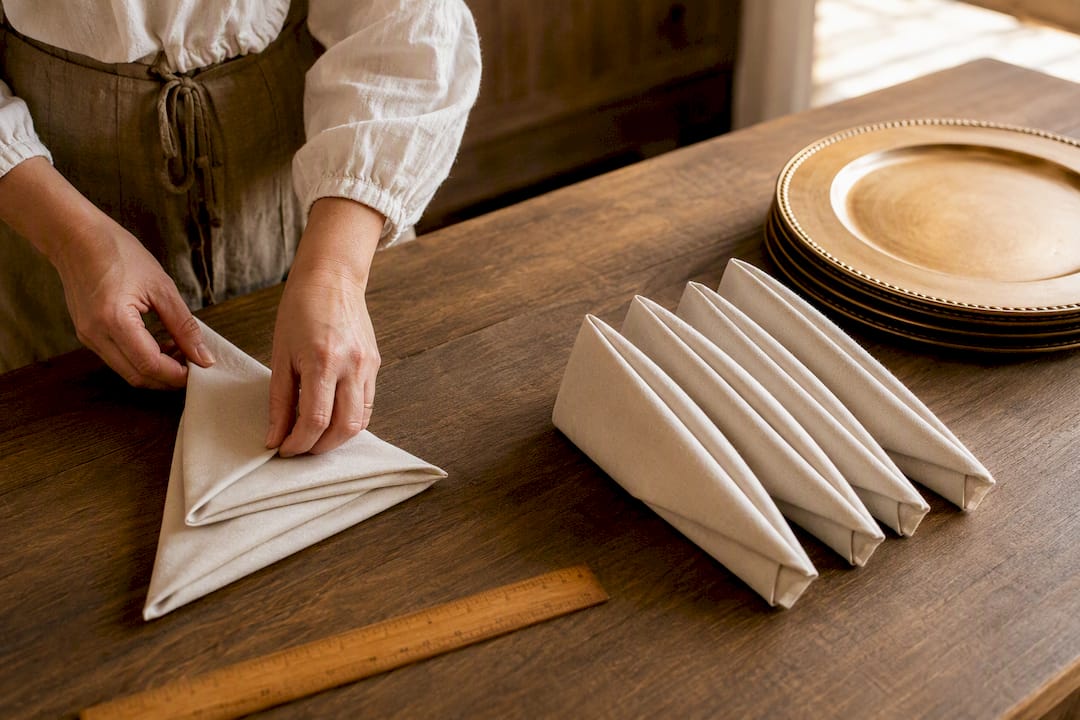
Fabric determines whether a fold holds its shape through cocktail hour or collapses by the time your guests sit down. Linen or lightly starched napkins in the 20 to 22 inch range hold sculptural folds like the rose and bishop's hat best, thanks to their weight and crease memory. Cotton napkins are easier to iron in bulk and work well for pocket, roll, and rectangle folds where crisp lines matter more than sculpted volume. Polyester napkins resist wrinkling and cost less, making them a reasonable choice for large guest counts where budget outweighs texture.
- Linen: best hold and texture, ideal for rose and bishop's hat, needs light starching.
- Cotton: easiest to iron in bulk, ideal for pocket and roll folds.
- Polyester: budget friendly, wrinkle resistant, best for simple folds at large events.
Iron every napkin before folding, not after. A light starch spray applied while ironing gives structured folds more staying power without stiffening the fabric so much that it feels unpleasant against a guest's lap.
Table sizing matters too. If your reception uses 60 inch round tables, the standard linen drop guidance that event professionals use to size tablecloths for 90 inch and 120 inch rounds applies just as directly to scaling napkin size against your chargers and plates. A napkin that looks proportional on a small sample table can look oversized or skimpy once it sits against your actual chargers, so check the pairing before ordering in bulk.
Setup Timing and Day-of Logistics
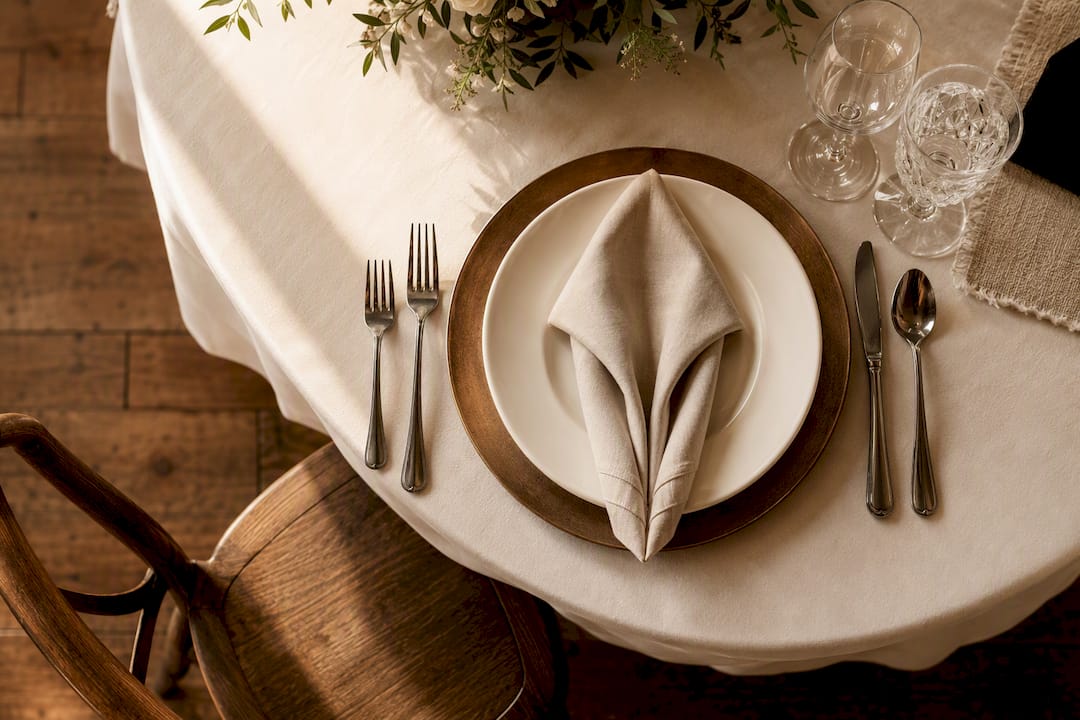
For 100 guests, budget roughly 90 minutes to 2 hours if you're using an easy fold like the rectangle or pocket, and closer to 3 to 4 hours for a sculptural fold like the rose or bishop's hat.
- Fold napkins 24 to 48 hours before the event, not the morning of, and store them flat or loosely stacked in a cool, dry space to avoid crushing the shape.
- For outdoor receptions, anchor each fold with a charger, napkin ring, or belly band, since even light wind can flatten a fan or bishop's hat in minutes.
- Test your chosen fold outdoors, in wind conditions similar to your venue, before the wedding day arrives.
- Delegate folding to your venue's staff, caterer, or a small group of bridal party members, and run one rehearsal fold session so timing stays predictable.
Pro Tip: Practicing the fold ahead of time and timing the process is one of the most overlooked ways to keep wedding-day setup predictable, since a fold that takes 90 seconds in a calm kitchen can stretch to three minutes under event-day pressure.
Pairing Napkin Folds With Menus, Cards, and Table Themes
A pocket fold is built for tucking a printed menu or place card directly into the flap, while a flat rectangle fold works better when the menu sits beside the plate rather than inside the napkin. Choose one dominant styling element, whether that's a ribbon, a sprig of greenery, or a monogrammed napkin ring, rather than layering several accents on the same setting.
- On the plate: clean and classic, easiest to keep uniform across a large guest count.
- Under the charger or salad plate: keeps the fold anchored, useful outdoors.
- Draped over the plate edge: relaxed and organic, best for waterfall or knot folds.
Small accessories carry real weight here. A napkin ring or belly band can turn a plain roll fold into a styled, photogenic setting, and doubles as a discreet place-card holder. For couples building out a broader tablescape, this rustic venue styling guide pairs well with boho and farmhouse color palettes, and a good detail photography checklist helps you flag which folds are worth a close-up shot.
Origins Ranch's Take on Napkin Details
We've watched enough tablescapes come together at Origins Ranch to know that small details carry outsized weight. A well-chosen napkin fold, set against a wood charger under our barn's warm light, does more visual work than couples expect. Our advice: test your fold on the exact napkins, plates, and chargers you'll use, in the actual space, before the big day. Coordinate early with your linen vendor and caterer so folding happens on a realistic schedule, not a rushed one. If you'd like a venue that handles staging and table logistics alongside you, we're happy to walk through it together.
— Origins
Sources
- Napkin folds that will elevate your reception tables — Martha Stewart
- How to fold cloth napkins: 28 different ways — The Spruce
- 8 pretty ways to fold napkins at your wedding reception — Brides
- 5 Best cloth napkin folds for a wedding reception — AllCottonAndLinen
Ready to bring your tablescape vision to life at a venue built for it? Explore Origins Ranch's barn wedding venue and packages, including venue-only and all-inclusive options, or check out our quinceañera packages if you're planning a different kind of milestone celebration. Whatever the event, we'll help you get the table details right.
FAQ
What is the best napkin fold for a wedding?
There isn't one single best fold, since it depends on your formality and setup time. A pocket fold works best for weddings using printed menus, while a rectangle or flat fold suits formal, understated tables, and a rose or bishop's hat fits romantic or upscale receptions where guest counts are smaller.
What are the basic napkin folds every planner should know?
The core folds most planners rely on are the rectangle, pocket, triangle, fan, loose knot, roll, waterfall, rose, bishop's hat, and bow-tie. Learning these ten covers nearly every style from casual farmhouse tables to formal ballroom settings.
How many napkins do I need for 100 guests?
Plan for one napkin per guest, plus a small buffer of a few extras for stains, last-minute seating changes, or practice folds. For 100 guests, that means ordering slightly more than 100 napkins total.
How long does it take to fold napkins for a large wedding?
Simple folds like the rectangle or pocket take 30 seconds to 1.5 minutes each, so 100 napkins run roughly 1.5 to 2 hours. Sculptural folds like the rose or bishop's hat take 2 to 4 minutes each, pushing the same guest count closer to 3 to 4 hours.
Should I fold napkins the day of the wedding or ahead of time?
Fold napkins 24 to 48 hours before the event and store them flat in a cool, dry space to protect the shape. Folding the morning of the wedding adds unnecessary pressure, especially for sculptural folds that take longer per napkin.