

TL;DR:
- Effective event catering design guides guest movement, enhances social interaction, and ensures smooth service. Matching kitchen type and venue layout optimizes food quality, operational efficiency, and guest experience. Thoughtful station placement and simplified setups are essential in small venues to prevent congestion and promote engagement.
The role of event catering space is to integrate food service with venue design so guests move freely, eat comfortably, and enjoy a cohesive experience from start to finish. Most planners treat catering as a menu decision. It is actually a spatial decision. Where you place food stations, how your kitchen operates behind the scenes, and how your serving setup guides foot traffic all shape whether an event feels effortless or chaotic. At weddings and special occasions, integrated catering services create cohesive food experiences that directly affect guest satisfaction and overall event success.
How does catering space shape guest movement and social interaction?
Catering is social architecture at its core. The placement of food stations tells guests where to go, how long to linger, and who to talk to along the way. When stations are thoughtfully distributed across a venue, they pull guests through different zones and prevent the dreaded bottleneck at a single buffet table.
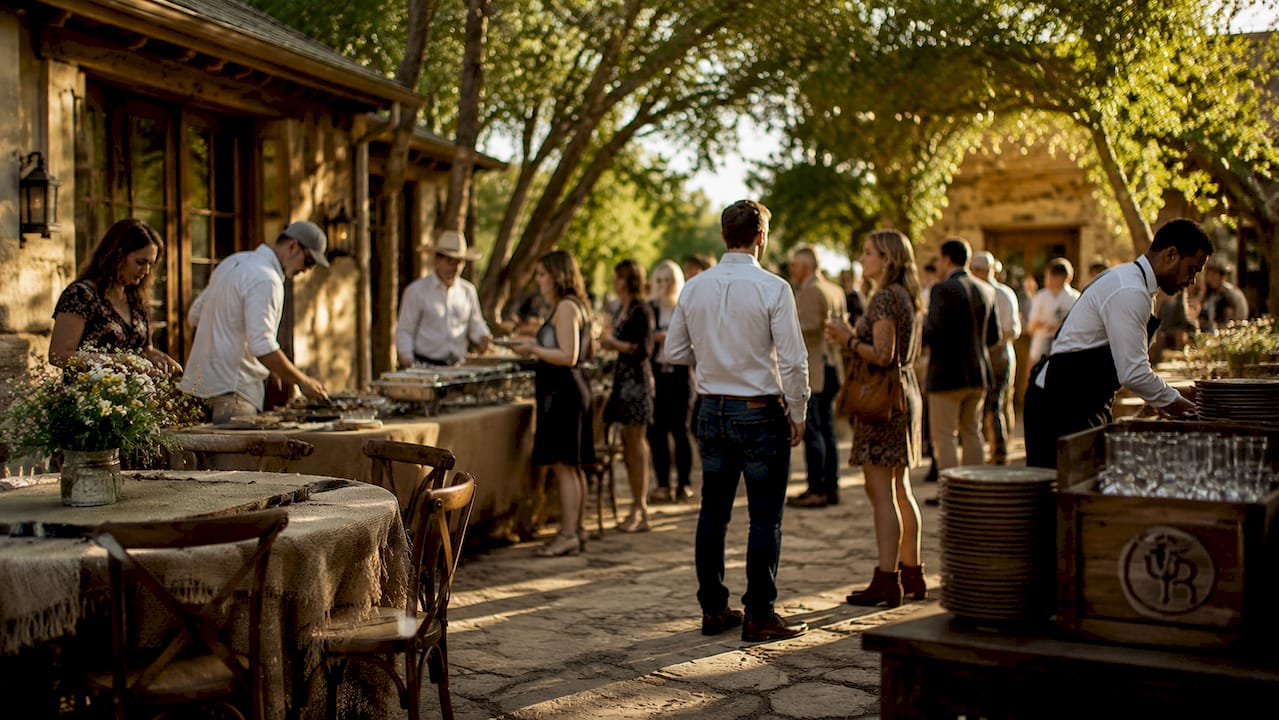
Think about a wedding reception with 150 guests. If all the food lives in one corner, that corner becomes a traffic jam. Guests who have already eaten avoid it. Guests who are hungry crowd it. The rest of the room feels empty. Spread appetizer stations near the entrance, a carving station near the dance floor, and a dessert display near the exit, and suddenly the entire room breathes.
Vertical, multi-tiered food presentation maximizes efficiency and drives social engagement by drawing the eye upward and creating visual interest without consuming more floor space. Tiered risers, elevated platters, and stacked displays all accomplish this. They also signal abundance without requiring a sprawling table footprint.
Station placement also encourages exploration. Guests who might never cross the room to refill a drink will wander toward a beautifully lit grazing board they spot from across the space. That wandering creates conversation, which is the real goal of any social event.
- Place high-traffic stations like bars and buffets away from entrances and exits to prevent crowding at doorways
- Use corner placements for specialty stations like dessert or charcuterie to draw guests into underused areas
- Keep clear sightlines between stations so guests can navigate without feeling lost
- Space stations at least 6 feet apart to allow comfortable two-way traffic flow
- Match station height to the formality of the event: low tables for casual grazing, elevated displays for formal receptions
Pro Tip: Align your catering station layout with your venue floor plan before finalizing any rental or linen orders. Changing station placement after setup begins costs time and often money.
What are the operational necessities of kitchen design in venues?
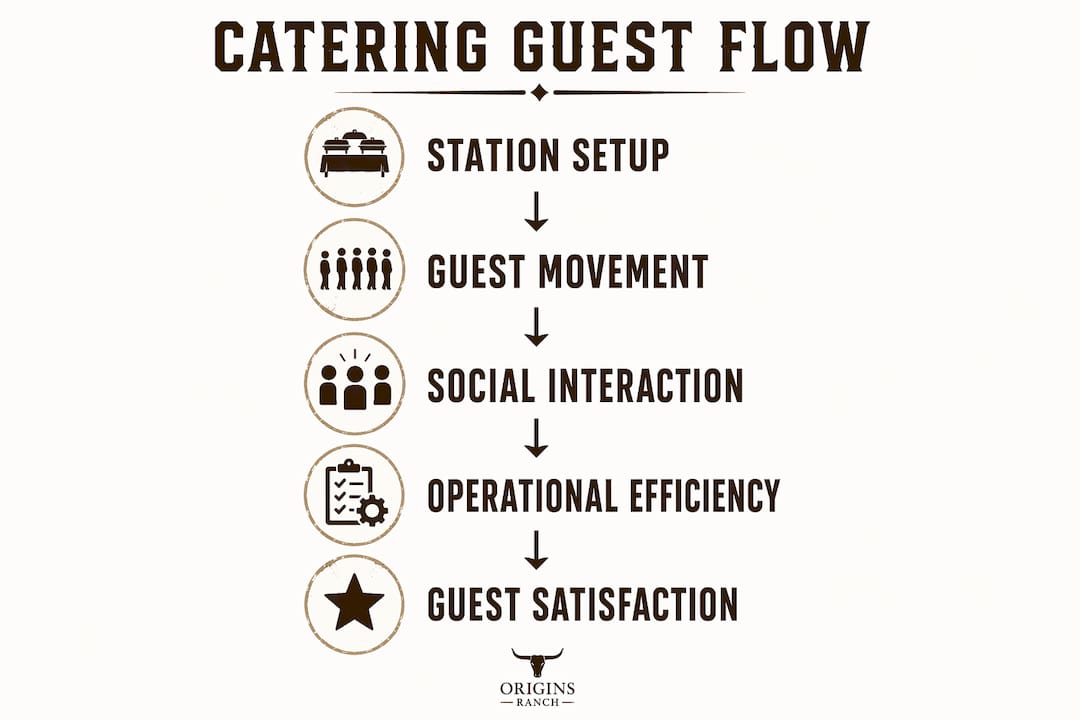
The kitchen is the engine of any catering operation, and most guests never see it. That invisibility is the goal. Well-designed commercial kitchens enable consistency, scalability, and what hospitality professionals call "invisible service," where food arrives on time, at the right temperature, without any visible scramble.
Two distinct kitchen types exist in event venues, and confusing them leads to planning mistakes. A full kitchen supports from-scratch cooking with commercial ranges, convection ovens, walk-in coolers, and full ventilation systems. A support kitchen focuses on holding, reheating, and staging food rather than original preparation. Many barn venues and boutique event spaces operate support kitchens, which means your caterer needs to prep off-site and finish on location.
Ventless cooking equipment has changed the game for venues with limited hood infrastructure. Induction burners, combi ovens with built-in ventilation, and ventless fryers allow caterers to execute more complex menus in spaces that were never designed for full culinary production. This matters enormously when you are booking a venue like a historic barn or a converted warehouse.
| Kitchen Type | Primary Function | Best For |
|---|---|---|
| Full Commercial Kitchen | From-scratch cooking and full production | Large weddings, plated dinner services |
| Support Kitchen | Holding, reheating, and plating | Boutique venues, off-site caterers |
| Ventless Setup | Limited cooking without hood systems | Barns, historic spaces, outdoor pavilions |
- Confirm whether your venue has a full or support kitchen before signing any catering contract
- Ask about refrigeration capacity, especially for events with raw proteins or elaborate desserts
- Verify that your caterer has worked in the venue's kitchen type before your event date
- Check local health code requirements for temporary food service setups
Pro Tip: Coordinate a walk-through between your caterer and the venue owner at least 60 days before your event. Kitchen surprises on the day of service are the leading cause of food timing failures.
What catering features work best in tight or small venues?
Small venues present real challenges for catering. Congestion builds fast, service slows down, and guests feel uncomfortable when the food setup competes with their personal space. The good news is that reducing menu complexity and using vertical presentation tools directly improve guest flow and reduce congestion in limited spaces.
The most effective approach for tight venues is to simplify without sacrificing quality. Fewer stations mean fewer decision points, which means faster movement. A curated menu of five to seven items served beautifully outperforms a sprawling buffet that overwhelms guests and clogs the room.
- Simplify the menu to reduce the number of active stations and serving points
- Use vertical risers and tiered displays to maximize table surface without expanding the footprint
- Plan refill and reset schedules during natural lulls like speeches or first dances to avoid mid-service congestion
- Choose small plates and grab-and-go formats to speed service and reduce crowding at serving areas
- Select lightweight, stable serveware that staff can carry and reposition quickly without disrupting guests
Efficient reset planning is often the most overlooked factor in small venue catering. Stations that run out of food during peak service create bottlenecks as guests wait. Scheduling resets during predictable downtime keeps the flow moving without visible disruption.
Pro Tip: For intimate weddings under 75 guests, consider a passed appetizer format during cocktail hour instead of a station setup. It eliminates the station footprint entirely and creates a more personal, curated guest experience.
Banquet hall vs. flexible event space: which fits your catering needs?
The venue type you choose dictates your catering style more than most planners realize. Banquet halls suit formal plated dinners and structured programs, while flexible event spaces handle activations and high-flow networking events far better. Both can accommodate events up to 500 guests, but the guest experience differs significantly based on layout and service style.
A banquet hall offers fixed infrastructure: built-in lighting grids, permanent staging areas, and often an in-house catering team. This makes coordination easier but limits creative freedom. A flexible event space, like a barn venue or open pavilion, gives you full control over layout and catering setup but requires more planning to get right.
| Feature | Banquet Hall | Flexible Event Space |
|---|---|---|
| Catering Style | Plated service, structured courses | Stations, family style, passed service |
| Layout Control | Limited by fixed infrastructure | Full flexibility |
| Kitchen Access | Usually full commercial kitchen | Often support kitchen or off-site prep |
| Atmosphere | Formal, polished | Relaxed, customizable |
| Best Event Type | Galas, formal weddings, corporate dinners | Rustic weddings, social events, activations |
The importance of catering space alignment with venue type cannot be overstated. A caterer who excels at plated service in a banquet hall may struggle with the logistics of a barn wedding where the kitchen is a trailer and the serving area is an open-air pavilion. Match your caterer's strengths to your venue's infrastructure, not just your menu preferences.
Venue amenities like professional catering and coordinated service improve guest comfort and simplify logistics. When the venue and caterer operate as one integrated team, the guest experience feels effortless. When they operate independently, the seams show.
For guidance on event venue terminology that affects catering decisions, understanding the difference between terms like "exclusive caterer," "preferred vendor," and "open catering" will save you from costly surprises during contract review.
Key takeaways
The role of event catering space extends far beyond food service. It shapes guest movement, supports operational efficiency, and defines the atmosphere of every wedding and special occasion.
| Point | Details |
|---|---|
| Catering as spatial design | Station placement guides guest flow and social interaction across the entire venue. |
| Kitchen type determines menu scope | Confirm full vs. support kitchen access before finalizing your catering contract. |
| Small venues need simplified setups | Fewer stations, vertical displays, and timed resets prevent congestion and improve comfort. |
| Venue type dictates catering style | Match your caterer's service strengths to your venue's infrastructure and layout. |
| Integrate catering early | Treat catering as a spatial strategy from the first planning conversation, not an afterthought. |
What we have learned planning events at Originsranch
After more than two decades in the event service industry, I have watched catering decisions make or break events that had everything else going for them. The flowers were stunning. The music was perfect. But the food stations were crammed into one corner, and by 7 p.m., half the guests were standing in a line instead of dancing.
The single most overlooked factor in event planning is the relationship between guest flow and catering layout. Most couples spend weeks choosing a menu and 20 minutes thinking about where the food will actually live in the room. That ratio needs to flip.
At Originsranch, we have seen firsthand how a thoughtfully placed dessert station near the photo booth creates a natural gathering point that keeps energy high late into the night. We have also seen what happens when a caterer shows up to a support kitchen expecting a full commercial setup. Neither outcome is acceptable when someone's wedding day is on the line.
My honest advice: bring your caterer to the venue before you sign anything. Walk the space together. Talk about where the stations go, where the kitchen is, and how staff will move between the two without crossing the guest path. That one conversation prevents more problems than any checklist ever could.
The catering space is not a backdrop. It is part of the event itself.
— Origins
Experience the Originsranch difference at your next event
At Originsranch in Plant City, FL, we designed our space with catering flow in mind from the very beginning. Our barn venue combines the warmth of a historic ranch with the practical infrastructure that professional caterers need to deliver flawless service. Whether you are planning an intimate wedding or a large celebration, our flexible layout accommodates a range of catering setups without sacrificing the charm that makes our venue special.
Our founder Barry brings over 20 years of event service experience to every occasion, including his deeply personal work through Weddings For Warriors, which helps Veterans and Active Duty service members celebrate their dream weddings. Browse our event gallery to see how catering setups, table arrangements, and venue layouts come together to create truly memorable experiences. We would love to help you plan yours.
FAQ
What is the role of event catering space at a wedding?
The role of event catering space at a wedding is to integrate food service with venue layout so guests move comfortably, eat well, and enjoy a smooth social experience. Catering placement directly influences guest flow and atmosphere throughout the event.
How does catering layout affect guest experience?
Catering layout acts as a navigation system, guiding guests through different areas of the venue and encouraging social interaction. Poorly placed stations create congestion, while distributed setups keep energy moving across the entire space.
What is the difference between a full kitchen and a support kitchen at an event venue?
A full kitchen supports from-scratch cooking with commercial equipment and ventilation. A support kitchen focuses on holding, reheating, and plating food that was prepared off-site, which is common in barn venues and boutique event spaces.
How do i choose between a banquet hall and a flexible event space for catering?
Choose a banquet hall for formal plated dinners and structured programs. Choose a flexible event space when you want station-style or family-style catering with full control over layout and atmosphere.
What catering setup works best in a small venue?
Simplified menus, vertical food displays, and passed appetizer formats work best in small venues. Scheduling resets during speeches or first dances prevents congestion during peak service times.