
Most U.S. wedding venues require vendors to carry vendor liability insurance and provide a Certificate of Insurance (COI) before setting foot on the property. If you're a vendor, here's what to do right now:
- Verify the limits in your venue contract (typically $1,000,000 per occurrence / $2,000,000 aggregate).
- Obtain a COI from your insurer naming the venue by its exact legal name and address.
- Add required endorsements: Additional Insured, primary & non-contributory wording, and a Waiver of Subrogation if the venue requests it.
If you manage a venue, your three immediate steps are just as clear:
- State limits and deadlines in the rental agreement before any vendor is confirmed.
- Specify required endorsements and provide your exact legal name and address so vendors can list you correctly.
- Set a COI deadline of 30–60 days before the event and hold firm to it.
Key Takeaways
Vendor liability insurance and a properly endorsed COI are the baseline requirements at most U.S. wedding venues, with $1,000,000 per occurrence and $2,000,000 aggregate as the standard limits vendors should carry.
| Point | Details |
|---|---|
| Standard limits | Most venues require $1M per occurrence / $2M aggregate; confirm in your contract before purchasing. |
| COI vs. Additional Insured | A COI proves coverage exists; Additional Insured status is what actually protects the venue under the vendor's policy. |
| Tiered vendor policy | Use Tier 1/2/3 to triage COI requirements by actual on-site activity, not job title. |
| Single-event vs. annual | Single-event policies often start around $199; annual policies are more cost-effective at three or more events per year. |
| Coverage gaps to close | E&O, inland marine, and hired/non-owned auto are not included in base GL — add them when your work requires it. |
Table of Contents
- What vendor insurance at a wedding venue actually means
- What vendor insurance typically covers — and where the gaps are
- Typical limits, pricing, and single-event vs. annual policy choices
- Which vendors need a COI? A practical 3-tier checklist
- What to check on a COI and what endorsements to request
- How vendors get insured and deliver a COI quickly
- How venues should build and run a COI verification policy
- Sample contract language, email templates, and the Originsranch checklist
- Why COIs matter more than most vendors realize
- Sources
- FAQ
What vendor insurance at a wedding venue actually means
Vendor liability insurance is a vendor's own commercial general liability (CGL) policy. It covers bodily injury, property damage, and legal defense costs for incidents the vendor causes at an event. A caterer whose staff spills hot liquid on a guest, a DJ whose cable trips a dancer, a florist whose ladder damages a beam — those are vendor-caused incidents, and the venue's own policy is not designed to absorb them.
That distinction matters because venue insurance and vendor insurance protect different parties. A wedding venue insurance policy covers the property, the building, and the venue's own staff. It does not extend to a third-party vendor's operations. When a venue asks for a COI, it is confirming that the vendor has their own coverage in place.
A few terms you'll see repeatedly in contracts and COIs:
- COI (Certificate of Insurance): A one-page document proving a policy exists, issued by the insurer or broker. It shows policy numbers, limits, and dates.
- Additional Insured: A status granted by endorsement that extends the vendor's policy to cover the venue for claims arising from the vendor's work. This is meaningfully different from being a certificate holder.
- Certificate Holder: The entity named on the COI for notification purposes only. Being a certificate holder does NOT grant coverage under the vendor's policy.
- Primary & Non-Contributory: Endorsement language requiring the vendor's policy to pay first, before the venue's own coverage contributes.
- Waiver of Subrogation: Prevents the vendor's insurer from suing the venue to recover money it paid out on a claim.
A COI proves a vendor has insurance. Being listed as an Additional Insured is what actually gives the venue protection under that vendor's policy. Venues that accept certificate-holder status only are leaving a meaningful gap in their coverage. — The Legal Paige
What vendor insurance typically covers — and where the gaps are
General liability is the foundation of any vendor policy. It covers bodily injury, property damage, and the legal defense costs that come with a claim. Most event-specific vendor policies also bundle in medical payments coverage and host liquor liability, which matters any time alcohol is present at the event.
Core coverages most vendor policies include:
- General Liability: bodily injury and property damage
- Medical Payments: minor injury costs without requiring a lawsuit
- Host Liquor Liability: covers alcohol-related incidents when the vendor is not a licensed bar but alcohol is served
Optional or separate coverages vendors should consider:
- Professional Liability (E&O): Covers missed deliverables, errors in service, or lost digital files. General liability does not cover these. Planners, photographers, and videographers should treat E&O as non-negotiable.
- Inland Marine (Equipment/Contents): Covers cameras, sound rigs, lighting, and other gear in transit or on-site.
- Product Liability: Critical for caterers and food vendors; covers illness or injury from food served.
- Commercial Auto / Hired & Non-Owned Auto: Needed when transporting guests or hauling equipment in personal or rented vehicles.
- Cyber Liability: Worth considering for vendors who process payments or store client data.
General liability will not cover a photographer's lost hard drive, a planner's missed vendor booking, or an employee injury. Those gaps require E&O, inland marine, or workers' compensation respectively.
Pro Tip: Match your endorsements to your actual activity. A drone operator needs aviation liability. A food vendor needs product liability. A vendor with borrowed or rented gear needs inland marine. Don't assume a base GL policy covers everything you bring to a venue.
Typical limits, pricing, and single-event vs. annual policy choices
Industry practice has coalesced around $1,000,000 per occurrence and $2,000,000 aggregate as the standard limits most venues require. High-end or larger venues sometimes ask for higher per-occurrence limits, so always read the contract before purchasing.
Pricing signals:
- Single-event (one-day) policies often start at a modest cost for basic coverage. Some event-specific vendor programs list starting prices around $199 for a single event, with host liquor liability and instant COI issuance included.
- Annual policies cost more upfront but become cost-effective when you work three or more events per year. Programs like WedSafe (K&K Insurance) offer tailored short-term and annual options with GL starting at $1M per occurrence, plus optional equipment coverage.
- K&K Insurance offers multiple durations: single event, 3-month, 6-month, and 12-month vendor liability options, with optional equipment/contents coverage. Note that underwriting availability varies by state.
Single-event vs. annual: how to decide
- Buy a single-event policy if you're a first-time vendor, doing one or two events this year, or working a venue with a unique requirement.
- Buy an annual policy if you work three or more events per year, carry expensive equipment, or want the convenience of issuing COIs on demand without re-purchasing each time.
Stat to know: Single-event vendor policies often start at a modest price, while annual policies offer better per-event value for vendors working multiple events per year. — SpecialEventInsurance.com
Which vendors need a COI? A practical 3-tier checklist
Not every vendor at a wedding carries the same risk. Nuptial's three-tier framework gives venues a fast, defensible way to triage COI requirements without drowning in paperwork for low-risk drop-offs.
Tier 1: Always require a COI
These vendors work on-site with equipment, food service, or physical installations that create real exposure:
- Caterers and food service staff
- Bartenders and mobile bar operators
- DJs with full sound rigs and bands
- Florists doing large on-site installs
- Rental companies (furniture, tents, linens)
- Photo booth vendors
- Drone operators
- Valet and transportation providers
- Bounce houses, mechanical rides, or interactive attractions
Tier 2: Require depending on scope
- Photographers and videographers (especially with large rigs or drones)
- Planners and coordinators who provide on-site staff
- Florists doing small, simple arrangements
- Hair and makeup artists using chemicals in venue prep rooms
- Vendors using rented or borrowed equipment
Tier 3: Possible pass for truly low-risk activity
- Drop-off cake bakers with no on-site setup or staffing
- Small handcrafted goods vendors who deliver and leave
- Solo acoustic musicians with minimal setup
A Tier 3 pass should always be documented in the contract. If the activity changes (a "drop-off" baker who suddenly wants to do on-site decorating), the tier changes too.
Pro Tip: Classify vendors by what they actually do on-site, not by their job title. A florist doing a full arch installation with a ladder and a crew is a Tier 1 vendor, even if most florists fall in Tier 2. The activity drives the risk.
What to check on a COI and what endorsements to request
A COI is only as useful as what's actually on it. Here's what to verify every time a vendor submits one.
COI checklist:
- Insurer name (and NAIC number if present)
- Policy number
- Coverage types listed (GL, host liquor, E&O, etc.)
- Per-occurrence and aggregate limits
- Policy effective and expiration dates (must cover the event date)
- Your venue's exact legal name and address
- Event date(s) listed or confirmed by the policy period
- Any endorsements noted on the COI
Endorsements venues commonly require:
- Additional Insured (CG 20 10 or equivalent): Extends the vendor's policy to cover the venue for claims arising from the vendor's work.
- Primary & Non-Contributory: Vendor's policy pays first; venue's policy is not tapped until vendor limits are exhausted.
- Waiver of Subrogation: Vendor's insurer cannot pursue the venue to recover paid claims.
- Host Liquor Liability confirmation: Required whenever alcohol is served, even if the vendor is not a licensed bar.
Insurance Canopy's venue guidance confirms that most venues request all four of these elements as a package, not individually.
COI vs. Additional Insured vs. Certificate Holder
| Status | What it means | Does it grant coverage? |
|---|---|---|
| Certificate Holder | Named on the COI for notification only | No |
| Additional Insured | Added by endorsement to the vendor's policy | Yes, for covered claims |
| Primary & Non-Contributory | Vendor's policy responds first | Yes, protects venue's own limits |
Red flags to watch for:
- Event date falls outside the policy period
- Limits are lower than your contract requires
- Venue is listed only as certificate holder, not Additional Insured
- COI issued by a non-admitted carrier with no explanation
- Missing endorsements that your contract specifies
Pro Tip: Require COIs 30–60 days before the event. Last-minute submissions rarely have time to correct errors, add endorsements, or get broker confirmation before the big day.
How vendors get insured and deliver a COI quickly
Getting compliant is straightforward when you follow these steps in order.
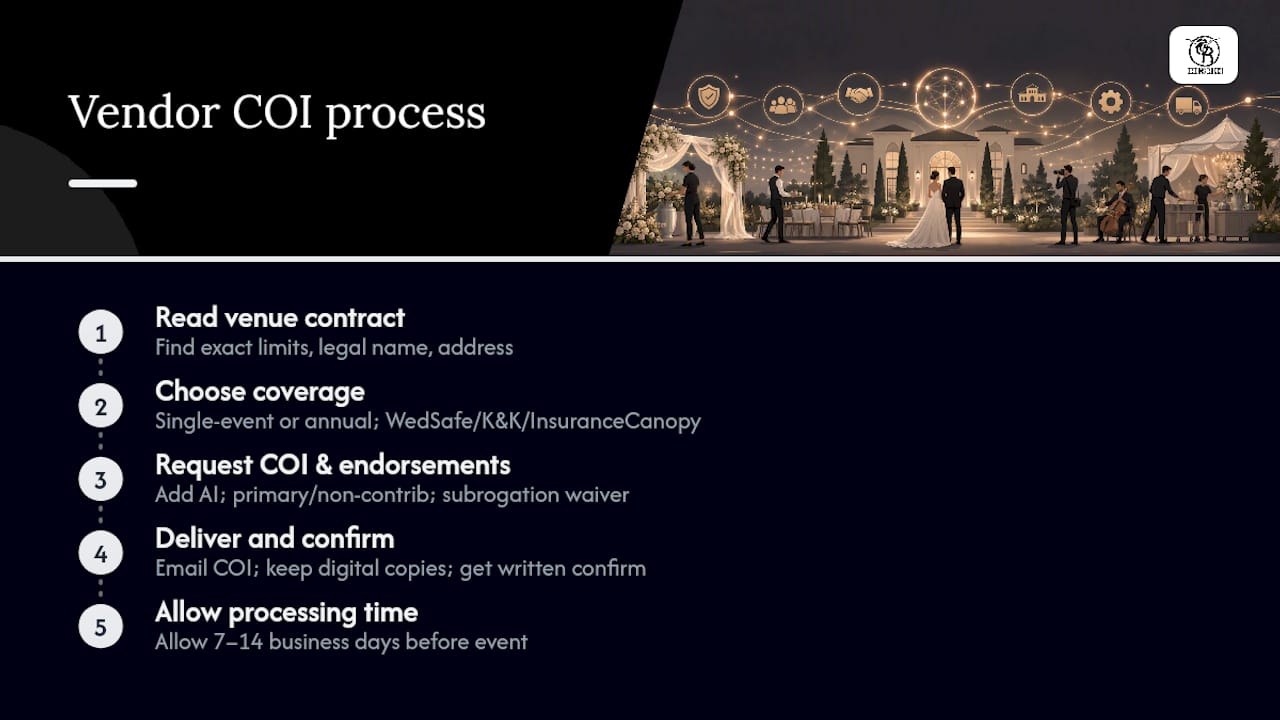
Step 1: Read the venue contract first. Find the exact limits required, the venue's legal name and address, and any specific endorsement language. Do not guess at the venue's name or address — a COI with a wrong name is not valid.
Step 2: Choose single-event or annual coverage. If this is your first event or you work fewer than three events per year, a single-event policy is the practical choice. For higher-volume vendors, an annual policy from a program like WedSafe, K&K Insurance, or InsuranceCanopy is more cost-efficient and lets you issue COIs on demand. Get quotes from event-specialist brokers or online platforms that specialize in vendor insurance options for events.
Step 3: Request the COI with the correct endorsements. Contact your insurer or broker and ask them to add the venue as Additional Insured using the exact legal name and address from the contract. Specify primary & non-contributory language if the contract requires it. Ask for a Waiver of Subrogation endorsement if requested.
Step 4: Deliver and confirm. Send the COI and any endorsement pages to the venue by email. Keep digital copies. Ask the venue to confirm receipt and acceptance in writing.
Timeline: Allow at least 7–14 business days for endorsements to be processed and the updated COI to be issued. Do not wait until the week of the event.
Understanding wedding venue terminology before you start this process helps you read contracts accurately and avoid misunderstandings with your broker.
How venues should build and run a COI verification policy
A clear, written COI policy protects the venue and reduces day-of friction. Here's how to build one that works.
The 3-tier policy in practice:
Apply the Tier 1/2/3 framework from Section 5 to every vendor in your rental agreement. Tier 1 vendors are non-negotiable. Tier 2 vendors get a scope review. Tier 3 passes must be documented.
Operational steps:
- Insert insurance requirements in the rental agreement, including required limits, endorsements, and your exact legal name and address.
- Set a COI deadline of 30–60 days before the event.
- Assign one staff member as the COI intake owner.
- Maintain a digital vendor COI file for each event.
Vendor COI tracking log:
| Field | What to record |
|---|---|
| Vendor name | Full legal or DBA name |
| Policy number | As shown on COI |
| Effective / expiry dates | Must bracket the event date |
| Per-occurrence / aggregate limits | Confirm against contract requirements |
| Additional Insured status | Confirmed yes/no |
| Endorsements on file | List each (P&NC, WOS, host liquor) |
| COI received date | Date venue received the document |
| Staff verifier initials | Who reviewed and approved |
Red flags that require follow-up:
- Dates don't cover the event
- Limits fall short of contract requirements
- Venue listed as certificate holder only
- Unfamiliar or non-admitted insurer
When a red flag appears, contact the vendor immediately and ask for their broker's direct contact. Do not accept a verbal assurance — require a corrected COI or endorsement page.
Pro Tip: Venues that maintain a preferred vendor list of pre-vetted, pre-insured vendors reduce COI intake work significantly. When a vendor is already on your list with a current annual policy, verification takes minutes instead of days.
Experienced furniture and equipment suppliers understand this workflow well. How experienced suppliers reduce on-site event risks is a useful read for venue operators thinking about vendor risk beyond the COI itself.
Sample contract language, email templates, and the Originsranch checklist
Here's practical, ready-to-adapt language for venues and vendors alike.
Sample contract clause:
"Vendor shall maintain commercial general liability insurance with limits of no less than $1,000,000 per occurrence and $2,000,000 aggregate throughout the term of this agreement. [Venue Legal Name], located at [Venue Address], shall be named as an Additional Insured on a primary and non-contributory basis. Vendor shall provide a Certificate of Insurance evidencing such coverage no later than 30 days prior to the event date. Failure to provide a compliant COI by the deadline may result in cancellation of this agreement."
Sample COI request email (venue to vendor):
Venue event checklist (one per event):
- Vendor name and contact
- Coverage types confirmed (GL, host liquor, E&O if applicable)
- Per-occurrence and aggregate limits verified
- Additional Insured endorsement on file
- Primary & non-contributory confirmed
- Policy dates cover the event date
- COI received date logged
- Staff verifier initials
At Originsranch, we've built our vendor process around 20+ years of event experience. Our founder Barry brings both a veteran's discipline and a DJ's real-world knowledge of what can go wrong when vendors aren't properly covered. Every couple who books with us deserves vendors who show up prepared — and a venue that has done its homework. For venue clients, we're happy to walk you through our process directly. Explore our venue resources for more on how we approach event safety and vendor compliance.
Why COIs matter more than most vendors realize
Running a venue means you see the full picture that individual vendors often miss. A vendor who skips insurance isn't just taking a personal risk — they're creating exposure for the couple, the guests, and the venue itself. We've seen situations where a vendor-caused incident could have turned into a serious dispute, and the only thing that kept it from escalating was a properly endorsed COI that put the right insurer in the conversation immediately.
The vendors who cause the most friction aren't the ones who have bad intentions. They're the ones who waited too long, bought a bare-bones policy without the right endorsements, or didn't realize that being a certificate holder is not the same as being an Additional Insured. That gap, small as it sounds on paper, can mean the venue's own policy gets pulled into a claim it should never have touched.
For vendors: carry the right coverage before you book your next event. A last-minute insurance scramble is one of the fastest ways to lose a venue booking permanently.
Sources
These are the most reliable resources for verifying details, getting quotes, and understanding venue-specific requirements:
- Which Wedding Venue Vendors Should You Collect COIs From And Which Ones Might Get a Pass? • Nuptial
- Wedding Vendor Insurance Requirements: The Ultimate 2025-2026 Guide | OurVows Blog | OurVows
- Vendor Insurance - Event Liability Insurance for
- How to Handle Business Insurance When Working with Venues — The Legal Paige
Always review your venue contract first and consult a licensed insurance broker for policy-level questions specific to your state and vendor type.
This article is general information, not a substitute for advice from a qualified financial advisor. Consult a qualified financial professional about your own circumstances before acting on anything here.
FAQ
What is vendor liability insurance for a wedding venue?
Vendor liability insurance is a vendor's own commercial general liability policy covering bodily injury, property damage, and legal defense for incidents the vendor causes at an event. It is separate from the venue's own insurance policy.
What limits do most wedding venues require from vendors?
Most venues require $1,000,000 per occurrence and $2,000,000 aggregate as standard limits, which has become the industry standard for wedding vendor general liability coverage in the U.S.
What is the difference between a COI and being an Additional Insured?
A COI proves a policy exists but grants no coverage to the venue. Being listed as an Additional Insured by endorsement extends the vendor's policy to cover the venue for claims arising from the vendor's work.
How quickly can a vendor get a COI for a wedding venue?
Most online event insurance platforms issue COIs instantly after purchase. For endorsements like Additional Insured or primary & non-contributory, allow 7–14 business days to process through a broker.
Do all wedding vendors need to provide a COI?
Not always. A tiered approach works best: vendors who work on-site with equipment or food service always need a COI; others depend on scope; truly low-risk drop-off vendors may receive a pass when documented in the contract.